




Safety Near Bicyclists [Video Safety Tip]
Here's some advice, provided by AAA and the Palmetto Cycling Coalition, to help motorists share the road safely with cyclists.

![Safety Near Bicyclists [Video Safety Tip]](https://assets.bobitstudios.com/image/upload/f_auto,q_auto,dpr_auto,c_limit,w_920/Screen-Shot-2015-08-30-at-11-37-23-AM_1776047013634_vnqutq.png)
Photo: AAA
Many major cities are looking for ways to promote cycling, adding bicycle lanes and paths in congested business districts as well as residential areas. The hope is that cycling will continue to become a bigger part of the transportation system, expanding well beyond its role as a recreational pastime and sport.
But the relationship between cyclists and motorists can, as we all know, become strained.
Here are some safety tips from the Palmetto Cycling Coalition that you may want to pass along to fleet drivers to help promote a safer coexistence.
Drive Cautiously
Reduce speed when encountering cyclists.
In inclement weather, give cyclists extra trailing and passing room.
Recognize situations that may be potentially dangerous to cyclists and give them space.
Yield to cyclists
Cyclists are considered vehicles and should be given the appropriate right of way.
Cyclists may take the entire lane when hazards, road width or traffic speed dictate.
Motorists should allow extra time for cyclists to traverse intersections.
Be considerate
Scan for cyclists in traffic and at intersections.
Do not blast your horn in close proximity to cyclists.
Look for cyclists when opening doors.
Pass with care
Leave at least three feet of space between your car and a cyclist when passing.
Wait until road and traffic conditions allow you to safely pass.
Check over your shoulder after passing a cyclist before moving back to your normal position.
Watch for children and keep in mind:
Children on bicycles are often unpredictable – expect the unexpected and slow down.
Most children don’t have adequate knowledge of traffic laws.
Children are harder to see because they are typically smaller than adults.
More Safety

Fleet Manager’s Ultimate Playbook: Navigating the New Standard in OEM Connectivity
Rising operating costs, driver safety concerns, and unplanned downtime are putting unprecedented pressure on modern fleets. Discover how fleet managers use embedded OEM connectivity and real-time vehicle data to cut TCO, prevent downtime, and protect drivers without aftermarket telematics hardware.
Read More →
From Driver Well-Being to EV Charging | AF News Recap
Mental health belongs in the fleet safety conversation. This week, we’re looking at five ways fleets can support employee well-being before a crisis, plus Holman’s expansion in Mexico, new one-day Fleet Forward passes, and why EV charging demand is outpacing infrastructure growth.
Read More →
Nexar-Nauto Merger Aims to Give Fleets Better Safety Intelligence Through Larger Driving Dataset
Stefan Heck tells Automotive Fleet that combining more than 10 billion miles of driving history with Nexar's AI models will give fleets deeper insights into driver risk and roadway conditions than either company could provide independently.
Read More →
Don't Wait for a Crisis: 5 Ways to Build Mental Health Into Your Fleet Safety Program
For Suicide Prevention Month, fleet and safety leaders have an opportunity to put mental health where it belongs: at the center of workplace safety.
Read More →
How Camera Data Can Strengthen a Fleet’s Insurance Renewal
Insights from a commercial insurance carrier and a broker show how fleets can turn video telematic data, driver coaching, and improved claims results into a stronger case at insurance renewal.
Read More →
The Safest Fleets Aren’t the Ones with the Most Technology
You’ve made the telematics investment. Here’s how to capture the other half of its value and build the safest fleet on the road.
Read More →
Hidden in Plain Sight: Fleet Compliance Risks
Fleet compliance isn't just about having policies — it's about consistently enforcing them. This practical guide reveals six hidden compliance risks common in public sector and shared fleet operations and outlines proven strategies to improve visibility, accountability, and audit readiness
Read More →
NETS Sets 2026 Fleet Safety Benchmark Conference for Indianapolis
The Sept. 15–17 program will feature fleet benchmarking data, case studies, emerging technologies, and implementation strategies while running alongside the NSC Safety Congress & Expo.
Read More →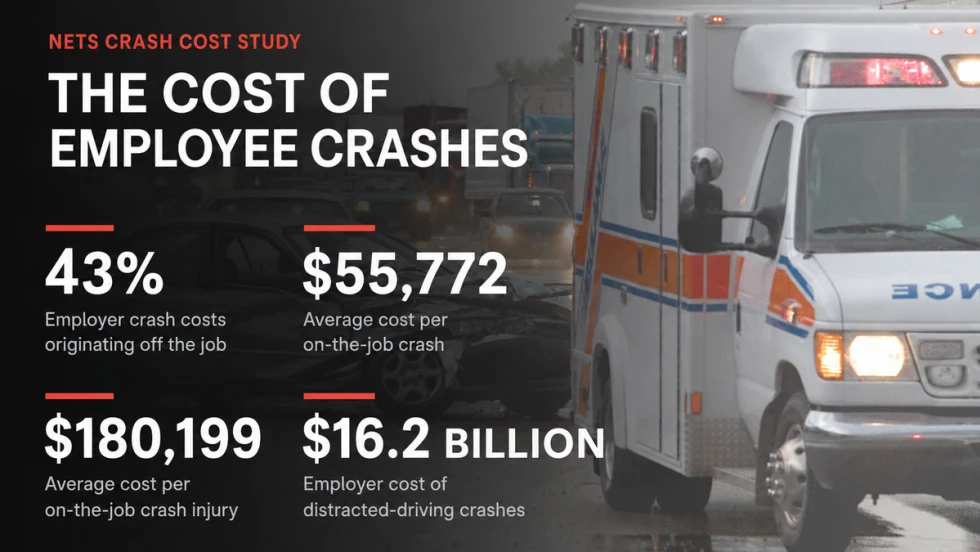
Off-the-Job Crashes Account for 43% of Employers’ $61.7 Billion Crash Burden
NETS quantifies costs dispersed across fleet, risk, HR, and other departments while providing new per-crash benchmarks for employers.
Read More →
Ram Recalls More Than 1.27 Million 1500 Pickups for Seat Belt Anchor Issue
The recall affects certain 2019-2026 Ram 1500 pickups that may have improperly attached second-row seat belt buckle anchors.
Read More →