




Rear-Entry Wheelchair Minivan Converted to Run on CNG
AKRON, OH – MobilityWorks Commercial, a manufacturer of commercial wheelchair accessible vehicles, is partnering with NatGasCar, LLC, a natural gas vehicle converter, to create a compressed natural gas (CNG) bi-fuel rear-entry wheelchair minivan.
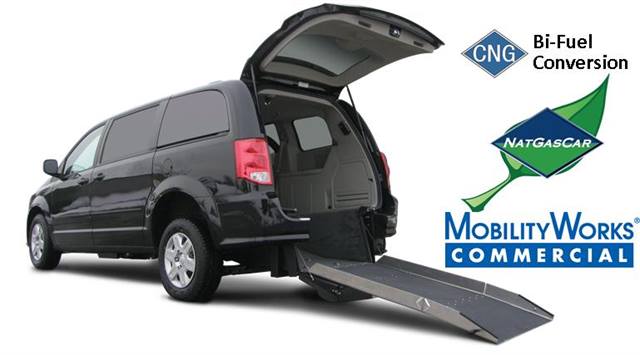
The bi-fuel conversion will allow the van to run on both CNG and unleaded gasoline, with a driving range in excess of more than 600 miles.
AKRON, OH – MobilityWorks Commercial, a manufacturer of commercial wheelchair accessible vehicles, is partnering with NatGasCar, LLC, a natural gas vehicle converter, to create the nation’s first compressed natural gas (CNG) bi-fuel rear-entry wheelchair minivan.
The converted 2013 Dodge Grand Caravan, nicknamed the “Eco-Taxi,” will be unveiled Oct. 27-30 at the Taxi, Limousine & Paratransit Association (TLPA) Annual Conference in Las Vegas. The NatGasCar CNG conversion uses a patent-pending CNG injection system and ultra-fast processor to meet stringent EPA emission standards.
The bi-fuel conversion will allow the van to run on both CNG and unleaded gasoline. The conversion does not change the capacity of the original fuel tank, and adds CNG cylinders, giving the van a driving range in excess of more than 600 miles, according to the companies.
“We have been getting more and more requests for CNG-powered vans over the past year, and are very excited to launch this new bi-fuel option,” said Denny Summers, vice president at MobilityWorks Commercial. “This innovative van solves the main issue companies have had with dedicated CNG vehicles, which is what to do when low on fuel and far from a CNG station. Now they can stop at any station, and the fuel range of over 600 miles is unbeatable.”
MobilityWorks Commercial has been building wheelchair-accessible minivans since 2008 for the taxi, nursing home, group home, and other non-emergency transport industries.
More Green Fleet

Merchants Fleet Reports 290M EV Miles as Fleets Navigate Changing Electrification Market
From millions in operating savings to hundreds of millions of EV miles, Merchants Fleet’s latest report reveals what’s working and what’s changing in fleet electrification.
Read More →
The EV Breakdown Nobody's Talking About: Why Most Electric Vehicle Roadside Calls Aren't Mechanical Failures
Here's why EV breakdowns are widely misunderstood.
Read More →
ChargePoint Now Available in Energy Pass
ChargePoint and additional planned charging network integrations were added to GM's Energy Pass.
Read More →

First Look: Slate Auto's Electric Fleet Pickup
Could an affordable, modular EV pickup make electrification more practical for fleets?
Read More →
Slate Debuts Colorful, Unique EV Models
A recent media and client event, studded with electric vehicles dressed up on platforms, planted a new position for the manufacturer in the wider EV market. Fleets will find cost-saving advantages.
Read More →
Slate Electric SUV, Pickup Switchable Model Aims For Light-Duty Fleets
Everything about this EV is counterintuitive and understated, making it stand out from the crowd.
Read More →
Inspiration Mobility Acquires Key Electrada Assets
Inspiration Mobility Group has acquired select assets of Electrada, adding the fleet electrification provider's team, technology, and charging infrastructure development capabilities to its energy management business.
Read More →
Turning Connected Vehicle Data Into Decisions That Matter
Fleet leaders have more data than ever, but turning that data into clear, actionable decisions remains a challenge. This white paper shows how leading organizations are using connected vehicle data to improve safety, reduce costs, and optimize fleet performance. Learn how to turn insight into action across your fleet.
Read More →
Are You Tracking Your Fleet's True Total Cost of Ownership?
Bobit Business Media surveyed 190 fleet professionals and found that while most fleets are tracking costs, fragmented systems and data gaps are keeping true TCO visibility out of reach. With rising pressure to control spend in an increasingly volatile environment, the gap between what fleets think they know and what the data actually shows is wider than you might expect. See how your peers are managing costs today and where the industry still has room to improve.
Read More →