




NTSB Urges Action on Drugged, Drowsy Driving
The agency releases its annual “most wanted” list for 2016, which also highlights need to end driver distractions and make collision avoidance technology more widely available.
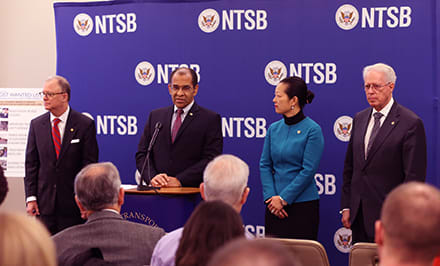
NTSB Chairman Christopher Hart (second from left) discusses the agency's "most wanted" list at a press conference in Washington, D.C., on Jan. 13.
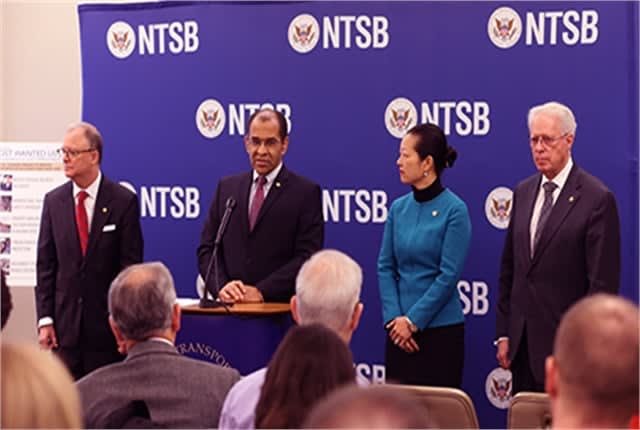
NTSB Chairman Christopher Hart (second from left) discusses the agency's "most wanted" list at a press conference in Washington, D.C., on Jan. 13.
The National Transportation Safety Board released its annual “most wanted” list for 2016, highlighting such priorities as ending substance impairment, reducing fatigue-related accidents, promoting availability of collision-avoidance technologies, and strengthening occupant protection.
The list also expresses the need for drivers and operators to “disconnect from deadly distractions” posed by the use of electronic devices.
Also making the list: “require medical fitness for duty.” This most-wanted item pertains to NTSB’s recommendation that safety-critical personnel, such as public vehicle operators, become subject to medical certification systems. The goal is to identify any untreated or undiagnosed conditions that might prevent operators from performing their job safely, the agency noted.
NTSB is an independent federal agency that investigates the causes of transportation accidents, promotes transportation safety and assists accident victims and their families. The board's “most wanted” list addresses accident causes in highway, rail, aviation, marine and pipeline transportation.
The list focuses on 10 broad safety improvements on which the NTSB has made recommendations that haven’t been implemented yet. NTSB has called the list a “road map from lessons learned to lives saved.”
Three of the highway-related items appeared on the 2015 list as well: ending substance impairment, disconnecting from deadly distractions, and requiring medical fitness for duty.
“How do we decide what goes on the list each year? The extent to which an improvement can help save lives and reduce injuries is a factor, but not the only factor,” said NTSB Chairman Christopher Hart. “If it were, all of the items would relate to highway crashes, where the vast majority of transportation deaths and injuries occur. We also look at so-called bang for the buck — how to use our limited resources most effectively to improve safety.”
In addressing the dangers of human fatigue, the list stresses that this problem “affects the safety of the traveling public in all modes of transportation.”
In fact, 20 percent of the 182 major NTSB investigations completed between 2001 and 2012 identified fatigue as a probable cause, contributing factor or a finding. To combat this problem, the board called for “a comprehensive approach focused on research, education and training, technologies, treatment of sleep disorders, hours-of-service regulations, and on- and off-duty scheduling policies and practices.”
In explaining the urgent need to end substance impairment, the NTSB also called for more research on the effects of drug use on driving and potential countermeasures.
“Recently, we are seeing that prescribed, over-the-counter and recreational drugs are exacerbating the problem of impaired driving,” Hart said. “We are also concerned about the emergence of synthetic drugs.”
The National Safety Council praised the newly released list, in particular commending the federal agency for adding collision avoidance technologies. The council, in a released statement, also echoed NTSB’s call for further action to prevent drugged driving.
“While alcohol remains a problem, prescription opioid use is an ever growing threat,” NSC said. “Prescription opioids such as Oxycontin, Percocet and Vicodin can alter a person’s judgment, impair coordination and create confusion. People taking the medicines are often too impaired to drive or report to work.”
NSC also underscored a need for further public education about the nature of cognitive distraction.
“Today’s vehicles are equipped with technology that makes it easier to make calls, send texts, email and update social media behind the wheel,” NSC said. “However, recent research shows these systems may also be distracting, increasing the need for consumer education.”
More Safety

Nexar-Nauto Merger Aims to Give Fleets Better Safety Intelligence Through Larger Driving Dataset
Stefan Heck tells Automotive Fleet that combining more than 10 billion miles of driving history with Nexar's AI models will give fleets deeper insights into driver risk and roadway conditions than either company could provide independently.
Read More →
Don't Wait for a Crisis: 5 Ways to Build Mental Health Into Your Fleet Safety Program
For Suicide Prevention Month, fleet and safety leaders have an opportunity to put mental health where it belongs: at the center of workplace safety.
Read More →
How Camera Data Can Strengthen a Fleet’s Insurance Renewal
Insights from a commercial insurance carrier and a broker show how fleets can turn video telematic data, driver coaching, and improved claims results into a stronger case at insurance renewal.
Read More →
The Safest Fleets Aren’t the Ones with the Most Technology
You’ve made the telematics investment. Here’s how to capture the other half of its value and build the safest fleet on the road.
Read More →
Hidden in Plain Sight: Fleet Compliance Risks
Fleet compliance isn't just about having policies — it's about consistently enforcing them. This practical guide reveals six hidden compliance risks common in public sector and shared fleet operations and outlines proven strategies to improve visibility, accountability, and audit readiness
Read More →
NETS Sets 2026 Fleet Safety Benchmark Conference for Indianapolis
The Sept. 15–17 program will feature fleet benchmarking data, case studies, emerging technologies, and implementation strategies while running alongside the NSC Safety Congress & Expo.
Read More →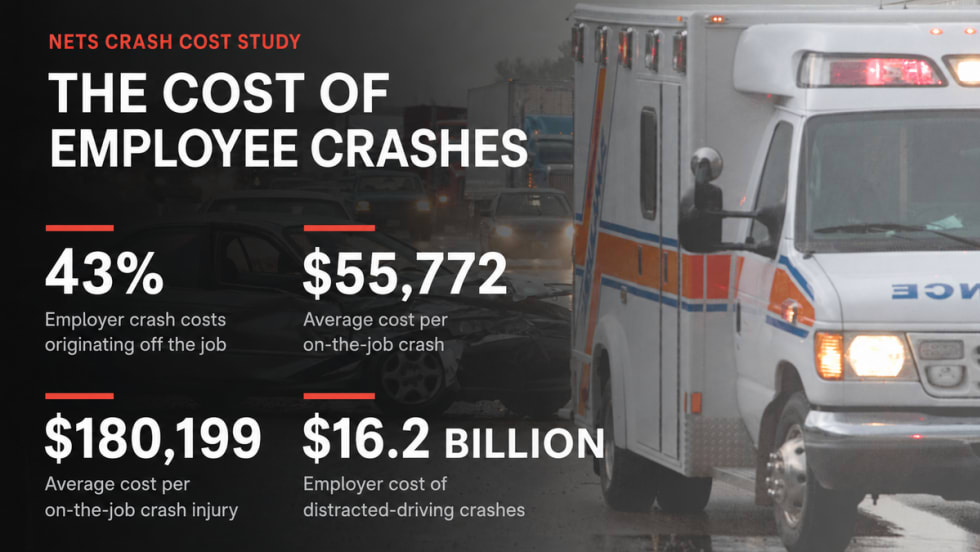
Off-the-Job Crashes Account for 43% of Employers’ $61.7 Billion Crash Burden
NETS quantifies costs dispersed across fleet, risk, HR, and other departments while providing new per-crash benchmarks for employers.
Read More →
Ram Recalls More Than 1.27 Million 1500 Pickups for Seat Belt Anchor Issue
The recall affects certain 2019-2026 Ram 1500 pickups that may have improperly attached second-row seat belt buckle anchors.
Read More →
How Better Visibility Cut Speeding Violations by 48%
Fleet leaders don't need more data, they need clearer visibility into what the data is saying. This case study explores how one utility replaced speeding-event counts with a single metric — miles driven in violation — to strengthen safety and significantly reduce speeding violations.
Read More →
Operation Safe Driver Week: Why the Industry's Oldest Safety Campaign Still Matters to Fleets
A look at how a 2007 enforcement initiative became one of the most consequential weeks on the fleet safety calendar, and what it means for your drivers in 2026.
Read More →