




NTSB Faults Trucker and Motorist in Fatal Tesla Crash
The National Transportation Safety Board has ruled that a truck driver’s failure to yield the right of way and a car driver’s “inattention due to over-reliance on vehicle automation” are the probable cause of the May 7, 2016, collision of a tractor-trailer and a Tesla S sedan operating in autonomous mode.

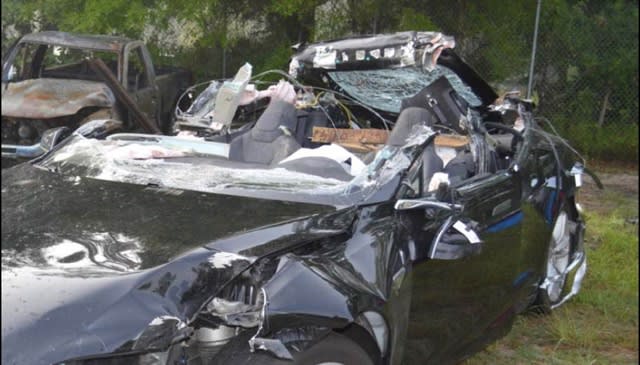
Joshua Brown's Tesla sedan, after the crash with a truck that took his life. Photo: NTSB/Florida Highway Patrol
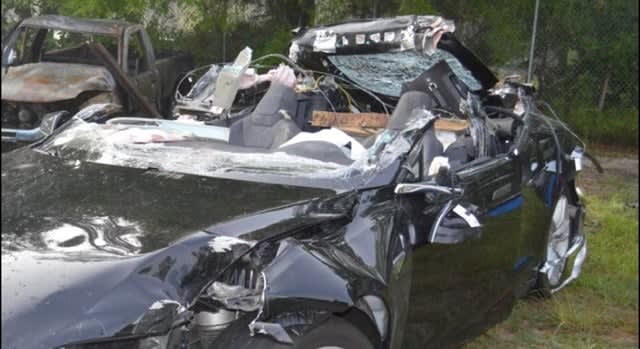
Joshua Brown's Tesla sedan, after the crash with a truck that took his life. Photo: NTSB/Florida Highway Patrol
The National Transportation Safety Board has ruled that a truck driver’s failure to yield the right of way and a car driver’s “inattention due to over-reliance on vehicle automation” are the probable cause of the May 7, 2016, collision of a tractor-trailer and a Tesla Model S 70D sedan operating in autonomous mode.
The first fatal crash of an autonomous car in the U.S., the accident claimed the life of the Tesla’s driver, 40-year-old Joshua Brown, of Canton, Ohio.
In a statement on the report, which was issued on Sept. 12, NTSB said it also found that the operational design of the Tesla’s vehicle automation “permitted the car driver’s overreliance on the automation," noting its design "allowed prolonged disengagement from the driving task and enabled the driver to use it in ways inconsistent with manufacturer guidance and warnings.”
“While automation in highway transportation has the potential to save tens of thousands of lives, until that potential is fully realized, people still need to safely drive their vehicles,” said NTSB Chairman Robert L. Sumwalt III. “Smart people around the world are hard at work to automate driving, but systems available to consumers today, like Tesla’s ‘Autopilot’ system, are designed to assist drivers with specific tasks in limited environments. These systems require the driver to pay attention all the time and to be able to take over immediately when something goes wrong.”
He added that “safeguards, that should have prevented the Tesla’s driver from using the car’s automation system on certain roadways, were lacking and the combined effects of human error and the lack of sufficient system safeguards resulted in a fatal collision that should not have happened.”
Per NTSB, the report’s findings include:
The Tesla’s automated vehicle control system was not designed to, and could not, identify the truck crossing the Tesla’s path or recognize the impending crash. Therefore, the system did not slow the car, the forward collision warning system did not provide an alert, and the automatic emergency braking did not activate
The Tesla driver’s pattern of use of the Autopilot system indicated an over-reliance on the automation and a lack of understanding of the system limitations
If automated vehicle control systems do not automatically restrict their own operation to conditions for which they were designed and are appropriate, the risk of driver misuse remains
The way in which the Tesla “Autopilot” system monitored and responded to the driver’s interaction with the steering wheel was not an effective method of ensuring driver engagement
Tesla made design changes to its “Autopilot” system following the crash. The change reduced the period of time before the “Autopilot” system issues a warning/alert when the driver’s hands are off the steering wheel. The change also added a preferred road constraint to the alert timing sequence
Fatigue, highway design and mechanical system failures were not factors in the crash. There was no evidence indicating the truck driver was distracted by cell phone use. While evidence revealed the Tesla driver was not attentive to the driving task, investigators could not determine from available evidence the reason for his inattention
Although the results of post-crash drug testing established that the truck driver had used marijuana before the crash, his level of impairment, if any, at the time of the crash could not be determined from the available evidence.
As a result of its investigation, NTSB has issued seven new safety recommendations. One recommendation has been issued to the Department of Transportation, three to the National Highway Traffic Safety Administration, two to the manufacturers of vehicles equipped with Level 2 vehicle automation systems, and one each to the Alliance of Automobile Manufacturers and Global Automakers.
NTSB said the safety recommendations for autonomous vehicles address the need for:
Event data to be captured and available in standard formats on new vehicles equipped with automated vehicle control systems
Manufacturers to incorporate system safeguards to limit the use of automated control systems to conditions for which they are designed and for there to be a method to verify those safeguards
Development of applications to more effectively sense a driver’s level of engagement and alert when engagement is lacking
Manufacturers to report incidents, crashes, and exposure numbers involving vehicles equipped with automated vehicle control systems
The board also reiterated two safety recommendations that it had issued to the National Highway Traffic Safety Administration in 2013. These deal with minimum performance standards for connected vehicle technology for all highway vehicles as well as the need to require installation of the technology-- once developed-- on all newly manufactured highway vehicles.
The abstract of NTSB’s final report, which includes the findings, probable cause, and the safety recommendations is available online. The final report itself will be publicly released in the next several days. The webcast of the board meeting for this investigation will be available here for 90 days.
More Safety

Fleet Manager’s Ultimate Playbook: Navigating the New Standard in OEM Connectivity
Rising operating costs, driver safety concerns, and unplanned downtime are putting unprecedented pressure on modern fleets. Discover how fleet managers use embedded OEM connectivity and real-time vehicle data to cut TCO, prevent downtime, and protect drivers without aftermarket telematics hardware.
Read More →
From Driver Well-Being to EV Charging | AF News Recap
Mental health belongs in the fleet safety conversation. This week, we’re looking at five ways fleets can support employee well-being before a crisis, plus Holman’s expansion in Mexico, new one-day Fleet Forward passes, and why EV charging demand is outpacing infrastructure growth.
Read More →
Nexar-Nauto Merger Aims to Give Fleets Better Safety Intelligence Through Larger Driving Dataset
Stefan Heck tells Automotive Fleet that combining more than 10 billion miles of driving history with Nexar's AI models will give fleets deeper insights into driver risk and roadway conditions than either company could provide independently.
Read More →
Don't Wait for a Crisis: 5 Ways to Build Mental Health Into Your Fleet Safety Program
For Suicide Prevention Month, fleet and safety leaders have an opportunity to put mental health where it belongs: at the center of workplace safety.
Read More →
How Camera Data Can Strengthen a Fleet’s Insurance Renewal
Insights from a commercial insurance carrier and a broker show how fleets can turn video telematic data, driver coaching, and improved claims results into a stronger case at insurance renewal.
Read More →
The Safest Fleets Aren’t the Ones with the Most Technology
You’ve made the telematics investment. Here’s how to capture the other half of its value and build the safest fleet on the road.
Read More →
Hidden in Plain Sight: Fleet Compliance Risks
Fleet compliance isn't just about having policies — it's about consistently enforcing them. This practical guide reveals six hidden compliance risks common in public sector and shared fleet operations and outlines proven strategies to improve visibility, accountability, and audit readiness
Read More →
NETS Sets 2026 Fleet Safety Benchmark Conference for Indianapolis
The Sept. 15–17 program will feature fleet benchmarking data, case studies, emerging technologies, and implementation strategies while running alongside the NSC Safety Congress & Expo.
Read More →
Off-the-Job Crashes Account for 43% of Employers’ $61.7 Billion Crash Burden
NETS quantifies costs dispersed across fleet, risk, HR, and other departments while providing new per-crash benchmarks for employers.
Read More →
Ram Recalls More Than 1.27 Million 1500 Pickups for Seat Belt Anchor Issue
The recall affects certain 2019-2026 Ram 1500 pickups that may have improperly attached second-row seat belt buckle anchors.
Read More →