




Nissan Details 2016 Titan's Cummins Turbo Diesel
Nissan is offering a 5.0-liter Cummins turbo diesel with its 2016 Titan pickup for the first time that will give work truck buyers greater capability for towing and payload, Nissan has announced.
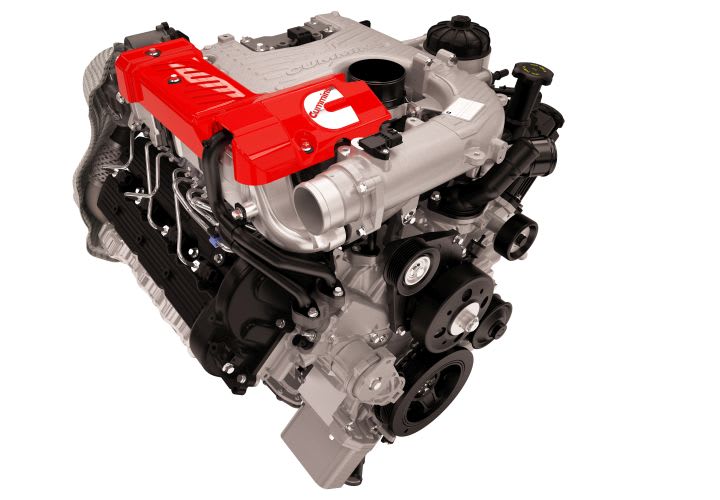
Photo of Cummins 5.0L turbo diesel courtesy of Nissan.
Photo of Cummins 5.0L turbo diesel courtesy of Nissan.
Nissan is offering a 5.0-liter Cummins turbo diesel with its 2016 Titan pickup for the first time that will give work truck buyers greater capability for towing and payload, Nissan has announced.
Nissan introduced its redesigned next-gen Titan at the North American International Auto Show in Detroit.
The new 5.0-liter V-8 turbo diesel, from the Cummins ISV family, is rated to produce 310 hp and 555 lb.-ft. of torque. It contains 70 percent of the parts offered on the commercial variant of the engine. The turbo diesel will be offered on the Titan XD model.
Nissan has been working with Cummins since 2007 in a partnership to possibly introduce a diesel engine for the Titan. Production will begin later in 2015.
The turbo diesel uses a compacted graphite iron cylinder block, forged steel crankshaft, high-strength aluminum allow heads, and composite valve covers to achieve a durable, lightweight package. The engine uses dual overhead camshafts.
The Cummins M2 two-stage turbocharger has been configured to work well at low and high engine speeds.
The series sequential turbocharging system uses two differently sized turbochargers, including a small turbocharger for low air flow requirements and a large turbo for high air flow. The small turbo provides good transient response due to its low inertia, and the large turbo maintains power at higher engine speeds. This helps eliminates turbo lag, providing a continuous delivery of peak torque through the RPM range, according to Nissan.
In order to control the air flow between the two turbo chargers, the new M2 system uses a rotary valve to open ports that perform the bypass or waste-gate functionality and provide exhaust after-treatment thermal management.
High injection pressures from the Bosch High Pressure Common Rail (HPCR) fuel system and piezo fuel injectors provide precise fuel control for optimized in-cylinder combustion, leading to better fuel efficiency and reduced emissions, Nissan announced.
More Operations

Here's When You Should Make an Exception to Fleet Policy
Fleet policies are designed to create consistency, but not every driver or situation fits neatly within standard rules.
Read More →
AI-Native or AI-Acquired: What Should Fleet Managers Look for in an AI Platform?
Six questions can help fleet managers look beyond AI marketing claims to evaluate integration, data access, and real-world operational performance.
Read More →
A buyer's guide to fleet management software in 2027
Buying fleet management software in 2027 means looking beyond features and price. As fleet operations, technology and expectations evolve, this guide explores what today’s fleet professionals should consider when choosing a system that can deliver value now and adapt to what comes next.
Read More →

What Will Shape the Next Era of Fleet Management?
EVs, AI, and autonomous vehicles are reshaping fleet management. Discover what’s ahead—and how fleet leaders can prepare for the next era.
Read More →
How Fleets Can Recruit and Train Veterans for Technician Roles
Here's how the technician shortage has affected uptime for fleets, and what to do about it.
Read More →
Avis Budget Group Deploys Neology Toll Management Technology Across Major Brands
Neology’s neoFleet platform will manage toll transactions and toll-authority operations for vehicles across Avis, Budget, Payless, Budget Truck and Zipcar.
Read More →
Fleet Personal-Use Charges Edge Higher in 2026
Nearly eight in 10 surveyed fleets allow personal use of company vehicles, while just over half of respondents report charging employees for the privilege.
Read More →
The Future of Fleet + What’s Changing Right Now | AF News Recap
Could developments overseas offer a preview of what’s coming for U.S. fleets? This week, we’re looking at the future of AI, autonomy, and electrification, plus Ford Pro’s new certified pre-owned program, smarter vehicle offboarding, and a new way for fleets to manage toll expenses.
Read More →
How to Handle Vehicle Offboarding
What do fleet managers need to do when a driver leaves?
Read More →
Fleet Manager’s Ultimate Playbook: Navigating the New Standard in OEM Connectivity
Rising operating costs, driver safety concerns, and unplanned downtime are putting unprecedented pressure on modern fleets. Discover how fleet managers use embedded OEM connectivity and real-time vehicle data to cut TCO, prevent downtime, and protect drivers without aftermarket telematics hardware.
Read More →