





Related Article: How Fleets Are Managing the Supply Chain Strain
New Vehicle Inventory Drops, But Availability Steadies
Despite lower production, there are more vehicles ready to be sold due to sales losing momentum since June.
September 15, 2021
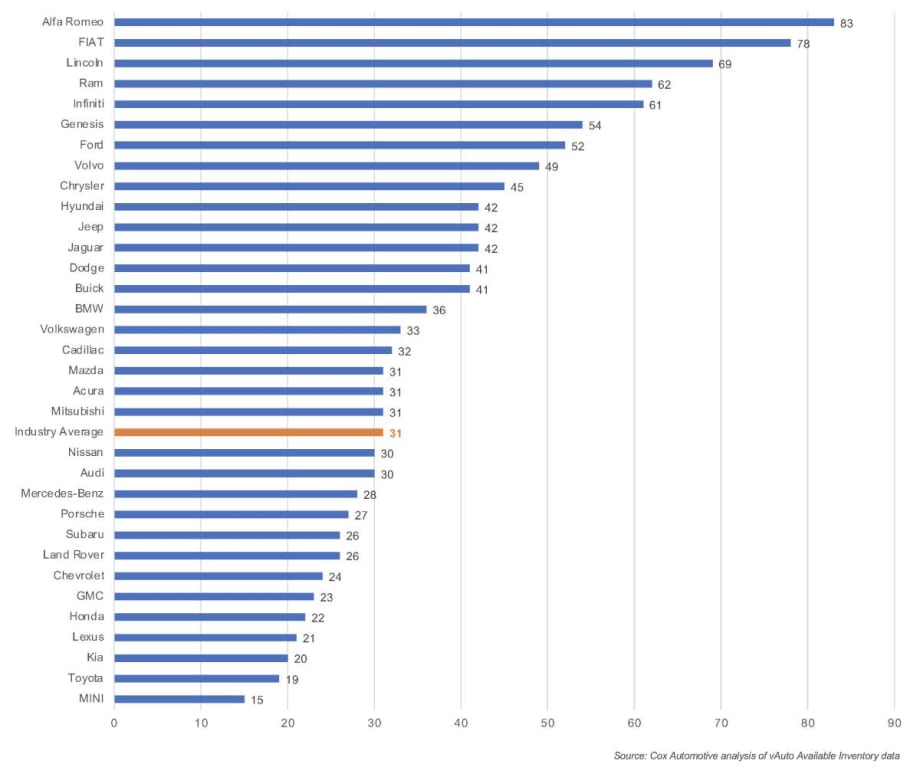
National Days' Supply by Brand, August 2021
Graph: Cox Automotive
4 min to read
The total volume of new-vehicle inventory declined again in August, as automakers continue to struggle with production due to the computer chip shortage, according to a Cox Automotive analysis of vAuto Available Inventory data released Sept. 15. The days’ supply has been holding steady over the past month.
The total U.S. supply of available unsold new vehicles stood at 1.08 million vehicles as August closed. That was down from 1.11 million vehicles in late July, but recent data reviews show supply inching higher but mostly because sales are slowing significantly.
Still, inventories remain historically low, running about 57% below a year ago, according to a Cox Automotive analysis. In raw numbers, supply is down about 1.4 million units from the same time in 2020 and more than 2.5 million units below the 2019 level.
The days’ supply of unsold new vehicles was 31 as September opened. Since mid-July, the days’ supply has been 30 to 31. Days’ supply was 47% below the same week in 2020.
The Cox Automotive days’ supply is based on the daily sales rate for the most recent 30-day period. New-vehicle sales have been losing momentum since June. The August sales pace, or seasonally adjusted annual rate (SAAR), dropped to 13.1 million, down from 14.8 million in July. By comparison, first-half sales were running at a blistering 17 million pace.
Non-luxury inventory again fell well below one million vehicles near the end of August for a 30 days’ supply. Luxury vehicle supply fell to just under 163,000 units at the close of the month from about 190,000 units the month earlier.
“New-vehicle inventory is stabilizing a bit,” said Cox Automotive Senior Economist Charlie Chesbrough, in a news release. “Days of supply has been holding steady because sales have slowed to such a pace that low supply is not being drawn down as rapidly.”
Added Chesbrough: “It is hard to see the situation changing in the near term as many automakers have made announcements of additional production cuts of late.”
Most notably Toyota announced it was slashing global production by 40% for September and recently stated it would also slash October’s planned production by the same amount.
Prices Climb at a Slower Rate
As September opened, the average listing price for new vehicles set another record. It rose to $42,450, up from $41,840 a month earlier. That puts it 10% higher than year-ago levels and 16% higher than 2019. The non-luxury average listing price was $39,182 as August closed, up from $38,483 a month earlier. For luxury vehicles, the average listing price was $62,012, up from $60,069.
It’s a fundamental economic principle that high demand and low supply result in rising prices. In addition, August and September typically are months when automakers and dealers try to sell down old inventory at greatly discounted prices to make room for the new model year products. This year, however, there is no old, discounted inventory to pull down the average price.
Across the price spectrum, the days supply for vehicles under $20,000 was lowest at 21 followed by the $20,000 to $30,000 category at a 24 days’ supply and 27 days’ supply for the $30,000 to $40,000 category. Higher priced segments were 30 days’ supply and higher.
Toyota, Honda Have Lowest Supply
Despite relentlessly low supply, Toyota had been mostly spared from massive production cuts earlier in the year. But that ended as fall approached when the Japanese automaker announced it would cut 40% from planned global production schedules for September and October.
Toyota closed August with 19 days’ supply. Lexus was at 21. Their high-volume models got hit hard. Lexus’ volume-leading RX SUV had a scant 14 days’ supply as September opened. At Toyota brand, the CH-R had about the lowest days’ supply of any model at nine days. Other Toyota volume models – Camry, Corolla, Highlander, Prius, RAV4 and Tacoma – had days’ supply in the teens. Toyota is building up its supply of the full-size Tundra pickup which is launching now in a redesigned form.
The Honda brand was in the same position with a days’ supply of 22. The Civic, CR-V and Ridgeline had 17 days’ supply or less. Accord had only slightly more at about 24 days’ supply. Civic, CR-V and Accord account for the bulk of Honda brand sales.
Kia fell between Toyota and Honda in the inventory rankings with only 20 days’ supply. The new Carnival minivan and Telluride SUV each had a skimpy 16 days’ supply.
Last week, GM warned investors that sales and production declines would be worse than expected in the second half, off 200,000 units – double what GM told investors in July – due to Southeast Asia supply chain issues. Its GMC and Chevrolet brands took the brunt with days’ supply even lower than Subaru.
Originally posted on Vehicle Remarketing
More Remarketing

When Should a Fleet Repair Vehicle Damage Before Remarketing?
Not every dent, scratch, or mechanical issue is worth fixing before selling a fleet vehicle. Learn how to weigh repair costs, resale value, market demand, and downtime to determine when reconditioning pays off and when selling as-is makes more sense.
Read More →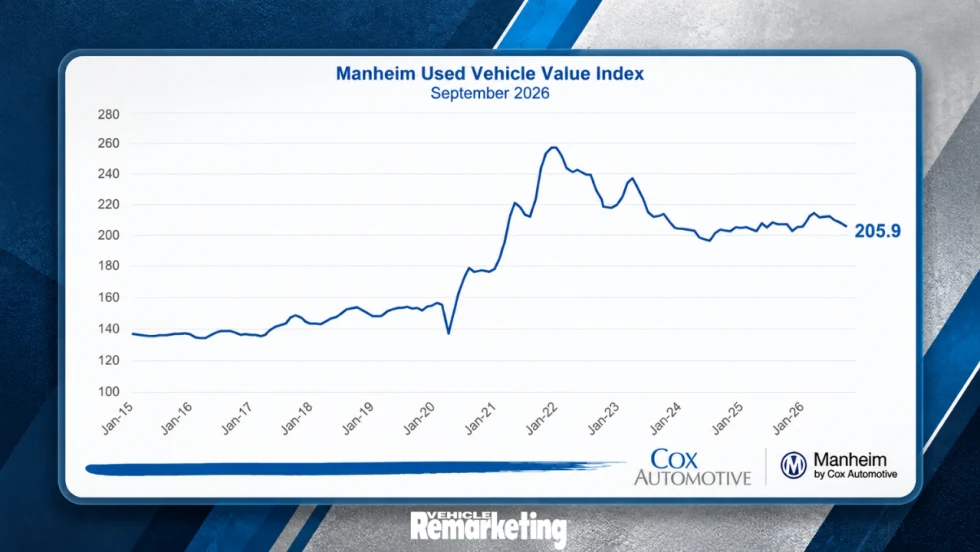
Wholesale Used-Vehicle Values Fall as Cox Automotive Cuts 2026 Forecast
Wholesale used-vehicle prices declined in September as depreciation accelerated, prompting Cox Automotive to lower its year-end forecast.
Read More →
FLD Promotes Three Executives in Leadership Changes
FLD has promoted three longtime executives, naming Gary Mott CEO, Richard Mallek president, and Ron Sanders managing partner.
Read More →
Ford Pro Launches Certified Pre-Owned Program for Commercial Vehicles
Ford Pro Advantage will offer certified pre-owned Class 1-7 commercial vehicles through more than 700 Ford Pro Commercial Vehicle Centers.
Read More →
Copart to Acquire ACV in $1.9 Billion Deal
The acquisition would expand Copart beyond its traditional salvage business into dealer-to-dealer wholesale remarketing while adding ACV’s vehicle data, inspection, and valuation technology.
Read More →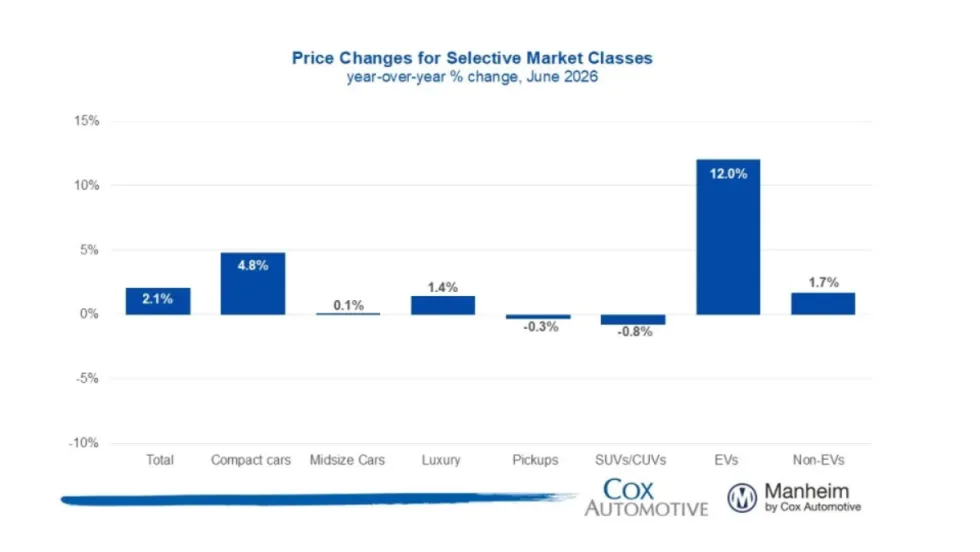
Manheim Index Shows Used-Vehicle Wholesale Prices Up 2.1% in June
The market is seeing stronger appreciation in older used vehicles this year, and the most affordable segments have been among the year’s best performers.
Read More →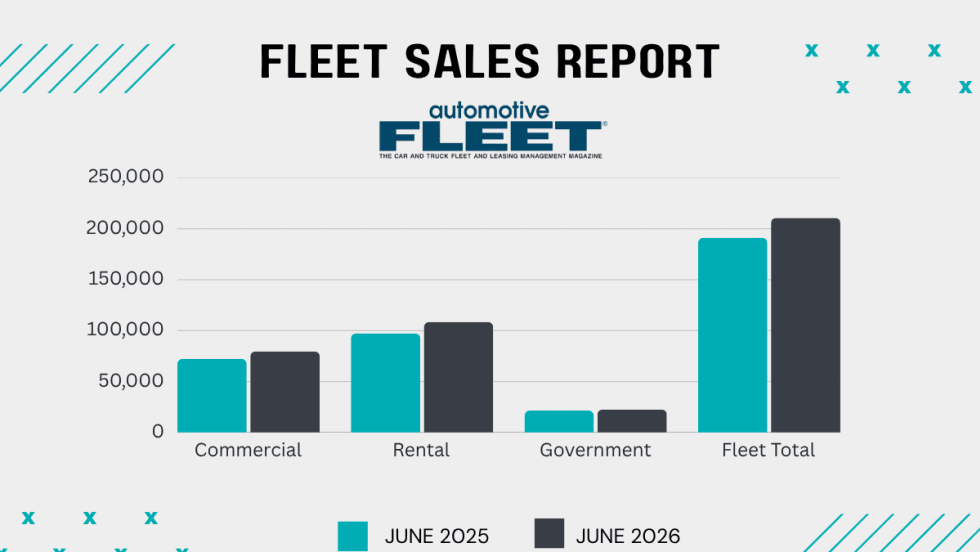
Commercial Fleet Sales Contribute To June, YTD Gains
The fleet sector has boosted its vehicle purchases at a reliable pace in the first half of this year compared with 1H 2025.
Read More →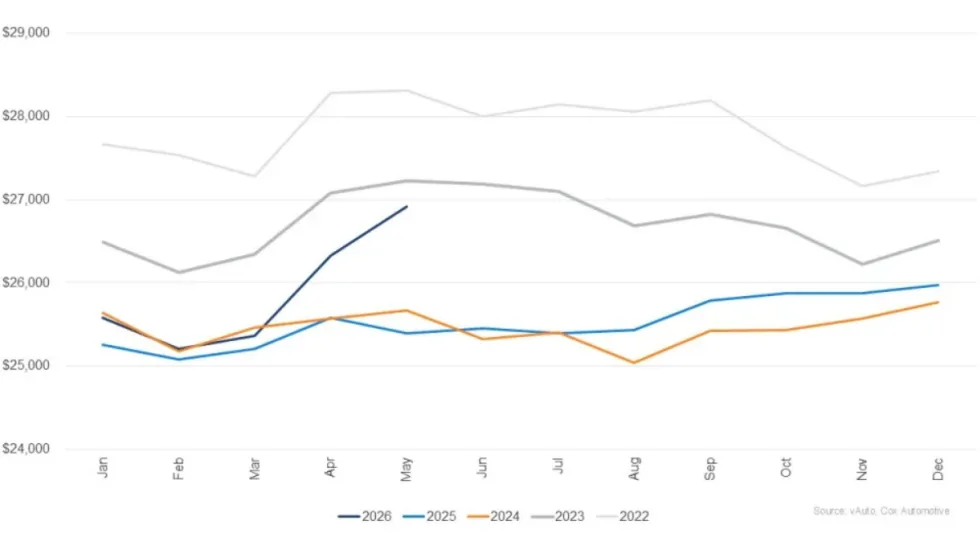
Used Vehicle Prices Climb Higher As Sales Pace Slows
The higher prices at used retail reflect strong wholesale values earlier in the spring, particularly for older, more affordable vehicles.
Read More →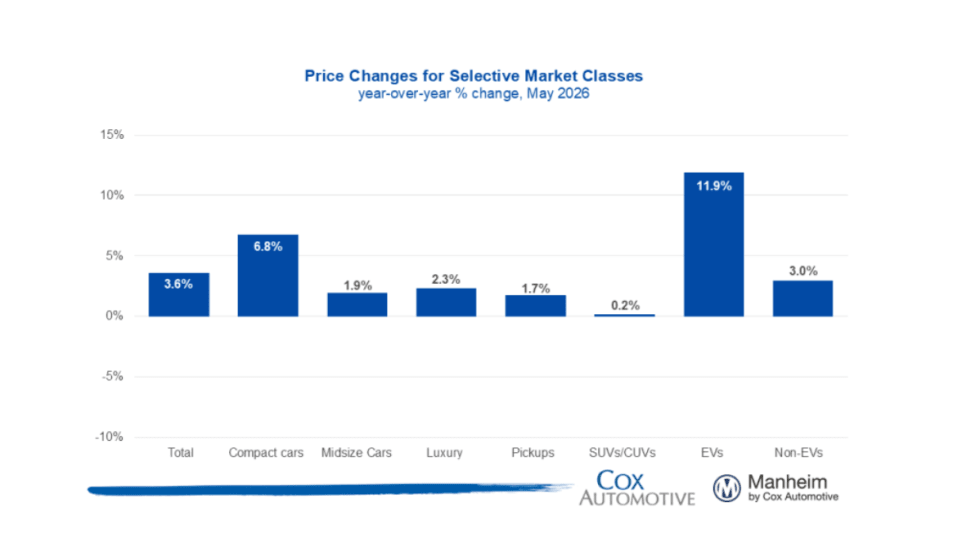
Wholesale Used Vehicle Market Sustains Moderate Rise In Values, Prices
Trends continue to normalize after a strong start to the year, as consumers contend with higher gas prices in the coming summer months.
Read More →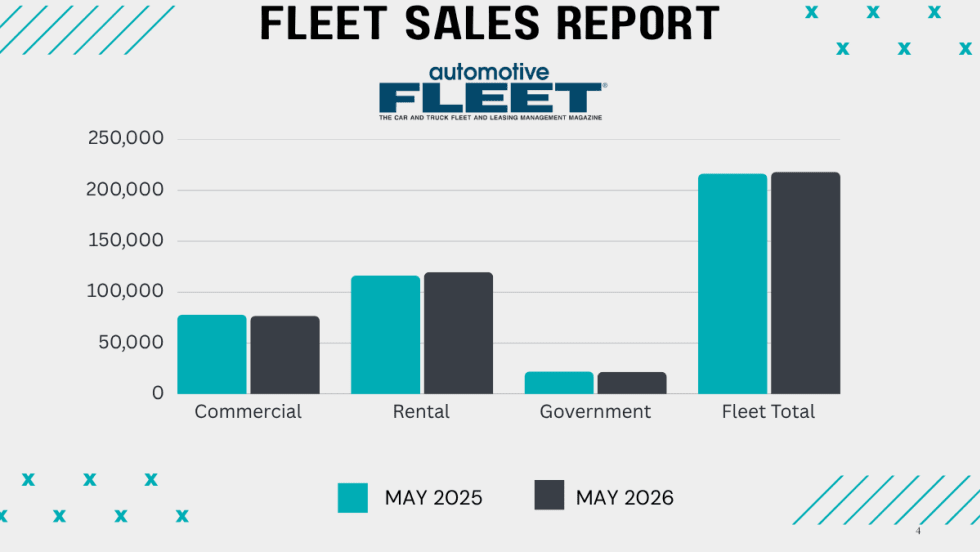
Commercial Fleet Sales Still Lead Sectors Despite May Mini Dip
The U.S. economy's continued growth and positive business investment are creating a favorable environment for fleet vehicle demand.
Read More →