





Related: Survey Reveals Increasing Fear of Self-Driving Cars
New Forecast on Widespread Autonomous Technology by 2033
The era of peak hype has passed, but forecasters still see long-term adoption in certain segments that benefit from today's rise in automated driving technology.
September 25, 2023

Study shows self-driving vehicles and mobility-on-demand is likely to exist eventually.
Photo: Canva
5 min to read
A world of self-driving vehicles and mobility-on-demand is likely to exist eventually. Still, for the next decade, widespread implementation of autonomous technology will not be realized, according to a new forecast from S&P Global Mobility.
The report reflects findings from robust model-level forecasting that autonomous vehicle expectations have not been fulfilled and still face more headwinds — affording significant opportunity and scale to automated driving implementations in the interim.
Autonomous Tech's Decade-Long Journey
Over the coming decade, autonomous technology will find its primary applications in two distinct domains: geofenced robotaxis, managed by fleets in specific locales, and semi-autonomous systems in personal vehicles, equipped with various safety measures but still necessitating some level of driver involvement.
S&P Global Mobility's most recent projections indicate that achieving Level 5 autonomy —vehicles capable of performing all tasks equivalent to a human driver — will likely not become publicly accessible until after 2035 and possibly later.
Jeremy Carlson, Associate Director for the Autonomy Practice at S&P Global Mobility, cautioned that the outlook for more targeted deployments of similar fundamental technologies, especially in Level 2+ and Level 3, and even certain forms of Level 4, is more promising and expected to materialize on a shorter timeline.
This revised perspective from S&P Global Mobility underscores the challenges and a slower pace of development witnessed in the automotive and tech sectors over the past several years.
It starkly contrasts the exuberance of just half a decade ago when the world was captivated by the promise and anticipation of a future dominated by fully autonomous vehicles, particularly at Levels 4 and 5.
Today, S&P Global Mobility presents a more pragmatic outlook, acknowledging the measured rate of progress while also unveiling fresh data on the intersection of autonomy and mobility-as-a-service (MaaS).
Rather than full autonomy, the industry's primary focus remains on automated driving. The forecast predicts that by 2035, the widespread adoption of Level 2+ and Level 3 systems by numerous automakers across different regions will encompass at least 31% of new vehicle sales worldwide.
In Level 2+ and Level 3 automation, drivers can relinquish control in specific driving scenarios, such as with General Motors' Super Cruise and Mercedes-Benz's Drive Pilot, while still supervising the vehicle's operation.
Jeremy Carlson explained in a press release that there is substantial potential for automated driving systems in Level 2+ and Level 3, and they benefit from the standardization of fundamental safety features that establish a foundation in terms of in-vehicle architecture, sensors, and computing power.
These systems also complement human driving rather than entirely replacing the driver, making them more palatable for consumers.
The next few years of broader implementation across various automotive brands and platforms will benefit automakers offering these optional features and suppliers seeking to expand their presence and lay a sturdy groundwork for the future.
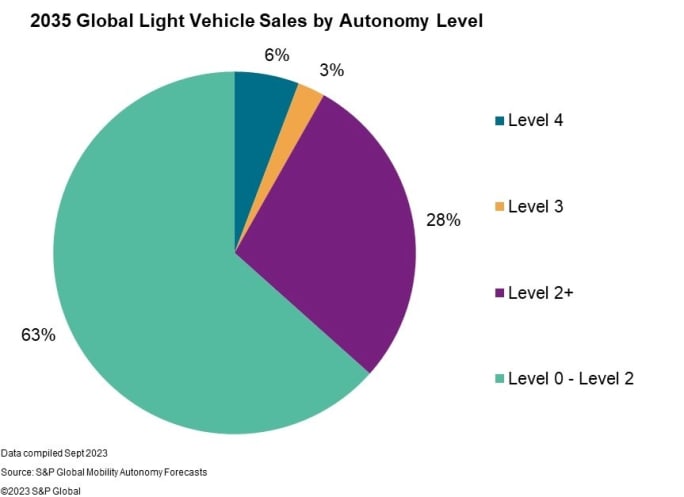
Photo: S&P Global Mobility
Autonomous Vehicle Progress Slower than Expected
The S&P Global Mobility forecast anticipates that less than 6% of light vehicles sold in 2035 will possess Level 4 functionality, as defined by the SAE J3016 classification.
Initial Level 4 implementations in privately owned vehicles offer advanced parking capabilities, often in conjunction with infrastructure support.
Nevertheless, many technology providers focus on the long-term potential of expanding autonomous vehicles within fleets that support Mobility-as-a-Service (MaaS) business models.
Despite notable instances of autonomous vehicles performing on par with human drivers in pilot programs, such as those in San Francisco, Phoenix, Beijing, Shanghai, and Guangzhou, they can still encounter complex traffic scenarios, prompting both regulators and consumers to exercise caution.
Caution and Optimism in Autonomous Mobility
MaaS and robotaxis are projected to spearhead the transition to an autonomous vehicle future, albeit with cautious growth expectations.
Small-scale deployments are becoming more common in select cities globally.
However, widespread accessibility is not anticipated within the next decade, with MaaS-equipped vehicles and robotaxi applications projected to constitute less than 800,000 vehicles sold worldwide by 2035.
Robotaxis will remain geofenced for the foreseeable future, operating exclusively in extensively tested areas, albeit with high utilization rates that introduce new mobility choices for some consumers and revenue streams for automakers and mobility providers.
Owen Chen, Senior Principal Analyst at S&P Global Mobility, outlined the complex and multi-stage development and commercialization process for robotaxis.
This process involves technical feasibility demonstrations, technology optimization, integration, vehicle design refinement, scaling of manufacturing and deployment, and expansion to new locations and operating conditions with profit generation on top of revenue from consumer adoption.
As of 2023, many are navigating stage 1, while some are advancing towards scale in stage 2, led by Mainland China and the United States. The potential for restructuring personal and shared mobility remains on the horizon.
Expanding Autonomous Taxi Operations
In August, the California Public Utility Commission greenlit expanded operations for Waymo and Cruise in San Francisco.
Mainland Chinese regulators also grant testing or operational permits to providers like Baidu Apollo, Pony AI, WeRide, and more in major Chinese cities. Europe is actively working on regulations to standardize these vehicles and services across the region.
While the United States initially took the lead in developing and deploying Level 4 MaaS, Mainland China is expected to contribute the most substantial volumes in the long run, followed by the United States and Europe, according to S&P Global Mobility.
Challenges persist for the widespread deployment of Level 4 MaaS. These include a fragmented regulatory landscape, a relatively low public trust that could hinder consumer acceptance, the high cost of technology, and the time required for robust hardware and software development and validation.
In contrast, with reduced complexity, Level 2+ and Level 3 features face lower risk and uncertainty in each aspect, leading to a more optimistic short-term outlook.
This optimism is further reinforced as some regulators mandate certain basic safety assistance features, increasing exposure to selective automation.
Automakers, suppliers, technology companies, and mobility providers remain unwavering in their commitment to a future of safe and equitable autonomous mobility, even if it takes more time to fully realize.
More Fleet Forward

Erin Gilchrist Receives Mike Antich Spirit of Fleet Award
Last week at AFLA in Vegas, Erin Gilchrist received the inaugural, brand-new Spirit of Fleet Award.
Read More →
Dominika Leja Named the 2026 Fleet Manager of the Year
The AstraZeneca associate director of fleet was recognized for her leadership in fleet electrification, cost savings, and operational transformation.
Read More →
Jamie McKay Named the 2026 Fleet Visionary Award Winner
The Aptive Pest Control fleet manager was recognized for her approach to operations, data, lifecycle management, and driver needs.
Read More →
Fleet Forward Conference Introduces One-Day Passes for 2026
New one-day registration gives fleet professionals the flexibility to attend Tuesday, Wednesday, or Thursday, with passes available for $199 through Sept. 18.
Read More →
Vibe Coding: When Fleet Managers Become Software Builders
Five fleet professionals — none with programming skills — discuss how they’re using AI to build fleet solutions in-house and in a fraction of the time.
Read More →
Fleet Forward Conference Tackles Fleet Industry’s Growing Leadership Gap
This session will examine succession planning, knowledge transfer, and the skills the next generation of fleet leaders will need as veteran professionals leave the industry.
Read More →
2026 Fleet Manager of the Year Finalists Announced
Who are the 2026 Fleet Manager of the Year finalists?
Read More →
John Rossant to Deliver Opening Keynote at 2026 Fleet Forward Conference
The CoMotion founder will draw on developments across Europe, China, the Middle East, and other international markets to identify trends that could influence how U.S. fleets plan for the coming decade.
Read More →
How to Build Custom Fleet Tools With AI and Vibe Coding [Webinar]
A new Automotive Fleet webinar explores how fleet managers are using AI and vibe coding to automate routine work and create simple operational tools without traditional programming skills.
Read More →