




New Audi A4 Earns Highest Federal Crash Test Rating
HERNDON, VA – The redesigned 2009 Audi A4 luxury sport sedan earned the U.S. government’s highest crashworthiness and rollover safety rating.

Audi A4
HERNDON, VA – The redesigned 2009 Audi A4 luxury sport sedan earned the U.S. government’s highest crashworthiness and rollover safety rating. The National Highway Traffic Safety Administration (NHTSA) said the A4 achieved the coveted 5-Star designation based on its performance in the New Car Assessment Program, or NCAP.
U.S. law requires all passenger cars to pass a 30 mph frontal crash test and a 33.5 mph side crash test.
But the NCAP tests involve crashes that are conducted at five mph above the required test speeds providing additional consumer safety information. NHTSA then gives ratings of one star for the worst performers to five stars for the best models.
“Unparalleled safety is a cornerstone of Audi’s new vehicle development, and we are thrilled to see the A4 earn top marks in one of the toughest crash testing programs in the world,” said Audi of America Inc. Executive Vice President Johan de Nysschen. “Add this to other elements, including segment-leading fuel economy, engine performance, luxury features, and size, which all prove the 2009 A4 is at the head of its class.”
The 2009 Audi A4 officially went on sale to American luxury car buyers in late September. The A4 offers advanced safety features and accident-prevention technologies in addition to a significantly stiffer and smoother body shell to protect motorists and passengers. Among the key safety features:
Front, side, and side-curtain airbags are standard equipment in every A4.
The available dynamic steering system helps stabilize the vehicle several times a second when it detects the car is exceeding its capabilities.
Available Adaptive cruise control detects a vehicle ahead of the A4 and gently reduces the car’s speed as the distance narrows. Once the road clears, the system slowly accelerates back to the set cruise control speed.
The A4 also offers superior handling due to a front track that is 2.5 inches wider than the closest competing BMW model and nearly an inch wider than the closest Lexus. It also offers more front row shoulder and head room than competing luxury models and a smoother ride helped by the longest wheelbase in its class.
The A4 also features a new 2.0L TFSI engine that generates 211 hp and 258-lbs-ft. of torque while getting 15 percent better fuel economy than the turbocharged engine it replaces. The improved 3.2L engine produces 265 hp and 243 lbs-ft of torque with a 10 percent gain in fuel economy. The new engines are paired with an all-new six-speed transmission to provide precise shifting and fuel efficiency.
More information on the performance of the Audi A4 in the federal crash tests is available at www.safercar.org. Additional information on the A4 can be found at www.audiusanews.com.

More Safety

Nexar-Nauto Merger Aims to Give Fleets Better Safety Intelligence Through Larger Driving Dataset
Stefan Heck tells Automotive Fleet that combining more than 10 billion miles of driving history with Nexar's AI models will give fleets deeper insights into driver risk and roadway conditions than either company could provide independently.
Read More →
Don't Wait for a Crisis: 5 Ways to Build Mental Health Into Your Fleet Safety Program
For Suicide Prevention Month, fleet and safety leaders have an opportunity to put mental health where it belongs: at the center of workplace safety.
Read More →
How Camera Data Can Strengthen a Fleet’s Insurance Renewal
Insights from a commercial insurance carrier and a broker show how fleets can turn video telematic data, driver coaching, and improved claims results into a stronger case at insurance renewal.
Read More →
The Safest Fleets Aren’t the Ones with the Most Technology
You’ve made the telematics investment. Here’s how to capture the other half of its value and build the safest fleet on the road.
Read More →
Hidden in Plain Sight: Fleet Compliance Risks
Fleet compliance isn't just about having policies — it's about consistently enforcing them. This practical guide reveals six hidden compliance risks common in public sector and shared fleet operations and outlines proven strategies to improve visibility, accountability, and audit readiness
Read More →
NETS Sets 2026 Fleet Safety Benchmark Conference for Indianapolis
The Sept. 15–17 program will feature fleet benchmarking data, case studies, emerging technologies, and implementation strategies while running alongside the NSC Safety Congress & Expo.
Read More →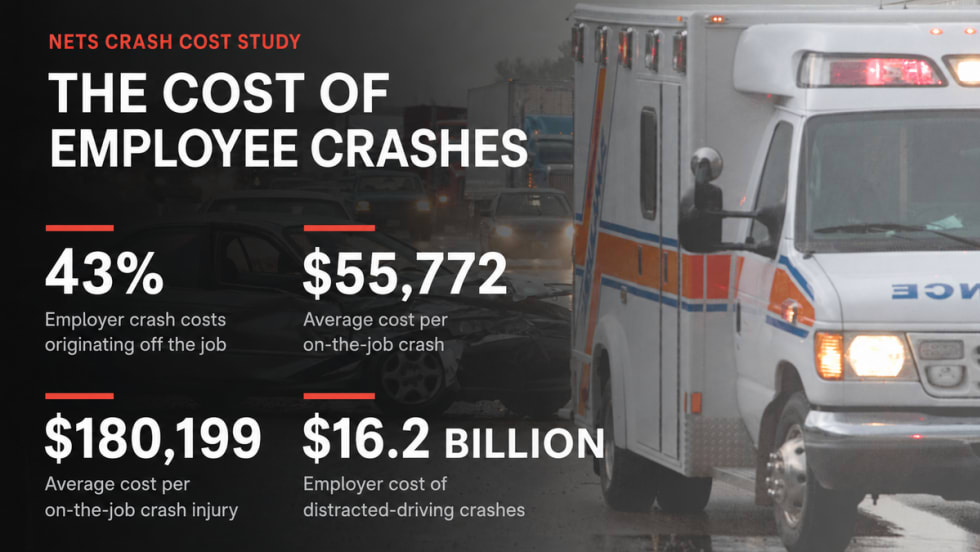
Off-the-Job Crashes Account for 43% of Employers’ $61.7 Billion Crash Burden
NETS quantifies costs dispersed across fleet, risk, HR, and other departments while providing new per-crash benchmarks for employers.
Read More →
Ram Recalls More Than 1.27 Million 1500 Pickups for Seat Belt Anchor Issue
The recall affects certain 2019-2026 Ram 1500 pickups that may have improperly attached second-row seat belt buckle anchors.
Read More →
How Better Visibility Cut Speeding Violations by 48%
Fleet leaders don't need more data, they need clearer visibility into what the data is saying. This case study explores how one utility replaced speeding-event counts with a single metric — miles driven in violation — to strengthen safety and significantly reduce speeding violations.
Read More →
Operation Safe Driver Week: Why the Industry's Oldest Safety Campaign Still Matters to Fleets
A look at how a 2007 enforcement initiative became one of the most consequential weeks on the fleet safety calendar, and what it means for your drivers in 2026.
Read More →