





Read More: Buckle Up: More Traffic, More EVs on the Road this Thanksgiving
Nearly 49 Million Americans to Hit the Roadways for Thanksgiving Feasts
AAA projects that the nation’s highways and byways will be busy over the Thanksgiving holiday period. Even so, while road trips have increased slightly — up 0.4% from 2021 — car travel remains 2.5% below 2019 levels.
November 17, 2022
An estimated 54.6 million people will travel 50 miles or more from home this Thanksgiving — and the majority will be going by car versus plane.
Photo: Canva
2 min to read
An estimated 54.6 million people will travel 50 miles or more from home this Thanksgiving — a 1.5% increase over 2021 and 98% of pre-pandemic volumes, according to AAA’s annual Thanksgiving Holiday Travel Forecast.
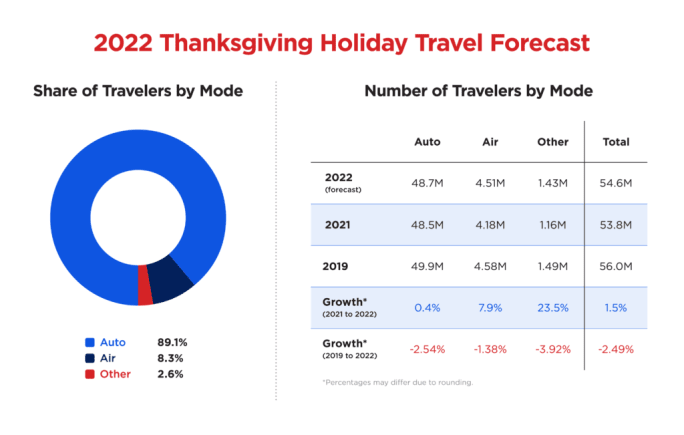
AAA expects this year’s holiday to be the third most busy since 2000.
Source: AAA
The Thanksgiving holiday travel period is defined as the five-day period from Wednesday, November 23 to Sunday, November 27. The Wednesday to Sunday period is consistent with previous years. Noteworthy, this year is expected to be the third busiest for Thanksgiving travel since the membership organization started tracking it in 2000.
Here’s what commercial drivers need to know. Like last year, most travelers will drive to their family feasts. Nearly 49 million people are expected to hit the nation’s highways and byways during the holiday period. Even so, while Thanksgiving road trips have increased slightly — up 0.4% from 2021 — car travel remains 2.5% below 2019 levels.
INRIX, a leading provider of data and analytics into how people move, offers some valuable insights on the anticipated busiest corridors as well as best and worst times to travel.
The data indicates severe congestion in several U.S. metro areas, with some drivers experiencing more than double normal delays. For example, highways in and around Atlanta, Chicago, New York City, and Los Angeles will be the busiest.
For example, on Wednesday afternoon in Atlanta traffic on I-85 South between Clairmont Road to MLK Jr. Drive is expected to increase 105% over typical traffic peak congestion. In New York during the same afternoon, traffic on both I-278 South and I-495 to 6th Ave is anticipated to increase 158% over the typical congestion scenario. And, on Wednesday between 5:30 and 7:30 p.m. in Los Angeles, the I-5 South corridor (Colorado Street to Florence Avenue) will experience an estimated 144% increase over typical traffic peak congestion.
To avoid the most hectic drive times, INRIX recommends traveling early in the morning on Wednesday or before 11 a.m. on Thanksgiving Day and avoiding travel between 4 to 8 p.m. Friday, Saturday, and Sunday. For fleet drivers working during the holiday weekend, those parameters may not be an option. However, it’s good for your drivers to be informed as to the prime times and places to expect congestion, so they prepare to stay calm, focused, and practice their best defensive driving skills.
More Safety

What’s Next for Fleet? Safety, AI & Industry Recognition | AF News Recap
Could your company's culture be encouraging distracted driving? This week, we're exploring how workplace expectations affect driver safety, what AI, EVs, and autonomous vehicles could mean for the future of fleet management, and how fleet professionals can strengthen their award nominations.
Read More →
Does Your Fleet's Culture Encourage Distracted Driving?
What happens when the people responsible for enforcing safety rules are the ones setting the wrong example? The answer may reveal why some of the biggest risks to fleet drivers have little to do with what's written in the employee handbook.
Read More →
Sponsored•October 1, 2026
Fleet Manager’s Ultimate Playbook: Navigating the New Standard in OEM Connectivity
Rising operating costs, driver safety concerns, and unplanned downtime are putting unprecedented pressure on modern fleets. Discover how fleet managers use embedded OEM connectivity and real-time vehicle data to cut TCO, prevent downtime, and protect drivers without aftermarket telematics hardware.
Read More →
From Driver Well-Being to EV Charging | AF News Recap
Mental health belongs in the fleet safety conversation. This week, we’re looking at five ways fleets can support employee well-being before a crisis, plus Holman’s expansion in Mexico, new one-day Fleet Forward passes, and why EV charging demand is outpacing infrastructure growth.
Read More →
Nexar-Nauto Merger Aims to Give Fleets Better Safety Intelligence Through Larger Driving Dataset
Stefan Heck tells Automotive Fleet that combining more than 10 billion miles of driving history with Nexar's AI models will give fleets deeper insights into driver risk and roadway conditions than either company could provide independently.
Read More →
Don't Wait for a Crisis: 5 Ways to Build Mental Health Into Your Fleet Safety Program
For Suicide Prevention Month, fleet and safety leaders have an opportunity to put mental health where it belongs: at the center of workplace safety.
Read More →
How Camera Data Can Strengthen a Fleet’s Insurance Renewal
Insights from a commercial insurance carrier and a broker show how fleets can turn video telematic data, driver coaching, and improved claims results into a stronger case at insurance renewal.
Read More →
The Safest Fleets Aren’t the Ones with the Most Technology
You’ve made the telematics investment. Here’s how to capture the other half of its value and build the safest fleet on the road.
Read More →
Sponsored•August 7, 2026
Hidden in Plain Sight: Fleet Compliance Risks
Fleet compliance isn't just about having policies — it's about consistently enforcing them. This practical guide reveals six hidden compliance risks common in public sector and shared fleet operations and outlines proven strategies to improve visibility, accountability, and audit readiness
Read More →
NETS Sets 2026 Fleet Safety Benchmark Conference for Indianapolis
The Sept. 15–17 program will feature fleet benchmarking data, case studies, emerging technologies, and implementation strategies while running alongside the NSC Safety Congress & Expo.
Read More →