




Mitsubishi Develops Distracted Driving Detection Tech
Mitsubishi Electric Corporation has announced it has developed a technology to detect absent-mindedness and other cognitive distractions in drivers when their vehicles are traveling straight, using a type of machine-learning algorithm known as deep learning.
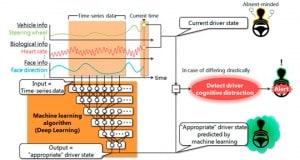
Infograpphic: Mitsubishi Electric Corporation
Mitsubishi Electric Corporation has announced it has developed a technology to detect absent-mindedness and other cognitive distractions in drivers when their vehicles are traveling straight, using a type of machine-learning algorithm known as deep learning. The company believes this is a first in the automotive industry.
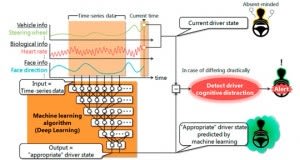
Infograpphic: Mitsubishi Electric Corporation
Although systems exist to detect drivers who are visually distracted due to drowsiness or inattentiveness, the detection of cognitive distractions has been difficult because symptoms sometimes appear in a driver’s behavior or biological patterns, rather than in their face or eye movements. Mitsubishi Electric said its new technology uses a machine-learning algorithm to analyze time-series data, including information about the vehicle (steering, etc.) and driver (heart rate, facial orientation, etc.), to detect and warn drivers about potentially dangerous indications.
The machine-learning algorithm uses a combination of data on “normal driving” and time-series data on the actual vehicle and driver to predict appropriate driver actions in real time. The technology detects cognitive distractions if the driver’s actions differ drastically from the algorithm-based prediction of what would be appropriate. If a distraction is detected, the driver is alerted immediately about their potentially dangerous driving, according to the company.
Deep learning enables machines to use both forward- and backward-moving time-series data, which helps to reduce errors in predicting driver actions by 66 percent compared to Mitsubishi Electric’s conventional algorithm, a so-called three-layer neural network, according to the company.
The technology is currently being displayed at the 44th Tokyo Motor Show 2015 until November 8.
Technologies for detecting cognitively and visually distracted driving are expected to be installed in driver sensing units sold commercially from around 2019 or beyond, according to the company.
More Global Fleet

GeoFencing Adds to Your Truck Security Arsenal
Geofencing is a familiar fleet tool today, but its early adoption marked a major shift in vehicle tracking, route monitoring, and the debate over employee privacy.
Read More →
Holman Takes Full Ownership of ARIZA in Mexico
Holman is bringing its Mexican fleet management operation fully under its own brand after more than 30 years as a joint venture. The change gives multinational fleet customers a single Holman operation across the U.S., Canada, and Mexico.
Read More →
5 Tire Maintenance Tips to Help Prevent Work Truck Downtime
Regular tire checks can do more than extend tread life. These five maintenance practices can help work truck fleets catch problems early, reduce costs, and prevent downtime.
Read More →

Proven Ways to Reduce Work Truck Downtime
The age-old problem of downtime will always be a reality, but with new strategies at hand, fleets have more ways to keep trucks on the road longer.
Read More →


Cameras, Safety and Insurance: From Reactive Claims to Real-Time Prevention (Part 2 of 2)
Part Two: Commercial auto remains one of the most challenging and costly lines of coverage for fleet operators and insurers alike. Continue learning more about how to effectively address these issues from Onur Aksan, Enterprise Business Development Executive, Geotab
Read More →
Cameras, Safety and Insurance: From Reactive Claims to Real-time Prevention
Commercial auto remains one of the most challenging and costly lines of coverage for fleet operators and insurers alike. Learn more about how to effectively address these issues from Onur Aksan, Enterprise Business Development Executive, Geotab.
Read More →
Fleet Costs Are Rising: Here’s How Leaders Are Responding
Fleet leaders are under pressure to reduce costs, adapt to economic uncertainty, and make smarter decisions. See how peers across North America are responding with real data, proven strategies, and forward-looking insights. Download the 2026 Market Pulse Report to benchmark your strategy and uncover where you can gain an edge.
Read More →
Enterprise Fleet Management Surpasses 900,000 Vehicles in U.S. & Canada
Enterprise Mobility connects with mobility solutions around the globe
Read More →