




Mitsubishi Details 2014 Outlander Features and Fuel Economy
Mitsubishi provided details on its new seven-passenger 2014-MY Outlander compact crossover. The automaker estimates the Outlander will get 31 mpg highway on the ES and SE front-wheel-drive models.
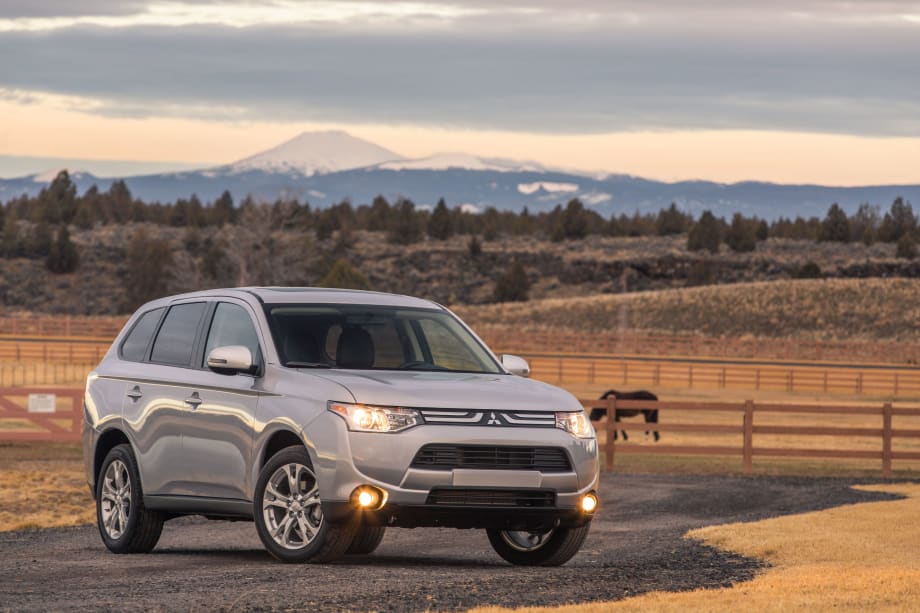
The 2014 Mitsubishi Outlander SE grade. Photo courtesy Mitsubishi.
The 2014 Mitsubishi Outlander SE grade. Photo courtesy Mitsubishi.
Mitsubishi provided details on its new seven-passenger 2014-MY Outlander compact crossover. The automaker estimates the Outlander will get 31 mpg highway on the ES and SE front-wheel-drive models. Models include ES, SE, and GT, with GT being at the top end.
New features on the 2014-MY Outlander include Mitsubishi’s Super All-Wheel Control (S-AWC) all-wheel-drive system on the mid-grade SE model rather than only on the top-end GT model. The crossover has a new exterior design that is 7% more aerodynamic and 200 lbs. lighter, according to Mitsubishi than the previous model. The vehicle also has a new interior HVAC system that uses less energy and a lighter weight S-AWC system.
The vehicle comes in six colors: Cool Silver Metallic, Cosmic Blue Mica, Mercury Gray Metallic, Copper Metallic, Diamond White Pearl or Labrador Black Mica.
Under the hood, the 2.4L four-cylinder engine comes with the latest version of Mitsubishi’s Innovative Valve Timing Electronic Control System (MIVEC) with continuously-variable valve lift timing technology. The engine can produce 166 hp at 6,600 rpm and 162 lb.-ft. of torque at 4,200 rpm. All 2014 Outlander models meet LEV II – ULEV emissions standards, according to the company.
This engine is paired with a continuously variable transmission (CVT) and a new feature called Acceleration Control, which Mitsubishi said is designed to provide better throttle response during early acceleration and postpones upshifting to later in the rev range.
A new ECO-mode setting, which the driver can activate, is standard on all 2014-MY Outlander models. The new ECO mode allows the vehicle to operate as a 2WD vehicle until sensors reactivate the 4WD mode when necessary.
The 2014-MY GT edition of the Outlander gets a 3.0L V-6 MIVEC engine that can produce 224 hp at 6,250 rpm and 215 lb.-ft. of torque at 3,750 rpm. Mitsubishi matched this engine with a six-speed automatic transmission.
For safety, Mitsubishi offers the following on the SE and GT models: Adaptive Cruise Control, a radar-based system that measures the distance between the Outlander and a vehicle in front of it and allows the drive to set one of three different following distances; Forward Collision Mitigation, which uses radar to warn the driver and apply brakes if it detects a potential collision and the driver doesn’t respond; and Lane Departure Warning, which is a camera-based system that warns the driver if the vehicle starts to drift out of a lane.
Other standard safety features include seven airbags; a brake pedal recession protection structure, which is designed to protect the driver in case of a frontal crash; a tire pressure monitoring system; active stability control; traction logic control; hill start assist; anti-lock brakes; and a new “ultra-rigid” chassis.
In terms of options, the mid-grade SE model features a six-inch touch-screen display audio system; rearview camera; SiriusXM satellite radio; Digital HD Radio; fog lamps; 18-inch alloy wheels, dual-zone automatic climate control; heated front seats; a FAST-key passive entry system with push-button engine ignition on/off switch; and Mitsubishi's FUSE Handsfree Link system with USB that allows voice activation of iPod and cell phone via voice commands. The GT level features the 3.0L V-6 as noted earlier, S-AWC, wide-beam HID headlights, and wood-grain interior trim.
Other features available on the SE and GT models include a Rockford-Fosgate sound system, a navigation system with a 7-inch touchscreen; and a remote power tailgate that can be activated from the driver’s seat or keyfob.
More Operations
Here's When You Should Make an Exception to Fleet Policy
Fleet policies are designed to create consistency, but not every driver or situation fits neatly within standard rules.
Read More →
AI-Native or AI-Acquired: What Should Fleet Managers Look for in an AI Platform?
Six questions can help fleet managers look beyond AI marketing claims to evaluate integration, data access, and real-world operational performance.
Read More →
A buyer's guide to fleet management software in 2027
Buying fleet management software in 2027 means looking beyond features and price. As fleet operations, technology and expectations evolve, this guide explores what today’s fleet professionals should consider when choosing a system that can deliver value now and adapt to what comes next.
Read More →

What Will Shape the Next Era of Fleet Management?
EVs, AI, and autonomous vehicles are reshaping fleet management. Discover what’s ahead—and how fleet leaders can prepare for the next era.
Read More →
How Fleets Can Recruit and Train Veterans for Technician Roles
Here's how the technician shortage has affected uptime for fleets, and what to do about it.
Read More →
Avis Budget Group Deploys Neology Toll Management Technology Across Major Brands
Neology’s neoFleet platform will manage toll transactions and toll-authority operations for vehicles across Avis, Budget, Payless, Budget Truck and Zipcar.
Read More →
Fleet Personal-Use Charges Edge Higher in 2026
Nearly eight in 10 surveyed fleets allow personal use of company vehicles, while just over half of respondents report charging employees for the privilege.
Read More →
The Future of Fleet + What’s Changing Right Now | AF News Recap
Could developments overseas offer a preview of what’s coming for U.S. fleets? This week, we’re looking at the future of AI, autonomy, and electrification, plus Ford Pro’s new certified pre-owned program, smarter vehicle offboarding, and a new way for fleets to manage toll expenses.
Read More →
How to Handle Vehicle Offboarding
What do fleet managers need to do when a driver leaves?
Read More →
Fleet Manager’s Ultimate Playbook: Navigating the New Standard in OEM Connectivity
Rising operating costs, driver safety concerns, and unplanned downtime are putting unprecedented pressure on modern fleets. Discover how fleet managers use embedded OEM connectivity and real-time vehicle data to cut TCO, prevent downtime, and protect drivers without aftermarket telematics hardware.
Read More →