




Related: TuSimple's New Autonomous Freight Network Lays Groundwork for Self-Driving Trucks
MIT: Widespread Autonomous Driving at Least a Decade Away
MIT research contends that the impact on truck-driving jobs is not expected to be widespread in the short term: “Truck drivers do more than just drive.”
by Staff
July 24, 2020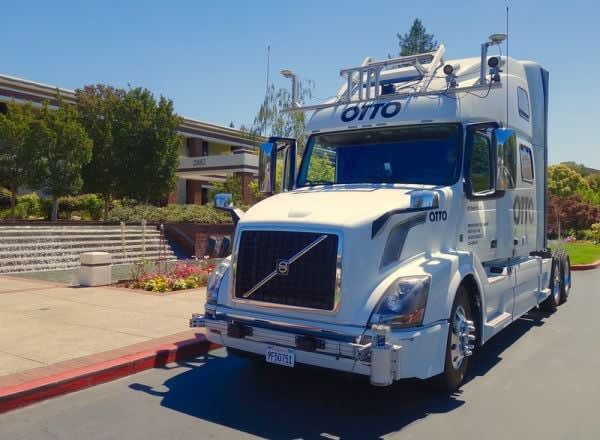
Early testers of autonomy in over-the-road trucking, Otto was acquired by Uber in 2016 — though Uber shuttered the program two years later.
Photo via Steve Jurvetson/flickr.com
3 min to read
Despite substantial recent progress by the industry, new research from MIT contends that fully automated driving systems with no safety driver onboard will take at least a decade to deploy over large areas.
This transition will happen first in regions with favorable weather and infrastructure; winter climates and rural areas will experience still longer transitions.
The brief, “Autonomous Vehicles, Mobility, and Employment Policy: The Roads Ahead,” examines the future of autonomous vehicles. The brief contends that expansion will likely be gradual and will happen region-by-region in specific categories of transportation, resulting in wide variations in availability across the country.
Automated vehicles should be conceived as one element in a mobility mix, and as potential feeders for public transit rather than replacements for it, but unintended consequences such as increased congestion remain risks.
The crucial role of public transit for connecting workers to workplaces will endure: the future of work depends in large part on how people get to work, the brief states.
Trucking Impact
While many believe that increased automation will bring greater impacts to trucking than to passenger carrying vehicles, the impact on truck-driving jobs is not expected to be widespread in the short term.
“Truck drivers do more than just drive, and so human presence within even highly automated trucks would remain valuable for other reasons such as loading, unloading, and maintenance,” MIT writes in synopsizing the brief.
MIT recommends strengthening career pathways for drivers, increasing labor standards and worker protections, advancing public safety, creating good jobs via human-led truck platooning, and promoting safe and electric trucks.
“Policymakers can act now to prepare for and minimize disruptions to the millions of jobs in ground transportation and related industries that may come in the future, while also fostering greater economic opportunity and mitigating environmental impacts by building safe and accessible mobility systems.” MIT writes.
AV operations will benefit from improvements to infrastructure, MIT contends. Investing in local and national infrastructure and forming public-private partnerships will greatly ease integration of automated systems into urban mobility systems.
“Human workers will remain essential to the operation of these systems for the foreseeable future, in roles that are both old and new,” says John Leonard, task force member and MIT Professor of Mechanical and Ocean Engineering and coauthor of the study. “Ensuring a place for human workers in the automated mobility systems of the future is a key challenge for technologists and policy makers as we seek to improve mobility and safety, and thereby opportunity, for all.”
The research is part of the MIT Task Force on the Work of the Future, coauthored by Leonard, David Mindell, cochair of the MIT Task Force, founder/CEO of Humatics, and Erik Stayton, an MIT doctoral candidate in History, Anthropology, and Science, Technology, and Society.
The brief is part of a series of subject-specific research projects by MIT faculty that will help frame national discussion and policies about work, technology, and how we can create greater shared prosperity in the country.
More Fleet Forward

Fleet Forward Conference Introduces One-Day Passes for 2026
New one-day registration gives fleet professionals the flexibility to attend Tuesday, Wednesday, or Thursday, with passes available for $199 through Sept. 18.
Read More →
Vibe Coding: When Fleet Managers Become Software Builders
Five fleet professionals — none with programming skills — discuss how they’re using AI to build fleet solutions in-house and in a fraction of the time.
Read More →
Fleet Forward Conference Tackles Fleet Industry’s Growing Leadership Gap
This session will examine succession planning, knowledge transfer, and the skills the next generation of fleet leaders will need as veteran professionals leave the industry.
Read More →
2026 Fleet Manager of the Year Finalists Announced
Who are the 2026 Fleet Manager of the Year finalists?
Read More →
John Rossant to Deliver Opening Keynote at 2026 Fleet Forward Conference
The CoMotion founder will draw on developments across Europe, China, the Middle East, and other international markets to identify trends that could influence how U.S. fleets plan for the coming decade.
Read More →
How to Build Custom Fleet Tools With AI and Vibe Coding [Webinar]
A new Automotive Fleet webinar explores how fleet managers are using AI and vibe coding to automate routine work and create simple operational tools without traditional programming skills.
Read More →
Is Fleet Ready for Its New Disruptors?
Three emerging leaders from a corporate fleet, public fleet, and the automotive supply chain will bring new ideas and a willingness to challenge industry norms to the Fleet Forward Conference stage.
Read More →
NAFA Announces 2026 Fleet Safety Symposium Education Program
Register for NAFA’s Fleet Safety Symposium and save $200 on your Fleet Forward Conference registration.
Read More →
Fleet Managers Take the Lead in Hands-On AI Workshop at FFC
The fleet manager-led session will show how to use “vibe coding” to build practical fleet tools without a traditional programming background.
Read More →
NETS Crash-Cost Data and CoolSys’ 80% Loss Reduction Take Center Stage at FFC
NETS will present findings from its latest Cost of Crashes research, then CoolSys safety leader and author Shawn Martinez will explain how the company built a safer driving culture across 3,500 employees.
Read More →