




Mercedes-Benz Strives for ‘Accident-Free Driving’ by 2050
One automaker with a history of safety innovation has set an ambitious goal to continue on that path and eliminate collisions in its vehicles.

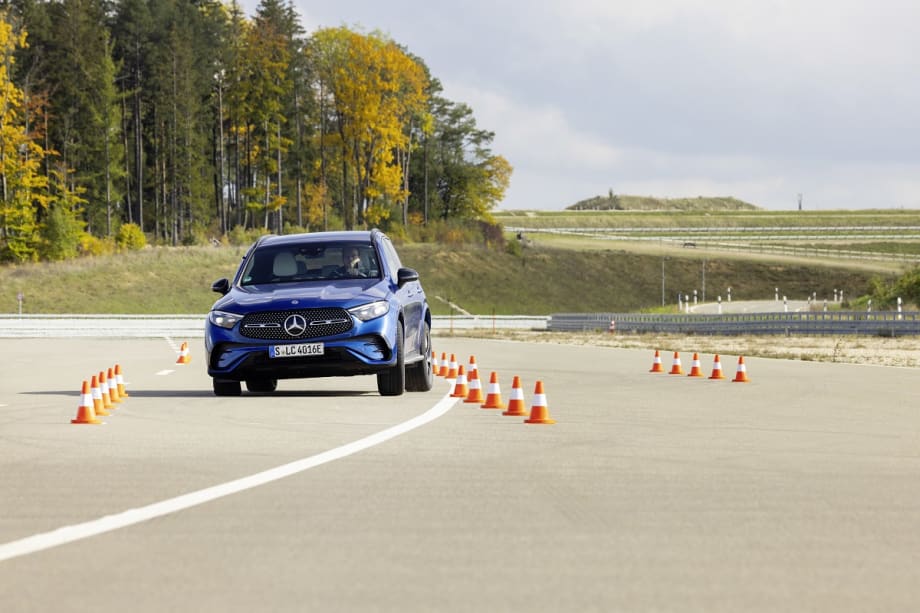
Automaker Mercedes-Benz remains focused on improving safety for traditional and electric vehicles.
Photo: Mercedes-Benz
While several safety advocates have set the goal of zero traffic fatalities by 2050, Mercedes-Benz is going above and beyond this by committing itself to a “vision of accident-free driving” by 2050, reports the automaker. In other words: no more accidents involving a Mercedes vehicle.
Vehicle safety has always been at the core of the Mercedes-Benz brand and the manufacturer wants to continue to expand this claim in the future. The following describes some of the design/engineering aspects of safety that this major auto manufacturer deems most important now and in the future.
Today, drivers of Mercedes-Benz models are supported by more than 40 active driver assistance systems. These range from adaptive cruise control, steering assist, lane keeping assist, blind spot assist, active emergency stop, and brake assist, for example. Driver assistance systems will remain a core safety feature moving forward in the future.
In recent times, Mercedes-Benz assistance systems are becoming increasingly closely interlinked, networked, and integrated — and brakes often play a role here. For example, Active Brake Assist, today can detect other motor vehicles, bicycles, pedestrians, and more. Brake technology from Mercedes-Benz is an integral part of the safety-related assistance systems and will likely continue to evolve.
Moreover, the automaker introduced a disruptive innovation some 20 years ago. Its PRE-SAFE system marked the first time that active elements helped support passive protective measures to improve outcomes in the event of an accident. Examples include automatic closing of the windows and the sunroof in critical driving situations before an imminent collision, preventive tensioning of the front seat belts with the first reversible belt tensioners or adjusting the front passenger seat to a more upright position.
More recent innovations of PRE-SAFE continue to this day. For example, the technology can now lift the driver or front passenger inwards out of the danger zone just before a side impact. And, there is even a feature designed to protect against hearing loss during a collision.
Mercedes-Benz’s safety standards do not differentiate between different drive systems, notes the automaker. Whether combustion, hybrid, or electric drives — in all cases, the development team ensures that appropriate technology ensures a comparable degree of protection.
When it comes to electric vehicles, the company has developed a unique protection system. To prevent the risk of electric shock and high-energy short circuits, the automaker instituted a multi-stage high-voltage (HV) safety concept that comprises seven essential elements. In addition to the battery, HV components comprise all components with a voltage in excess of 60 volts. If a vehicle’s sensors detect a dangerous collision, the pyrofuse safety system automatically powers down the HV system.
This protection concept provides a high level of safety while driving and charging, as well as during and after a crash.
More Safety

What’s Next for Fleet? Safety, AI & Industry Recognition | AF News Recap
Could your company's culture be encouraging distracted driving? This week, we're exploring how workplace expectations affect driver safety, what AI, EVs, and autonomous vehicles could mean for the future of fleet management, and how fleet professionals can strengthen their award nominations.
Read More →
Does Your Fleet's Culture Encourage Distracted Driving?
What happens when the people responsible for enforcing safety rules are the ones setting the wrong example? The answer may reveal why some of the biggest risks to fleet drivers have little to do with what's written in the employee handbook.
Read More →
Fleet Manager’s Ultimate Playbook: Navigating the New Standard in OEM Connectivity
Rising operating costs, driver safety concerns, and unplanned downtime are putting unprecedented pressure on modern fleets. Discover how fleet managers use embedded OEM connectivity and real-time vehicle data to cut TCO, prevent downtime, and protect drivers without aftermarket telematics hardware.
Read More →
From Driver Well-Being to EV Charging | AF News Recap
Mental health belongs in the fleet safety conversation. This week, we’re looking at five ways fleets can support employee well-being before a crisis, plus Holman’s expansion in Mexico, new one-day Fleet Forward passes, and why EV charging demand is outpacing infrastructure growth.
Read More →
Nexar-Nauto Merger Aims to Give Fleets Better Safety Intelligence Through Larger Driving Dataset
Stefan Heck tells Automotive Fleet that combining more than 10 billion miles of driving history with Nexar's AI models will give fleets deeper insights into driver risk and roadway conditions than either company could provide independently.
Read More →
Don't Wait for a Crisis: 5 Ways to Build Mental Health Into Your Fleet Safety Program
For Suicide Prevention Month, fleet and safety leaders have an opportunity to put mental health where it belongs: at the center of workplace safety.
Read More →
How Camera Data Can Strengthen a Fleet’s Insurance Renewal
Insights from a commercial insurance carrier and a broker show how fleets can turn video telematic data, driver coaching, and improved claims results into a stronger case at insurance renewal.
Read More →
The Safest Fleets Aren’t the Ones with the Most Technology
You’ve made the telematics investment. Here’s how to capture the other half of its value and build the safest fleet on the road.
Read More →
Hidden in Plain Sight: Fleet Compliance Risks
Fleet compliance isn't just about having policies — it's about consistently enforcing them. This practical guide reveals six hidden compliance risks common in public sector and shared fleet operations and outlines proven strategies to improve visibility, accountability, and audit readiness
Read More →
NETS Sets 2026 Fleet Safety Benchmark Conference for Indianapolis
The Sept. 15–17 program will feature fleet benchmarking data, case studies, emerging technologies, and implementation strategies while running alongside the NSC Safety Congress & Expo.
Read More →