




Jaguar Land Rover Studying Driver Monitoring Tech
Jaguar Land Rover has revealed its Sixth Sense driver-monitoring research technology aimed at reducing accidents caused by stressed or distracted drivers.
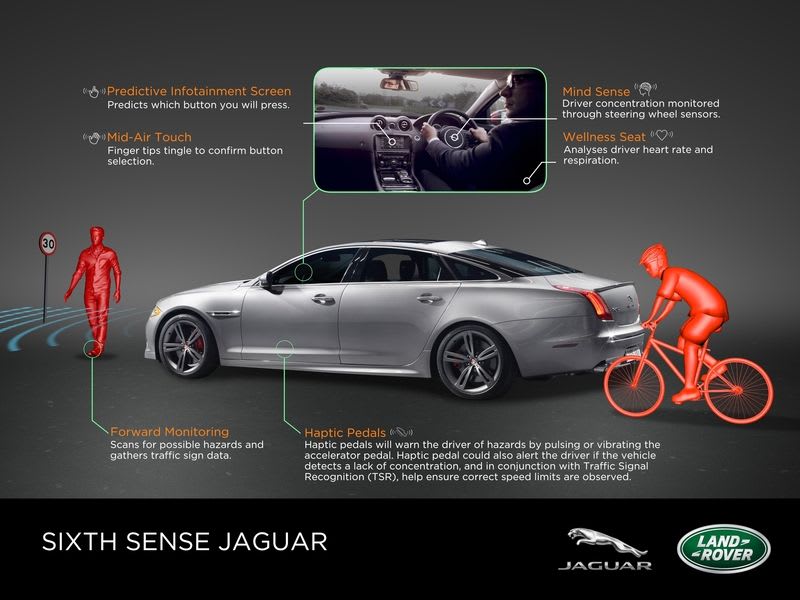
Photo illustration courtesy of Jaguar Land Rover.
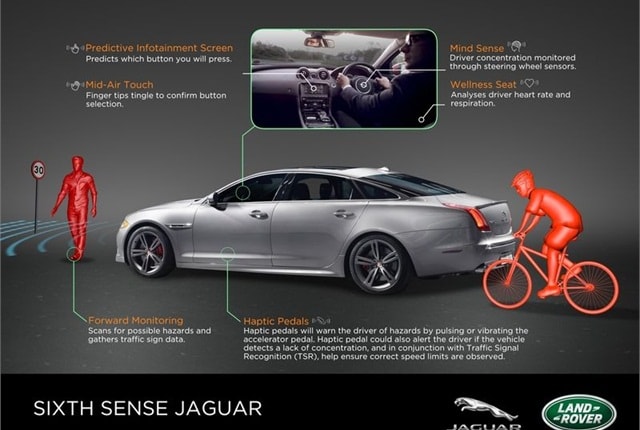
Photo illustration courtesy of Jaguar Land Rover.
Jaguar Land Rover has revealed its Sixth Sense driver-monitoring research technology aimed at reducing accidents caused by stressed or distracted drivers.
The advanced technology pulls from sports, medicine and aerospace to monitor the driver’s heart rate, respiration and brain activity. It can detect levels of stress, fatigue and concentration. The United Kingdom-based research team is also studying how to maximize the amount of time a driver's eyes are on the road and how to effectively communicate with the driver through pulses and vibrations through the accelerator pedal.
“One key piece of new research is to see how we could measure brainwaves to monitor if the driver is alert and concentrating on driving,” said Wolfgang Epple, Jaguar Land Rover's director of research and technology.
The goal of the Mind Sense research is to have an on-board computer that indicates a driver who is daydreaming or falling asleep by continually monitoring the dominant brainwave of a driver. The technology would monitor the four or more individual brainwaves at different frequencies that are present in the human brain.
“If brain activity indicates a daydream or poor concentration, then the steering wheel or pedals could vibrate to raise the driver’s awareness and re-engage them with driving,” said Epple.
Jaguar Land Rover is investigating a method used by NASA that detects brainwaves through hand sensors embedded in the steering wheel. Jaguar Land Rover is currently conducted user trials to better understand the different brainwaves that the hand sensors are able to identify, and will verify their results with neuroscientists.
Jaguar Land Rover is assessing how to monitor the wellness of a driver using a medical-grade sensor to be embedded in the driver’s seat and will detect vibrations from a driver’s heart beat and breathing.
By monitoring the driver’s health, the sensors may be able to detect the onset of illness or additional stress. The car could help reduce stress by changing the climate or adjusting the audio settings.
Jaguar Land Rover is also working on technology to decrease distraction by reducing the amount of time the driver looks at the infotainment screen.
“Our Predictive Infotainment Screen prototype uses cameras embedded in the car to track the driver’s hand movements and this enables the system to predict which button the driver intends to press” Epple said. “This allows successful button selection to take place in mid-air, which means users wouldn’t have to touch the screen itself.”
This increased the speed of button selection by 22 percent, according to the user trials.
Providing the driver with a sensation, also known as haptic feedback, could be used to communicate with the driver through the gas pedal using an actuator that allows for vibrations or pulses on the driver’s foot.
The technology also uses a torque motor to create resistance in the pedal. This has the potential to notifying the driver that they are exceeding the speed limit or prevent them from bumping the car in front if traffic is bumper-to-bumper.
The haptic pedals are geared toward providing the driver with non-visual warnings about possible accidents.
More Global Fleet
Holman Takes Full Ownership of ARIZA in Mexico
Holman is bringing its Mexican fleet management operation fully under its own brand after more than 30 years as a joint venture. The change gives multinational fleet customers a single Holman operation across the U.S., Canada, and Mexico.
Read More →
Proven Ways to Reduce Work Truck Downtime
The age-old problem of downtime will always be a reality, but with new strategies at hand, fleets have more ways to keep trucks on the road longer.
Read More →
The Top 300 Commercial Fleets
The Top 300 Commercial Fleets: See the List
Read More →

Cameras, Safety and Insurance: From Reactive Claims to Real-Time Prevention (Part 2 of 2)
Part Two: Commercial auto remains one of the most challenging and costly lines of coverage for fleet operators and insurers alike. Continue learning more about how to effectively address these issues from Onur Aksan, Enterprise Business Development Executive, Geotab
Read More →
Cameras, Safety and Insurance: From Reactive Claims to Real-time Prevention
Commercial auto remains one of the most challenging and costly lines of coverage for fleet operators and insurers alike. Learn more about how to effectively address these issues from Onur Aksan, Enterprise Business Development Executive, Geotab.
Read More →
Fleet Costs Are Rising: Here’s How Leaders Are Responding
Fleet leaders are under pressure to reduce costs, adapt to economic uncertainty, and make smarter decisions. See how peers across North America are responding with real data, proven strategies, and forward-looking insights. Download the 2026 Market Pulse Report to benchmark your strategy and uncover where you can gain an edge.
Read More →
Enterprise Fleet Management Surpasses 900,000 Vehicles in U.S. & Canada
Enterprise Mobility connects with mobility solutions around the globe
Read More →
Automotive Fleet's Guide to Fleet Electrification
Unlock the secrets to a successful transition to electric fleets with Automotive Fleet's comprehensive Fleet Electrification Guide!
Read More →
Sumitomo Rubber Industries to Acquire Viaduct
Viaduct will join Sumitomo as an independent subsidiary. Partnership strengthens global reach and accelerates AI-driven innovation for fleets and manufacturing.
Read More →