




Few car seats and head restraints offer adequate protection for passengers in rear-end crashes, according to a new insurance industry study that could pressure automakers to improve seat and headrest design, according to the Detroit News newspaper. Few car seats and head restraints offer adequate protection for passengers in rear-end crashes, according to a new insurance industry study that could pressure automakers to improve seat and headrest design, according to the Detroit News. The Insurance Institute for Highway Safety, an independent research group funded by insurance companies, said only eight of 73 seats it subjected to a new crash test provided good protection against neck injuries such as whiplash. Another 16 were deemed "acceptable." Another 24 seats failed a more basic test by not providing head restraints high enough to reach the heads of tall passengers. For the first time, the group used crash dummies to measure the effectiveness of car seats to prevent injuries in a rear-impact crash at low to moderate speeds. The new study will join insurance institute ratings for passenger protection in frontal and side crashes. The institute publishes the ratings on its Web site, www.iihs.org/, and through a newsletter. The ratings are used in shopping guides targeted at consumers in the market for a new car or truck. In response to poor scores in previous safety studies by the insurance industry, automakers have rushed to improve car and truck designs in response to poor scores, but they reacted cautiously to the new rankings. According to the Detroit News, Eron Shosteck, a spokesman for the Alliance of Automobile Manufacturers in Washington, said automakers will study the test results and evaluate whether they provide useful information to consumers. While neck injuries caused by poor seat designs are not generally life threatening, they are painful. Symptoms including headache, dizziness, and tingling in the arms that can last from a few hours to several years. Whiplash injuries are common in rear-end crashes. The insurance industry estimates there are more than 250,000 neck injury cases a year. Treating the injuries costs the insurance industry $7 billion a year. General Motors said it has been designing new seating systems, including a self-aligning head restraint, a device that moves the head restraint up and forward dynamically during a rear crash. In the new tests, the institute identified positioning and seat stiffness as two keys to protecting a passenger in a rear-impact crash. The seating system must ensure the passenger will contact the head restraint at the right angle. The restraint has to be high enough and close enough that the head doesn't snap back – the classic cause of whiplash injuries. Similarly, the seat itself has to be stiff enough so the back does not collapse, but not so stiff that it injures a person. The best seats act like catchers' mitts, absorbing the blow of the body flying back during the crash. Of the cars tested, Volvo and Saab models received the highest marks from the insurance institute, with five of their models rated as "good." Jaguar's S-Type sedan and the Subaru Impreza also achieved the highest rating. The new Volkswagen Beetle equipped with active head restraints and lumbar support also was rated good, while models with other types of seats were rated acceptable. At the other end of the scale were 24 models that could not pass the group's basic test. The models had head restraints that were too low or too far away to prevent neck injury. The institute did not subject the cars to the new, more rigorous test but automatically rated them "poor." Susan Ferguson, senior vice president for research at the insurance institute, said adjustable head restraints pose another problem. Many consumers aren't aware of how important the head restraints can be in a crash and do not bother to adjust the restraints. There is a common misperception that the restraints are really just "headrests." The institute recommends an adjustable restraint be positioned at least level with the top of the ears, about 3.5 inches below the top of the head. For the restraint to work properly, the distance between the back of the head and the restraint should be as small as possible, and no more than 4 inches. The federal law that dictates a minimum performance level for head restraints has not been updated since 1969. A proposal to toughen the requirements has been pending since 2001. In the meantime, automakers have been improving seats and head restraints on their own. When the insurance institute began to measure head restraints for height and distance to the back of the head in 1995, only 3 percent were rated good and 82 percent poor. By 2003, 45 percent got the good rating, and the number deemed poor had dropped to 10 percent, reported the Detroit News. The new insurance institute test is designed to simulate what would happen if a car were struck from behind by another vehicle going 20 mph. Institute engineers first remove the seats from a vehicle and mount them on a sled. For the first time, crash-test dummies designed specifically for rear-impact tests were used. The sled, mounted on fixed rails, is moved with forces similar to a real-world crash, with a maximum acceleration of 10 Gs, or 10 times the force of gravity. The test lasts 91 milliseconds.
Insurance Institute Reports that Most Car Seats are Unsafe in Rear-End Collisions
Few car seats and head restraints offer adequate protection for passengers in rear-end crashes, according to a new insurance industry study that could pressure automakers to improve seat and headrest design, according to the Detroit News newspaper.
More Operations

Lytx Introduces New AI Fleet Technologies at Protect 2026
The company introduced new AI-driven fleet safety and operations technologies during its annual user conference.
Read More →
Fleet Costs Are Rising: Here’s How Leaders Are Responding
Fleet leaders are under pressure to reduce costs, adapt to economic uncertainty, and make smarter decisions. See how peers across North America are responding with real data, proven strategies, and forward-looking insights. Download the 2026 Market Pulse Report to benchmark your strategy and uncover where you can gain an edge.
Read More →
From Waffle House to AI: Fleet Trends You Need to Know
In this AF news recap, host Faith Howell covers how Waffle House stepped up during disaster response and new AI tech on the market.
Read More →
Fleet Operations in the Age of AI: Navigating Ethical and Legal Challenges
AI is no longer a future concept for fleets—it’s already embedded in the tools, data, and decisions that operators rely on every day. In this episode of the Fleet Forward Podcast, recorded live at Fleet Forward, industry leaders take the conversation beyond hype to examine what responsible AI adoption really looks like in fleet operations.
Read More →
Factory Installed vs. Aftermarket: Choosing the Right Telematics Path & Managing the Data
As fleets rethink how they capture, manage, and act on vehicle data, telematics is at a major inflection point. In this episode of the Fleet Forward Podcast, we dive deep into one of the most pressing questions facing fleet leaders today: Should you rely on OEM factory-installed connectivity, aftermarket devices, or a hybrid of both?
Read More →
What Real-Time Data Reveals About EV Cost, Performance, and Scalability
Experts from telematics analytics, fleet-as-a-service operations, and national EV benchmarking share how real-time data is reshaping fleet strategy—dispelling assumptions, validating best practices, and exposing costly missteps.
Read More →
Planning Through Policy Shifts: What Fleets Must Track in 2026
A powerhouse panel featuring experts from the American Automotive Leasing Association, CalSTART, and municipal fleet leadership dives into the realities of navigating shifting emissions rules, regulatory waivers, federal agency actions, the future of the EPA’s endangerment finding, and the push for unified standards. They also examine the impacts of tariffs, autonomous vehicle policy, battery innovation, and the accelerating global EV market.
Read More →
Managing Market Turbulence with Strategic Fleet Insights
This episode kicks off with a deep dive into the technologies and market forces reshaping today’s fleet landscape. Host Chris Brown is joined by Laolu Adeola (Leke Services), Tyson Jomini (J.D. Power), and Richard Hall (ZappiRide) to break down real-world data, shifting incentives, and practical strategies fleet leaders can use right now.
Read More →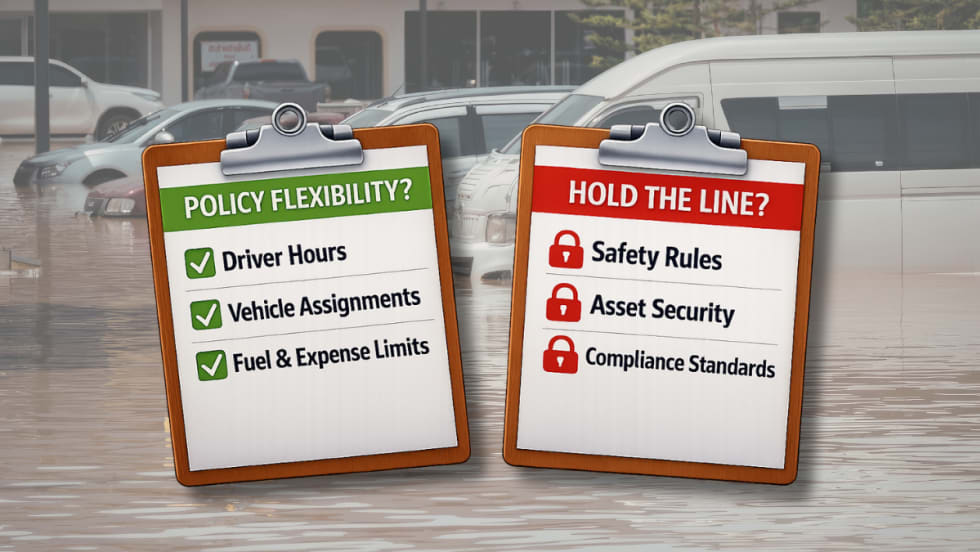
Adapting Fleet Policy When Disasters Strike
In the middle of natural disasters fleet managers must shift priorities to protect people and assets. What policy items should be loosened, and when should the line be held?
Read More →
EV Reality Check: How Fleets Are Managing Policy Shifts, Safety, and Scaling Challenges
In this episode, fleet leaders from municipal, university, and private-sector organizations share a candid EV reality check. From infrastructure setbacks and policy whiplash to grant funding, total cost of ownership, and charging resiliency, this conversation dives into what it actually takes to scale electrification in the real world.
Read More →