




DEARBORN, MI – In 1999, Ford Motor Company decided to further improve the compatibility of its larger vehicles in crashes with cars. The move has helped to significantly reduce fatalities in such collisions, according to a recent study by the Insurance Institute for Highway Safety (IIHS). The study supports Ford’s own findings that the number of passenger-car driver deaths in both front- and side-impact collisions between cars and SUVs or pickup trucks was substantially reduced when SUVs or pickup trucks were either lowered or equipped with special impact-absorbing bars below the front bumpers. The company’s patented BlockerBeam underride protection system, introduced on Excursion, is fashioned with less than 50 lbs. of steel. It is used on vehicles in which frame rails cannot be sufficiently lowered due to ground clearance and approach angle requirements for off-road use. Currently on the Ford F-250 and F-350 Super Duty models, the system allows a larger vehicle and a car to share energy during a crash, instead of the smaller car absorbing the bulk of the crash energy. The Ford BlockerBeam essentially is a hollow cross member attached to the frame approximately 2.5 inches below car bumpers and 6.5 inches behind the conventional front bumper. During a frontal collision with a car, the structure is designed to make contact with the frame rails of a car in an effort to help prevent the car from sliding beneath a higher-riding vehicle. To help manage crash energy from rear collisions, vehicles equipped with the BlockerBeam are fitted with Ford’s largest trailer hitch — standard on all models. The hitch spans more than three feet across the vehicle’s rear and attaches to the frame. The 3.5-square-inch hitch is designed to prevent lower-riding cars from sliding underneath the back of the F-250 and F350 Super Duty trucks. It also reduces the amount of intrusion into the passenger compartment of the car. The Volvo XC90 and Land Rover Range Rover and LR3 also are equipped with impact-absorbing bars. Ford has opted to lower the frame rails on other SUVs and pickups in order to provide better compatibility with cars. Those vehicles include the Ford Expedition, Explorer, Freestar, and F-150, Mercury Mountaineer and Monterey, Lincoln Navigator and Mark LT, and the Volvo XC70.
IIHS Study Affirms Ford's Vehicle Changes Reduce Fatalities
DEARBORN, MI – In 1999, Ford Motor Company decided to further improve the compatibility of its larger vehicles in crashes with cars. The move has helped to significantly reduce fatalities in such collisions, according to a recent study by the Insurance Institute for Highway Safety (IIHS).
More Operations
Lytx Introduces New AI Fleet Technologies at Protect 2026
The company introduced new AI-driven fleet safety and operations technologies during its annual user conference.
Read More →
Fleet Costs Are Rising: Here’s How Leaders Are Responding
Fleet leaders are under pressure to reduce costs, adapt to economic uncertainty, and make smarter decisions. See how peers across North America are responding with real data, proven strategies, and forward-looking insights. Download the 2026 Market Pulse Report to benchmark your strategy and uncover where you can gain an edge.
Read More →
From Waffle House to AI: Fleet Trends You Need to Know
In this AF news recap, host Faith Howell covers how Waffle House stepped up during disaster response and new AI tech on the market.
Read More →
Fleet Operations in the Age of AI: Navigating Ethical and Legal Challenges
AI is no longer a future concept for fleets—it’s already embedded in the tools, data, and decisions that operators rely on every day. In this episode of the Fleet Forward Podcast, recorded live at Fleet Forward, industry leaders take the conversation beyond hype to examine what responsible AI adoption really looks like in fleet operations.
Read More →
Factory Installed vs. Aftermarket: Choosing the Right Telematics Path & Managing the Data
As fleets rethink how they capture, manage, and act on vehicle data, telematics is at a major inflection point. In this episode of the Fleet Forward Podcast, we dive deep into one of the most pressing questions facing fleet leaders today: Should you rely on OEM factory-installed connectivity, aftermarket devices, or a hybrid of both?
Read More →
What Real-Time Data Reveals About EV Cost, Performance, and Scalability
Experts from telematics analytics, fleet-as-a-service operations, and national EV benchmarking share how real-time data is reshaping fleet strategy—dispelling assumptions, validating best practices, and exposing costly missteps.
Read More →
Planning Through Policy Shifts: What Fleets Must Track in 2026
A powerhouse panel featuring experts from the American Automotive Leasing Association, CalSTART, and municipal fleet leadership dives into the realities of navigating shifting emissions rules, regulatory waivers, federal agency actions, the future of the EPA’s endangerment finding, and the push for unified standards. They also examine the impacts of tariffs, autonomous vehicle policy, battery innovation, and the accelerating global EV market.
Read More →
Managing Market Turbulence with Strategic Fleet Insights
This episode kicks off with a deep dive into the technologies and market forces reshaping today’s fleet landscape. Host Chris Brown is joined by Laolu Adeola (Leke Services), Tyson Jomini (J.D. Power), and Richard Hall (ZappiRide) to break down real-world data, shifting incentives, and practical strategies fleet leaders can use right now.
Read More →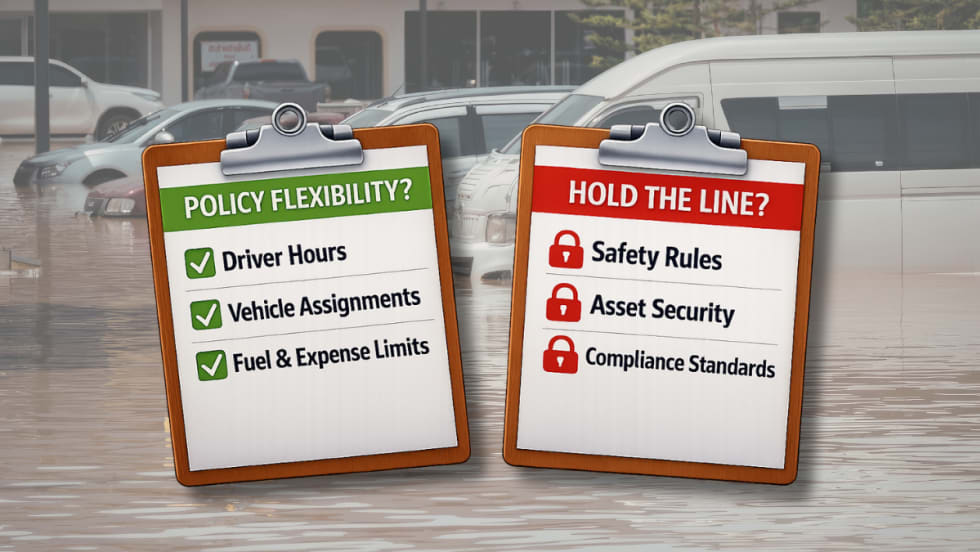
Adapting Fleet Policy When Disasters Strike
In the middle of natural disasters fleet managers must shift priorities to protect people and assets. What policy items should be loosened, and when should the line be held?
Read More →
EV Reality Check: How Fleets Are Managing Policy Shifts, Safety, and Scaling Challenges
In this episode, fleet leaders from municipal, university, and private-sector organizations share a candid EV reality check. From infrastructure setbacks and policy whiplash to grant funding, total cost of ownership, and charging resiliency, this conversation dives into what it actually takes to scale electrification in the real world.
Read More →