




Further Reading: OVO Energy Orders 1,000 Electric Vans For Its UK Fleet
How the Pinnacle Group Manages Fleet Electrification
Pinnacle Group Procurement Manager Sarah Russell reveals how the move to electrification is going and why they recently purchased 33 Nissan vans.
by Ralph Morton, London
January 26, 20224 min to read
[EMPTY CREDIT]
It all started in January 2021 when stakeholders across Pinnacle Group set up what was to be known as "Project Electrify." It was the start point for the electrification process of the company's 500-van fleet.
Although headquartered in central London, Pinnacle Group—a UK facilities and multi-tenure housing management company working in both the public and private sectors—operates nationally at more than 100 locations, providing a range of integrated services across a variety of community-facing assets, including multi-tenure housing, schools, open spaces, public buildings, and utilities.
Sarah Russell is the company’s group procurement manager and ultimate responsibility for Project Electrify lies at her desk.

[EMPTY CREDIT]
She is supported by the company’s CEO—a huge advocate of decarbonization, according to Russell—and its own ESG (Environmental, Social and Governance) and carbon agendas. She says getting high-level buy-in is critical to fleet electrification.
“There will always be resistance to change. So having high-level sponsorship is critical to making it happen,” explains Russell. Among the stakeholders were the chief financial officer, a crucial supporter of Project Electrify and the data analytics manager.
“Our data analytics manager was vital because he was able to map out which vehicles were best suited for replacement. For example, these would be vans out of lease, those operating in restricted Clean Air Zones (CAZ), and where the mileage was appropriate for electrification. We also looked at the telematics to see which driver routes regularly called into our depots or traveled close by. In that way we could make informed decisions.”
Enter the Nissan eNV200 Electric Vans
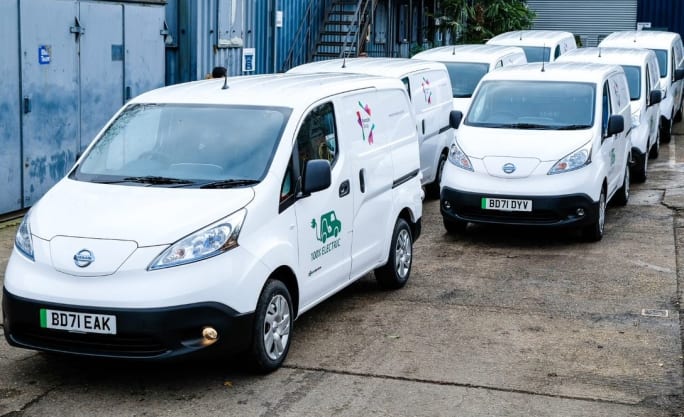
The vans selected for electrification—replaced with Nissan eNV200s—were mostly mobile teams operating contracts within specified areas. They also make use of public chargepoints for charging the battery.
“We’re currently relying on public infrastructure to charge vehicles while we install charging infrastructure across the estate,” explains Russell. “We have now identified 10 of our sites to get charging points into.”
While Russell says the company did not get charge points installed at drivers’ homes, it’s not ruled this out for the future once longer-term data has been analyzed.
“It has been challenging,” she admits. “We have 20 electric vans out and a further 20 coming. You can do all this on paper, but until you get vans out you just don't know exactly what operational issues you will face.
“For example, public charging has been challenging because chargepoints are in use, they are ‘ICEd’ or simply out of use. Then there’s the range. The vans chosen for this initial tranche cover about 100 miles a week, but by the time you have a team of two in the van and all of their kit, it’s difficult to determine exactly what the range will be.
“We’ve also noticed that, with the vehicles operating in London, if they are sitting in traffic for any length of time, the effect on range is detrimental. Now, that could be because of the cold snap we’re currently experiencing, so once we’ve been running them for six months we’ll have a better idea of real operational range, along with all the telematics data we are gathering.
“Everything is such an unknown—even, for example, which charging point to use and how to pay for it since there are so many providers.
“It’s why we have started with a small batch of electric vans so we could learn from experience and then re-invest that into the electrification program rollout.”
Russell says that the drivers have readily accepted the change to electric vans although feedback runs along the lines of “it does feel different.” While there has been no specific driver training, Russell says the business runs an extensive driver engagement program around safe driving, which has factored in the use of electric vans.
Electrifying with Fleet Management Help
Russell says one of the other key contributors to Project Electrify has been the company’s fleet management provider, Fleet Alliance.
“We have a close working relationship with Fleet Alliance, providing us with information on what vehicles were available during the supply chain issues and accessing the initial tranche of 33 electric Nissan vans.
“They also advised us to change our operational profile from three to four years to really capture the carbon savings, because while we would like to save costs, the real focus for us is the carbon reduction. Having said that, over the four-year cycle with the savings on fuel and the lower maintenance of eLCVs, there will be parity with diesel vans in terms of costs, if not a marginal saving.”
Russell's Tip for Fleet Electrification
Apart from the advice to ensure top-level buy-in to fleet electrification, what guidance would Sarah give to fleet managers undertaking decarbonization programs?
“I think it’s to start with small steps. So the key thing for us is to remain operational while electrifying. Using the telematics and data analysis over the initial period, we’ll loop back into the program and see what changes we need to make, including continuous efficiency reviews based on what we are experiencing in the field. That means telematics has to be part of any fleet electrification policy to fully understand the process.”
More Global Fleet

GeoFencing Adds to Your Truck Security Arsenal
Geofencing is a familiar fleet tool today, but its early adoption marked a major shift in vehicle tracking, route monitoring, and the debate over employee privacy.
Read More →
Holman Takes Full Ownership of ARIZA in Mexico
Holman is bringing its Mexican fleet management operation fully under its own brand after more than 30 years as a joint venture. The change gives multinational fleet customers a single Holman operation across the U.S., Canada, and Mexico.
Read More →
5 Tire Maintenance Tips to Help Prevent Work Truck Downtime
Regular tire checks can do more than extend tread life. These five maintenance practices can help work truck fleets catch problems early, reduce costs, and prevent downtime.
Read More →

Proven Ways to Reduce Work Truck Downtime
The age-old problem of downtime will always be a reality, but with new strategies at hand, fleets have more ways to keep trucks on the road longer.
Read More →


Cameras, Safety and Insurance: From Reactive Claims to Real-Time Prevention (Part 2 of 2)
Part Two: Commercial auto remains one of the most challenging and costly lines of coverage for fleet operators and insurers alike. Continue learning more about how to effectively address these issues from Onur Aksan, Enterprise Business Development Executive, Geotab
Read More →
Cameras, Safety and Insurance: From Reactive Claims to Real-time Prevention
Commercial auto remains one of the most challenging and costly lines of coverage for fleet operators and insurers alike. Learn more about how to effectively address these issues from Onur Aksan, Enterprise Business Development Executive, Geotab.
Read More →
Fleet Costs Are Rising: Here’s How Leaders Are Responding
Fleet leaders are under pressure to reduce costs, adapt to economic uncertainty, and make smarter decisions. See how peers across North America are responding with real data, proven strategies, and forward-looking insights. Download the 2026 Market Pulse Report to benchmark your strategy and uncover where you can gain an edge.
Read More →
Enterprise Fleet Management Surpasses 900,000 Vehicles in U.S. & Canada
Enterprise Mobility connects with mobility solutions around the globe
Read More →