




House Committee OKs Bill Aimed at Making Vehi
WASHINGTON, D.C. --- A House committee this week approved a bill requiring the government to address a number of vehicle safety issues posing a threat to children.
WASHINGTON, D.C. --- A House committee this week approved a bill requiring the government to address a number of vehicle safety issues posing a threat to children. The House Energy and Commerce Committee passed the bill to require federal regulators to search for ways to diminish blind spots in large SUVs and pickups, to prevent vehicles from rolling away and to make power windows safer, BusinessWeek reported. Committee Chairman John Dingell (D-Mich.) said the bill would "help protect these young victims by instituting common-sense safety provisions in the design of cars," BusinessWeek reported. A committee in the Senate gave its OK to similar legislation in May. According to estimates, about four children die each week in backovers, strangulation from power windows, or from being left alone in hot cars without enough ventilation. The bill also includes a voluntary agreement that 19 automakers approved in 2006. The agreement calls for brake interlock systems in all new vehicles by September 2010. These systems ensure that the vehicle can shift out of park only when the brake pedal is depressed. An earlier version of this bill mandated the inclusion of backup cameras in new vehicles. But after automakers objected, arguing this would be too expensive, auto industry representatives and legislators reached a compromise. They agreed that visibility problems could be alleviated through the use of additional mirrors, sensors, cameras or other technologies. If the bill passes, the National Highway Traffic Safety Administration would need to issue a final rule within three years of the legislation's enactment. In particular, the NHTSA would need to develop new rules requiring automakers to ensure that windows automatically reverse direction if there's an obstruction in the way. If the agency decided against issuing a final rule, it would need to explain its decision to Congress.
More Safety

From Driver Well-Being to EV Charging | AF News Recap
Mental health belongs in the fleet safety conversation. This week, we’re looking at five ways fleets can support employee well-being before a crisis, plus Holman’s expansion in Mexico, new one-day Fleet Forward passes, and why EV charging demand is outpacing infrastructure growth.
Read More →
Nexar-Nauto Merger Aims to Give Fleets Better Safety Intelligence Through Larger Driving Dataset
Stefan Heck tells Automotive Fleet that combining more than 10 billion miles of driving history with Nexar's AI models will give fleets deeper insights into driver risk and roadway conditions than either company could provide independently.
Read More →
Don't Wait for a Crisis: 5 Ways to Build Mental Health Into Your Fleet Safety Program
For Suicide Prevention Month, fleet and safety leaders have an opportunity to put mental health where it belongs: at the center of workplace safety.
Read More →
How Camera Data Can Strengthen a Fleet’s Insurance Renewal
Insights from a commercial insurance carrier and a broker show how fleets can turn video telematic data, driver coaching, and improved claims results into a stronger case at insurance renewal.
Read More →
The Safest Fleets Aren’t the Ones with the Most Technology
You’ve made the telematics investment. Here’s how to capture the other half of its value and build the safest fleet on the road.
Read More →
Hidden in Plain Sight: Fleet Compliance Risks
Fleet compliance isn't just about having policies — it's about consistently enforcing them. This practical guide reveals six hidden compliance risks common in public sector and shared fleet operations and outlines proven strategies to improve visibility, accountability, and audit readiness
Read More →
NETS Sets 2026 Fleet Safety Benchmark Conference for Indianapolis
The Sept. 15–17 program will feature fleet benchmarking data, case studies, emerging technologies, and implementation strategies while running alongside the NSC Safety Congress & Expo.
Read More →
Off-the-Job Crashes Account for 43% of Employers’ $61.7 Billion Crash Burden
NETS quantifies costs dispersed across fleet, risk, HR, and other departments while providing new per-crash benchmarks for employers.
Read More →
Ram Recalls More Than 1.27 Million 1500 Pickups for Seat Belt Anchor Issue
The recall affects certain 2019-2026 Ram 1500 pickups that may have improperly attached second-row seat belt buckle anchors.
Read More →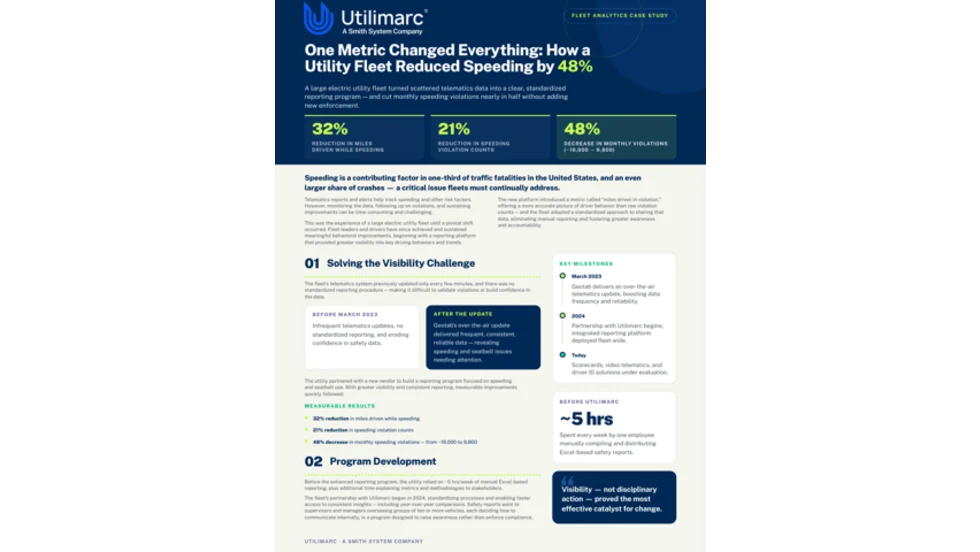
How Better Visibility Cut Speeding Violations by 48%
Fleet leaders don't need more data, they need clearer visibility into what the data is saying. This case study explores how one utility replaced speeding-event counts with a single metric — miles driven in violation — to strengthen safety and significantly reduce speeding violations.
Read More →