





Related: Considerations for an OEM-Based Telematics Solution
GM Develops Workplace Safety Tech
General Motors has developed new technology to aid workplace safety during the COVID-19 pandemic, and the company is sharing its innovations with the world for potential use in job sites as diverse as manufacturing plants, offices, or even schools.
August 12, 2020
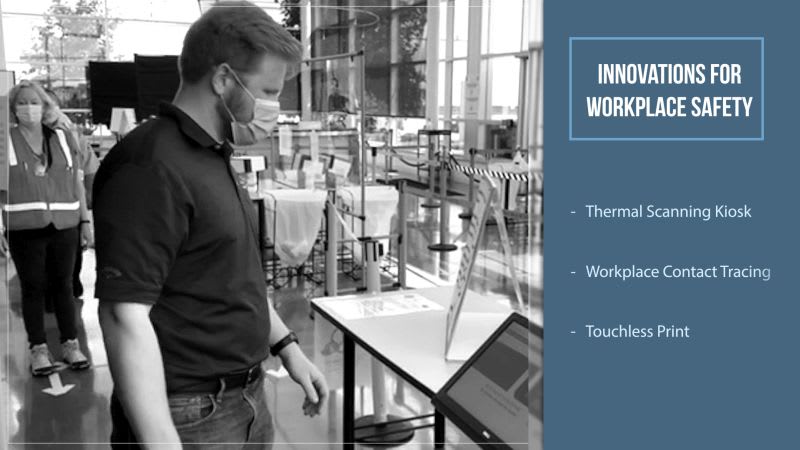
he new technologies include an automated kiosk for temperature scanning, software for contact tracing, and a mobile app for touchless printing.
Photo: General Motors
4 min to read
General Motors has developed new technology to aid workplace safety during the COVID-19 pandemic, and the company is sharing its innovations with the world for potential use in job sites as diverse as manufacturing plants, offices, or even schools. The new technologies include an automated kiosk for temperature scanning, software for contact tracing, and a mobile app for touchless printing.
While developed to aid the company’s workplace protocols, GM has made these tools available to the public for potential use in any workplace, school, or facility.
“We developed an extensive playbook for a safe return to work for our employees, and we’re seeing very good success,” said Dr. Jeffery Hess, GM medical director. “As we implemented the protocols, GM software developers started to work on how technology could make the process smoother and more precise.”
GM’s in-house software developers innovated solutions aimed at helping employees return to work with more confidence, streamlining and improving workplace safety protocols.
“We had to respond quickly to the challenges the COVID-19 pandemic created for our workforce,” said Randy Mott, GM executive vice president and chief information officer. “Our teams collaborated online with experts around the world to quickly innovate and support the safe return of our employees to the workplace. We know many of these challenges affect others globally. We felt it important to share our innovation so other companies, organizations and institutions could benefit from our experience.”
Thermal Scanning Kiosk
In GM workplaces – and many other kinds of facilities today – safety protocols call for an entry process that includes a temperature evaluation, normally administered by another worker. GM developed new software code that integrates the operation of an infrared thermal camera with a computer and monitor, automating and streamlining the entire process.
Leveraging open-source code from the OpenCV project, the system automatically detects when someone has stepped in front of the camera and checks for an elevated skin temperature, indicating it is either safe to proceed or the entrant needs further evaluation. The process can take as little as 1-2 seconds, relieving bottlenecks at workplace entry points and reducing physical contact between workers. The scanning is effective when the worker is wearing a mask or face covering.
Kiosks are in use at numerous GM offices and plants across the United States and will expand to other global locations soon. While the actual kiosk GM built is for its own facilities, the innovation that makes it work can be applied in many other kinds of workplaces. The software is available to help any workplace or facility with similar entry scanning processes.
Workplace Contact Tracing
Developers worldwide are designing technology solutions to improve contact tracing. GM made significant improvements to Covid Watch, an open-source contact tracing application, by adding real-time social distance alerts, boosting performance on both iOS and Android devices and adding support for Bluetooth beacons. GM will release its open-source software soon, helping developers worldwide who are collaborating on open-source solutions to aid contact tracing.
“We believe our application advances the state of the art when it comes to mobile apps for contact tracing, which is the subject of massive software development efforts across multiple industries today,” said Tony Bolton, GM chief information officer of Global Telecommunications and End-User Services.
GM is testing a mobile app that would create a record for the employee, listing other users with whom he or she has been in contact. It can help medical staff reach employees that had contact with a worker testing positive for COVID-19, while maintaining privacy and security. The app also constantly computes the physical distance between users and can send an alert to help encourage safe behavior. GM is planning a pilot to test the application soon.
Touchless Print
The new Touchless Print mobile web application now enables employees to print documents without touching the printer’s control panel, leveraging instead a QR code scanned through the employee’s mobile phone. The process is not only safer, but very quick and extremely simple.
“Touchless printing is a first step, as the team is also working on using technology to make other daily activities more hands-free,” Bolton said.
This app is in use now at GM facilities worldwide, for iOS and Android devices, and exclusive to HP printers. The open-source software for the app was released earlier this month.
These innovations are the latest in a series of pandemic-response actions from the company, including production of critical care ventilators and personal protective equipment such as masks, face shields and N95 respirators.
Originally posted on Work Truck Online
More Safety

What’s Next for Fleet? Safety, AI & Industry Recognition | AF News Recap
Could your company's culture be encouraging distracted driving? This week, we're exploring how workplace expectations affect driver safety, what AI, EVs, and autonomous vehicles could mean for the future of fleet management, and how fleet professionals can strengthen their award nominations.
Read More →
Does Your Fleet's Culture Encourage Distracted Driving?
What happens when the people responsible for enforcing safety rules are the ones setting the wrong example? The answer may reveal why some of the biggest risks to fleet drivers have little to do with what's written in the employee handbook.
Read More →
Sponsored•October 1, 2026
Fleet Manager’s Ultimate Playbook: Navigating the New Standard in OEM Connectivity
Rising operating costs, driver safety concerns, and unplanned downtime are putting unprecedented pressure on modern fleets. Discover how fleet managers use embedded OEM connectivity and real-time vehicle data to cut TCO, prevent downtime, and protect drivers without aftermarket telematics hardware.
Read More →
From Driver Well-Being to EV Charging | AF News Recap
Mental health belongs in the fleet safety conversation. This week, we’re looking at five ways fleets can support employee well-being before a crisis, plus Holman’s expansion in Mexico, new one-day Fleet Forward passes, and why EV charging demand is outpacing infrastructure growth.
Read More →
Nexar-Nauto Merger Aims to Give Fleets Better Safety Intelligence Through Larger Driving Dataset
Stefan Heck tells Automotive Fleet that combining more than 10 billion miles of driving history with Nexar's AI models will give fleets deeper insights into driver risk and roadway conditions than either company could provide independently.
Read More →
Don't Wait for a Crisis: 5 Ways to Build Mental Health Into Your Fleet Safety Program
For Suicide Prevention Month, fleet and safety leaders have an opportunity to put mental health where it belongs: at the center of workplace safety.
Read More →
How Camera Data Can Strengthen a Fleet’s Insurance Renewal
Insights from a commercial insurance carrier and a broker show how fleets can turn video telematic data, driver coaching, and improved claims results into a stronger case at insurance renewal.
Read More →
The Safest Fleets Aren’t the Ones with the Most Technology
You’ve made the telematics investment. Here’s how to capture the other half of its value and build the safest fleet on the road.
Read More →
Sponsored•August 7, 2026
Hidden in Plain Sight: Fleet Compliance Risks
Fleet compliance isn't just about having policies — it's about consistently enforcing them. This practical guide reveals six hidden compliance risks common in public sector and shared fleet operations and outlines proven strategies to improve visibility, accountability, and audit readiness
Read More →
NETS Sets 2026 Fleet Safety Benchmark Conference for Indianapolis
The Sept. 15–17 program will feature fleet benchmarking data, case studies, emerging technologies, and implementation strategies while running alongside the NSC Safety Congress & Expo.
Read More →