




Ford Demonstrates Results of Research on Active Safety Systems
Ford's European Research Centre recently presented its results for PReVENT, a research project aimed at improving road safety through active safety systems.
Ford's European Research Centre in Germany recently presented its results for PReVENT, a research project aimed at improving road safety through active safety systems. The project is co-funded by the EU Commission. Viviane Reding, the EU commissioner for information society and media, opened the PReVENT conference and exhibition in Versailles, France. The five-day event allowed attendees to experience and test a range of innovative active safety systems. Within the framework of PReVENT, Ford demonstrated how digital data from navigation systems can be used to support future active safety systems in cars. For example, by using the detailed digital map data, the vehicle "recognizes" potential hazard areas and prepares itself to react accordingly. Lane-keeping systems, in particular, will benefit from the additional information provided by digital map data. These systems usually are led by cameras recording lane markings. If the latter are deficient or missing --- in slip roads or intersections, for example --- the cameras alone cannot function properly. In such situations, the digital data provides the necessary and accurate information to allow the lane-keeping system to continue to function. Path Prediction is an additional feature that enhances the use of the digital map data from the navigation system. It is generated by analyzing the daily route pattern of a driver. Through probability calculation, the on-board computer "learns and knows" the route in advance, since most people travel the same one every day. This pool of experience helps the on-board computer to focus on the relevant information and to ignore the unimportant data of the surroundings. This makes the information provided by the navigation system more efficient, more accurate and available faster. (In case the driver does not follow the predicted route, the active safety systems will only consider the recorded data on the navigation system.) For example, path prediction could further enhance a vehicle's adaptive headlamp system, which currently is controlled by the steering angle. In the future, the on-board computer would learn the angle of curves on the route in advance and thus would be able to light the curve at a very early stage. In the occasion of complete darkness or poor visibility resulting from bad weather conditions, the adaptive lighting system could make a significant contribution to route guidance. In addition to the technical issues, PReVENT has also addressed legal issues, to define when and to what extent the different active safety systems may interfere with the driver's autonomy. PReVENT (PReVENTive and Active Safety Applications) is a four-year research project that will end in January 2008, and forms part of the 6th framework program of "Information Society Technologies." In total, 54 partners from industry, as well as from public and private institutions, participated. They included automobile manufacturers and suppliers, electronics manufacturers, information technology and software companies as well as research institutes and public authorities. With a budget of over 55 million Euros, the PReVENT consortium developed new preventive and active safety applications and sophisticated driver information systems based on advanced intelligent technologies. The funding from the European Commission covered approximately 50 percent of the costs.
More Safety

From Driver Well-Being to EV Charging | AF News Recap
Mental health belongs in the fleet safety conversation. This week, we’re looking at five ways fleets can support employee well-being before a crisis, plus Holman’s expansion in Mexico, new one-day Fleet Forward passes, and why EV charging demand is outpacing infrastructure growth.
Read More →
Nexar-Nauto Merger Aims to Give Fleets Better Safety Intelligence Through Larger Driving Dataset
Stefan Heck tells Automotive Fleet that combining more than 10 billion miles of driving history with Nexar's AI models will give fleets deeper insights into driver risk and roadway conditions than either company could provide independently.
Read More →
Don't Wait for a Crisis: 5 Ways to Build Mental Health Into Your Fleet Safety Program
For Suicide Prevention Month, fleet and safety leaders have an opportunity to put mental health where it belongs: at the center of workplace safety.
Read More →
How Camera Data Can Strengthen a Fleet’s Insurance Renewal
Insights from a commercial insurance carrier and a broker show how fleets can turn video telematic data, driver coaching, and improved claims results into a stronger case at insurance renewal.
Read More →
The Safest Fleets Aren’t the Ones with the Most Technology
You’ve made the telematics investment. Here’s how to capture the other half of its value and build the safest fleet on the road.
Read More →
Hidden in Plain Sight: Fleet Compliance Risks
Fleet compliance isn't just about having policies — it's about consistently enforcing them. This practical guide reveals six hidden compliance risks common in public sector and shared fleet operations and outlines proven strategies to improve visibility, accountability, and audit readiness
Read More →
NETS Sets 2026 Fleet Safety Benchmark Conference for Indianapolis
The Sept. 15–17 program will feature fleet benchmarking data, case studies, emerging technologies, and implementation strategies while running alongside the NSC Safety Congress & Expo.
Read More →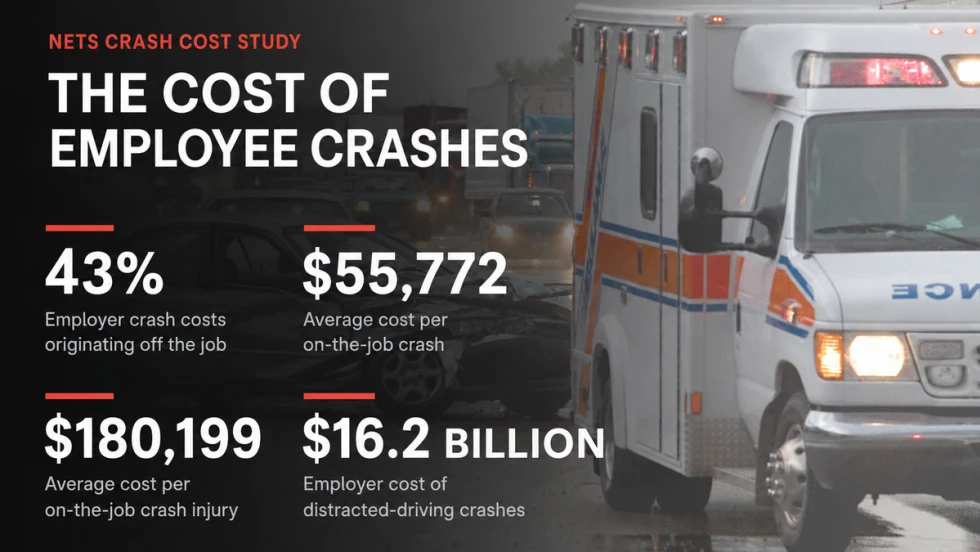
Off-the-Job Crashes Account for 43% of Employers’ $61.7 Billion Crash Burden
NETS quantifies costs dispersed across fleet, risk, HR, and other departments while providing new per-crash benchmarks for employers.
Read More →
Ram Recalls More Than 1.27 Million 1500 Pickups for Seat Belt Anchor Issue
The recall affects certain 2019-2026 Ram 1500 pickups that may have improperly attached second-row seat belt buckle anchors.
Read More →
Operation Safe Driver Week: Why the Industry's Oldest Safety Campaign Still Matters to Fleets
A look at how a 2007 enforcement initiative became one of the most consequential weeks on the fleet safety calendar, and what it means for your drivers in 2026.
Read More →