





The Two-Pronged Approach to Driver Safety Management Programs
Fleet Drivers Distracted By Work and Want More Safety Training, Study Finds
Drivers are also overwhelmingly supportive of technology like dash cams and telematics, which they feel can improve their safety on the roads and increase transparency and accountability.
June 13, 2024

3 min to read
New research from insurance provider Nationwide shows commercial fleet drivers are facing increased distractions and safety risks on the road, exacerbated by staffing shortages that are leading to longer hours behind the wheel and a reduced focus on safety.
Nearly three-quarters of commercial drivers surveyed said they want their management to increase the training being provided to drivers to help prevent accidents and improve safety.
Edelman Data and Intelligence (DXI) conducted the national online survey of 400 commercial drivers and 1,000 general consumers.
Drivers Feel Distracted and Overworked
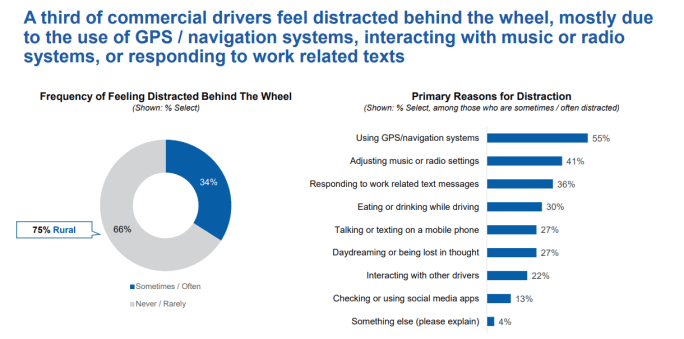
Many survey respondents said they feel distracted by technology in their vehicle.
Photo: Nationwide
One-third of company drivers said they “often or sometimes” feel distracted while driving for work purposes – mostly caused by known safety hazards like operating GPS/navigation systems, interacting with radio or music systems, or responding to work-related texts.
More than a quarter of respondents also daydream behind the wheel and 13% are checking social media apps.
Staffing shortages could be contributing to risky driving behaviors as drivers work longer hours and face challenging deadlines.
Four in 10 drivers say their employer is struggling with staffing shortages, leading to increased workloads, longer hours and more difficulty meeting deadlines.
Drivers also reported facing distractions due to work demands:
55% take work phone calls while driving
30% read/respond to work texts while driving
18% read work emails, while 16% respond to work emails
While 57% of commercial drivers reported that their company enforces a 'hands-free' phone policy, about half of those drivers also said their company does not monitor cell phone usage.
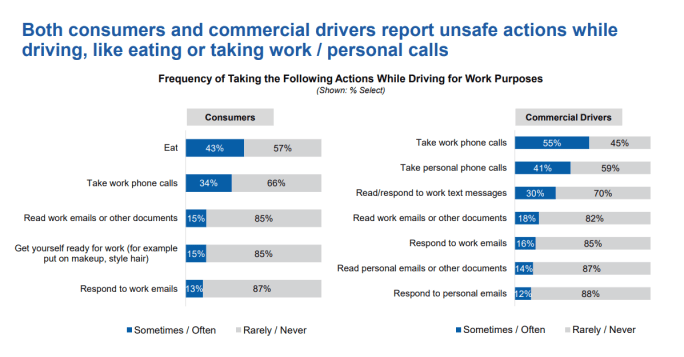
More than half of commercial drivers reported they sometimes or often take work calls.
Photo: Nationwide
Concerns About Safety From Drivers
Driver shortages may also be fueling concerns about overall workplace standards and practices that could impact the safety of fleet drivers and the general public on the roads with them. Here's how some of the data breaks down:
42% of drivers say their employer has reduced hiring criteria
39% say employee training has suffered
34% say there’s less of a focus on safety
More than half of fleet drivers say they're worried about their own personal safety and liability behind the wheel. More than half of respondents reported being involved in or having witnessed an accident in the past year.
Support For Safety Initiatives and Technology
As a result, 72% of drivers want their management to increase the training being provided to drivers to help prevent accidents and improve safety.
Drivers are also overwhelmingly supportive of technology like dash cams and telematics, which they feel can improve their safety on the roads and increase transparency and accountability. Despite this, only 38% of drivers say their employer requires a dash cam or monitors their driving with telematics.
“Business owners may have opportunities to elevate the training and safety resources they’re offering for drivers, further demonstrating their commitment to their workers and, in turn, potentially helping with hiring and retaining good drivers in the future,” said Kristina Talkowski, Nationwide’s leader of Middle Market Commercial Lines. “Safe, high quality drivers also welcome technology like dash cams that can help improve safe driving behaviors and stave off legal system abuse that’s negatively impacting insurance customers through higher insurance costs, longer claims resolution times and limited access to coverage.”
A proactive approach can save companies money in the long run, helping them avoid repair and replacement costs, as well as workers comp payouts.
Where Do Drivers Feel Safest?
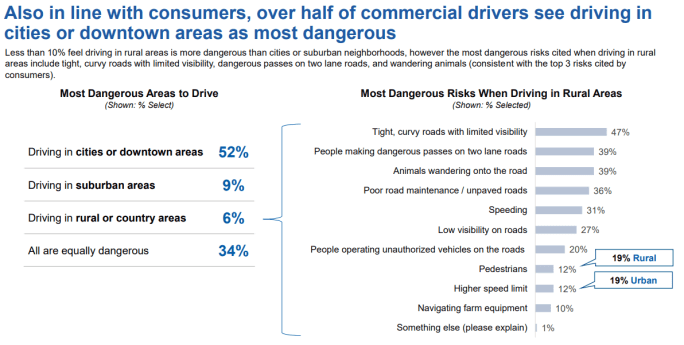
Over half of respondents reported that they believe urban road settings are the most dangerous.
Photo: Nationwide
Just over half of respondents said they feel cities and downtown areas are the most dangerous areas to drive, with 15% saying they believed suburban or rural/country areas are the most dangerous. About one-third said all settings are equally dangerous.
In rural areas, nearly half of fleet drivers said they felt tight, curvy roads with limited visibility were the most dangerous risks, with people making dangerous passes on two-lane roads just behind it.
More Safety

Does Your Fleet's Culture Encourage Distracted Driving?
What happens when the people responsible for enforcing safety rules are the ones setting the wrong example? The answer may reveal why some of the biggest risks to fleet drivers have little to do with what's written in the employee handbook.
Read More →
Sponsored•October 1, 2026
Fleet Manager’s Ultimate Playbook: Navigating the New Standard in OEM Connectivity
Rising operating costs, driver safety concerns, and unplanned downtime are putting unprecedented pressure on modern fleets. Discover how fleet managers use embedded OEM connectivity and real-time vehicle data to cut TCO, prevent downtime, and protect drivers without aftermarket telematics hardware.
Read More →
From Driver Well-Being to EV Charging | AF News Recap
Mental health belongs in the fleet safety conversation. This week, we’re looking at five ways fleets can support employee well-being before a crisis, plus Holman’s expansion in Mexico, new one-day Fleet Forward passes, and why EV charging demand is outpacing infrastructure growth.
Read More →
Nexar-Nauto Merger Aims to Give Fleets Better Safety Intelligence Through Larger Driving Dataset
Stefan Heck tells Automotive Fleet that combining more than 10 billion miles of driving history with Nexar's AI models will give fleets deeper insights into driver risk and roadway conditions than either company could provide independently.
Read More →
Don't Wait for a Crisis: 5 Ways to Build Mental Health Into Your Fleet Safety Program
For Suicide Prevention Month, fleet and safety leaders have an opportunity to put mental health where it belongs: at the center of workplace safety.
Read More →
How Camera Data Can Strengthen a Fleet’s Insurance Renewal
Insights from a commercial insurance carrier and a broker show how fleets can turn video telematic data, driver coaching, and improved claims results into a stronger case at insurance renewal.
Read More →
The Safest Fleets Aren’t the Ones with the Most Technology
You’ve made the telematics investment. Here’s how to capture the other half of its value and build the safest fleet on the road.
Read More →
Sponsored•August 7, 2026
Hidden in Plain Sight: Fleet Compliance Risks
Fleet compliance isn't just about having policies — it's about consistently enforcing them. This practical guide reveals six hidden compliance risks common in public sector and shared fleet operations and outlines proven strategies to improve visibility, accountability, and audit readiness
Read More →
NETS Sets 2026 Fleet Safety Benchmark Conference for Indianapolis
The Sept. 15–17 program will feature fleet benchmarking data, case studies, emerging technologies, and implementation strategies while running alongside the NSC Safety Congress & Expo.
Read More →
Off-the-Job Crashes Account for 43% of Employers’ $61.7 Billion Crash Burden
NETS quantifies costs dispersed across fleet, risk, HR, and other departments while providing new per-crash benchmarks for employers.
Read More →