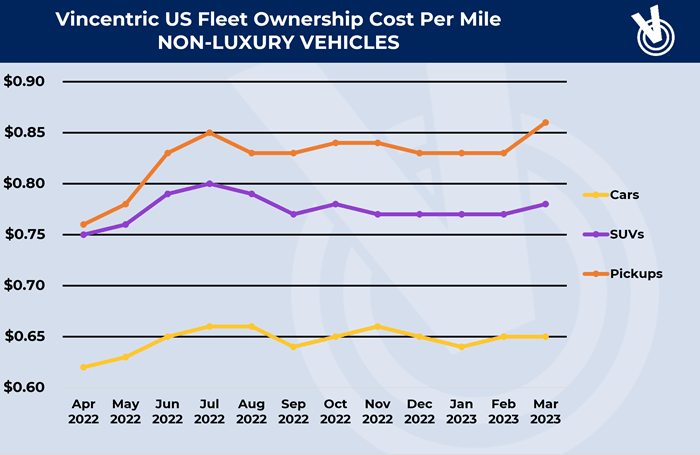
Vincentric data shows that for pickups, total cost per mile increased by 2.73% from January to April 2023, primarily impacted by a 3.74% increase in depreciation costs and a 9.15% increase in financing costs.
Graphic: Vincentric, LLC
2 min to read
Welcome to Fleet Data Depot, which provides snapshots of information, trends, and analysis relevant to the fleet market.
Ad Loading...
In this edition, the total cost of ownership experts at Vincentric deliver another quarterly update on per-mile ownership costs for fleets over the previous 12 months.
Ad Loading...
The analysis is based on vehicles driven 20,000 miles per year for a three-year window. For the analysis, Vincentric calculated its standard eight cost elements: depreciation, financing, fees and taxes, fuel, insurance, maintenance, opportunity cost, and repairs.
High Fuel Prices Drive Ownership Cost Increase
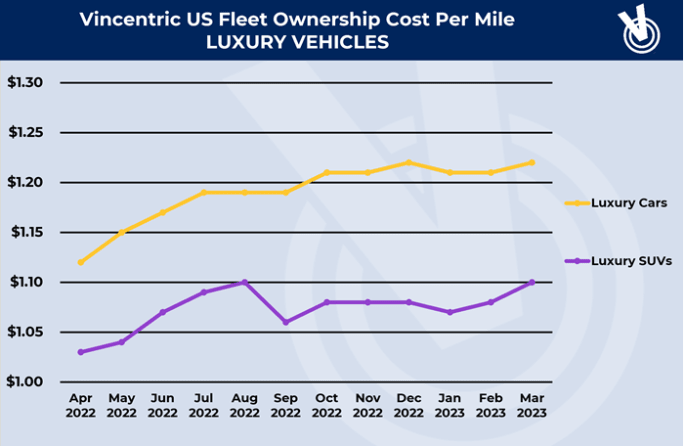
Over this 12-month period, ownership costs spiked in the summer of 2022 due to record-high fuel prices. High fuel prices had a greater impact on pickups and luxury SUVs, as those vehicles are the highest consumers of fuel in these segments.
Following that summer peak, costs moderated in the car, pickup, and SUV segments. However, luxury car costs have been rising steadily over this time.
Luxury cars and SUVs have been on an upward cost of ownership trend to start 2023.
Graphic: Vincentric, LLC
New Vehicle Transaction Prices Hit Record Highs
Moderating fuel costs over the last eight months were offset by increasing new vehicle costs. Average new vehicle transaction prices hit a record high of $49,507 in December but have decreased steadily in January ($49,388) February ($48,558) and March ($48,008) to start 2023.
As depreciation is always the largest expense (with fuel second), increases in new vehicle prices will have the greatest effect on ownership costs of any of the eight cost elements. Inflation has increased commodity prices on parts, particularly tires, which has had a smaller but measurable effect on maintenance costs.
Ad Loading...
High Financing Costs Hit Pickup Segment
For pickups specifically, total cost per mile increased by 2.73% from January to April 2023, primarily impacted by a 3.74% increase in depreciation costs and a 9.15% increase in financing costs.
Note that fuel costs for pickups decreased from last quarter by 6.5%.
On the wholesale side, used values saw four straight months of increases over the last four months according to Cox Automotive data, mostly due to tight supply. Decreasing new prices and a strong wholesale market have been good for depreciation, and thus average ownership costs, over this period.
Wholesale prices, while still buoyant, may be in for a slight decline ahead, according to Cox Automotive’s Jonathan Smoke, which would put further pressure on depreciation if new vehicle costs stay high.
Vincentric notes that addition of new vehicles into the database and subtraction of the oldest model year (MY20) vehicles can cause fluctuations in the data.
Automotive Fleet, Government Fleet, Work Truck, and Heavy Duty Trucking present the 2027 Fleet Fact Book, bringing together data and research from commercial, government, vocational, and heavy-duty fleets in one edition.
Nick Caller will become president of Fleet, while Mark Bryan will take on the role of executive vice president and chief operating officer of Fleet, effective Jan. 1, 2027.
During the annual Toyota Fleet Executive Meeting, fleet leaders learned about Toyota’s legacy of driving fuel efficiency with hybrids, its investments in U.S. production, the early success of Toyota Fleet Service Advantage, and much more.
The new program will award up to four scholarships annually to help eligible fleet professionals cover the cost of Certified Automotive Fleet Manager certification.
Cars, trucks, vans, SUVs, and upfits. Help choose the 2027 fleet award winners and unlock early-access resources for voters. Ballots close December 31.