




Feds: Vehicle-to-Vehicle Communication Mandate In the Works
This technology is aimed at improving road safety by allowing vehicles to "talk" to each other to avoid crashes.
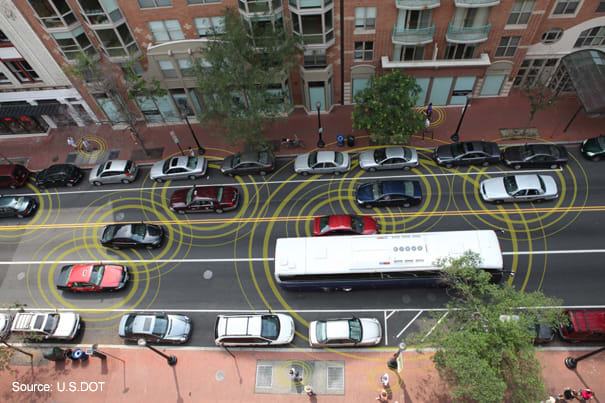
With safety data such as speed and location flowing from nearby vehicles, vehicles can identify risks and provide drivers with warnings.
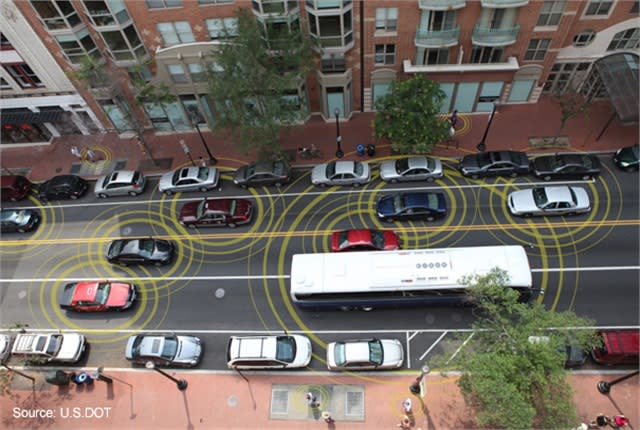
With safety data such as speed and location flowing from nearby vehicles, vehicles can identify risks and provide drivers with warnings.
Federal transportation officials have begun working on a mandate that would require that automakers add a wireless chip to light-duty vehicles so they could "talk" to each other and avoid crashes.
The U.S. Department of Transportation will begin developing regulations for vehicle-to-vehicle (V2V) communication technology, Secretary Anthony Foxx said at a press conference on Monday. The DOT's National Highway Traffic Safety Administration (NHTSA) will lead this effort, following years of research into the topic.
Vehicles will be able to exchange basic safety data, such as speed and position, at ten times per second. This technology holds the promise of dramatically reducing collisions, according to researchers.
"Vehicle-to-vehicle technology represents the next generation of auto safety improvements, building on the life-saving achievements we've already seen with safety belts and air bags," Foxx said. "By helping drivers avoid crashes, this technology will play a key role in improving the way people get where they need to go while ensuring that the U.S. remains the leader in the global automotive industry."
DOT research indicates that safety applications using V2V technology can address a large majority of crashes involving two or more motor vehicles. With safety data such as speed and location flowing from nearby vehicles, vehicles can identify risks and provide drivers with warnings to avoid other vehicles in common crash types such as rear-end, lane change, and intersection crashes. These safety applications have been demonstrated with everyday drivers under both real-world and controlled test conditions.
The safety applications currently under development provide warnings to drivers so that they can prevent imminent collisions, but do not automatically operate any vehicle systems, such as braking or steering. NHTSA is also considering future actions on active safety technologies that rely on on-board sensors. Those technologies are eventually expected to blend with the V2V technology.
In addition to enhancing safety, these future applications and technologies could help drivers to conserve fuel and save time.
V2V technology doesn’t involve exchanging or recording personal information or tracking vehicle movements, NHTSA said. The information sent between vehicles won’t identify those vehicles. It will merely contain basic safety data.
In fact, the system as contemplated contains several layers of security and privacy protection to ensure that vehicles can rely on messages sent from other vehicles. A vehicle or group of vehicles would be identifiable through defined procedures only if there’s a need to fix a safety problem, NHTSA said.
In August 2012, DOT launched the safety pilot "model deployment" in Ann Arbor, Mich., where nearly 3,000 vehicles were deployed in the largest-ever road test of V2V technology. DOT testing has confirmed interoperability of V2V technology among products from different vehicle manufacturers and suppliers and has demonstrated that they work in real-world environments.
In DOT-conducted driver clinics prior to the model deployment, the technology showed high favorability ratings and levels of customer acceptance. Participants indicated they would like to have V2V safety features on their personal vehicle.
"V2V crash avoidance technology has game-changing potential to significantly reduce the number of crashes, injuries and deaths on our nation's roads," said NHTSA Acting Administrator David Friedman. "Decades from now, it's likely we'll look back at this time period as one in which the historical arc of transportation safety considerably changed for the better, similar to the introduction of standards for seat belts, airbags and electronic stability control technology."
NHTSA said it is currently finalizing its analysis of data gathered as part of its year-long pilot program and will publish a research report on V2V communication technology for public comment in the coming weeks. The report will include analysis of DOT’s research findings in several key areas, including technical feasibility, privacy and security, and preliminary estimates on costs and safety benefits.
NHTSA will then begin working on a regulatory proposal that would require V2V devices in new vehicles in a future year, consistent with applicable legal requirements, executive orders and guidance.
The Department of Transportation hopes that the signal this announcement sends to the market will enhance V2V technology development and pave the way for market penetration of safety applications.
"We are pleased with the direction NHTSA is taking in terms of V2V technology," said Greg Winfree, assistant secretary for research and technology. "The decision to move forward comes after years of dedicated research into the overwhelming safety benefits provided by a connected vehicle environment."
V2V communications can provide the vehicle and driver with 360-degree situational awareness to address additional crash situations – including those, for example, in which a driver needs to decide if it is safe to pass on a two-lane road (potential head-on collision) or make a left turn across the path of oncoming traffic. In those situations, V2V communications can detect threats hundreds of yards from other vehicles that cannot be seen, often in situations in which on-board sensors alone cannot detect the threat.
In this research, NHTSA has worked closely with other DOT agencies, including the Office of the Assistant Secretary for Research and Technology and the Federal Highway Administration, and with several leading auto manufacturers and academic research institutions.
The collaboration of government, industry and academia is critical to ensure V2V technology's interoperability across vehicles, NHTSA said.
More Operations

Fleet Has a Talent Pipeline Problem. What Comes Next? | AF News Recap
Where will fleet’s next generation of leaders come from? This week, we’re looking at the industry’s talent pipeline, what certification can add to a fleet career, how to build an award-worthy track record, and the return of Automotive Fleet’s Personal Use Survey.
Read More →
Smith System Launches Driver Risk Management Program
Fleets have more driver data than ever, but identifying risky behavior doesn't necessarily correct it. Smith System's new Driver Risk Management program combines monitoring, training, and follow-up coaching to help fleets connect risk signals with driver intervention.
Read More →
Automotive Fleet Opens 2026 Personal Use Survey for Commercial Fleet Managers
Less than two weeks left! Commercial and corporate fleet managers are invited to share how their organizations handle company vehicle personal-use policies, charges, and driver eligibility.
Read More →
From AI Prompts to AI-Generated Safety Songs | AF News Recap
Can better prompts make AI more useful for fleet managers? This week, we’re breaking down smarter fleet analysis, an AI-assisted experiment that turned safety training into music, and what happened to fuel prices in August.
Read More →
How to Write Better AI Prompts for Fleet Analysis
Include these six elements in your fleet prompts to generate more relevant analysis and accurate answers.
Read More →
Fleet Meets: Eric Kilgore
This edition of the Fleet Meets series features one of the industry's best leaders driving multi-market and national operations.
Read More →
Why Reactive Fleet Management Is Becoming Too Expensive to Sustain
Research highlights a growing need for proactive management strategies to address rising costs in fleet operations effectively.
Read More →
What Your Fleet KPIs Aren’t Telling You
Tracking fleet metrics is only useful when the data leads to better decisions. This guide helps fleet leaders assess cost, utilization, and downtime more accurately, identify performance gaps, and prioritize the actions that can improve operational results.
Read More →
Hidden in Plain Sight: Fleet Compliance Risks
Fleet compliance isn't just about having policies — it's about consistently enforcing them. This practical guide reveals six hidden compliance risks common in public sector and shared fleet operations and outlines proven strategies to improve visibility, accountability, and audit readiness
Read More →
Turning Fleet Payment Data into Executive Insights
Does data alone drive results in operations?
Read More →