




WASHINGTON, D.C. --- Advocates for Highway and Auto Safety, a national coalition of safety groups and insurance organizations, presented its first Lifetime Achievement Award to U.S. Sen. Elizabeth Dole (R-NC) and Public Citizen President Joan Claybrook in recognition of their "significant contributions to advancing air bag technology." Twenty years ago, few makes and models of cars were equipped with this lifesaving technology. Today, frontal airbags are standard equipment on all passenger vehicles. U.S. government figures credit airbags with saving more than 25,000 lives over the past two decades. In addition, side head air bags are saving additional lives and will shortly become standard equipment on most passenger vehicles. Joan Claybrook was the administrator of the National Highway Traffic Safety Administration (NHTSA), an agency of the U.S. Department of Transportation (DOT), during the Carter Administration (1977-81), and implemented the first rule requiring automatic occupant protection, including air bags. Air bag technology was new and not widely understood by the public. After Claybrook left NHTSA in 1981, the air bag rule was changed and the matter eventually went before the U.S. Supreme Court. In 1983, the nation's highest court rejected the changes and required DOT to rewrite and reissue the safety rule. Senator Dole served as U.S. transportation secretary from 1983 to 1987. During that time an alternative called Rule 208 was proposed that required air bags or automatic safety belts in new vehicles, with an extra credit for use of air bags. The rule stipulated that if states representing two-thirds of the population passed seat belt laws within five years that met strict criteria, the rule would be suspended. The rule is credited with encouraging states to adopt seat belt laws and the auto industry to consider installing air bags as standard equipment on some makes and models. This voluntary action began with one manufacturer -- Chrysler -- in the late 1980s, and was quickly followed by others. The awards were presented to Dole and Claybrook by Terri Vaccher, a mother of four from Fullerton, Calif., who was accompanied by her 10-year-old son, Dominic. In 1997, Vaccher was eight months pregnant with Dominic when her vehicle collided with a large jack-knifed truck. Her car was struck again by another vehicle, further propelling her vehicle under the truck. Although Vaccher's legs were badly injured, the air bag on the driver's side is credited with saving her life and that of her baby, who was born prematurely several hours after she was safely pulled from the wreckage. "I think of that day every day because what could have been two tragedies instead resulted in two lives saved. Dominic and I stand here today because of the leadership and decisions of these two extraordinary women," Vaccher said. "The airbag made the difference between our living and dying, and my family and I are grateful for this opportunity to publicly thank Senator Dole and Joan Claybrook for their lifesaving leadership." Vaccher and her husband have had two more children since the 1997 crash, and she ran a marathon two years ago. "When we enacted Rule 208, our goal was simple: to save as many lives as possible as quickly as possible," said Dole upon receiving the Lifetime Achievement award. "This action totally changed the climate for automotive safety in America, and the statistics prove that the rule worked just as designed. As a result, there are many real-life stories similar to that of Terri and Dominic, where tragedies have been averted and family members and friends have been spared the loss of a loved one in an automobile accident." Because of the lifesaving benefits of air bags, in 1991 Congress enacted legislation with bipartisan support requiring automakers to install frontal air bags in all vehicles as standard equipment. Advances and new applications of air bag technology have resulted in their use for side impact protection that further increases the number of lives saved and traumatic injuries prevented. "Air bag technology in motor vehicles is one of the most important public health advances in our nation's history," said Joan Claybrook. "We may never know how many Terri and Dominic Vacchers there are out across our country, and also in nations across the globe who have followed our lead."
Elizabeth Dole Honored for Advancing Air Bag Use
WASHINGTON, D.C. --- Advocates for Highway and Auto Safety, a national coalition of safety groups and insurance organizations, presented its first Lifetime Achievement Award to U.S. Sen. Elizabeth Dole (R-NC) and Public Citizen President Joan Claybrook in recognition of their "significant contributions to advancing air bag technology."
More Safety
How Coca-Cola United Protects Its Fleet from Growing Legal Risk
As litigation risk rises, vehicles are increasingly targeted. This Coca-Cola bottler shares how it’s reducing exposure through driver training, technology, and a proactive risk management approach.
Read More →
How to Speak the Same Language on Fleet Safety
Drivers, supervisors, and data often speak different safety “languages.” Getting on the same page will drive better results.
Read More →
Fleet Cybersecurity 101: What You Need from Your Technology Vendors
From identity management to third-party certifications, the right technology partner should make security easier to manage. Here are the three building blocks that fleet managers need to stay in control as connected systems scale.
Read More →
Reducing Risk by Eliminating Phone Use Behind the Wheel
Distracted driving remains one of the most persistent risks in fleet operations. New approaches focus on removing mobile device use entirely while adding real-time safety support.
Read More →
Distracted Driving in the Age of Smart Tech – Part 2
As distraction risks evolve, fleets are turning to smarter, more connected technologies to better understand what’s happening behind the wheel. Part 2 explores how these tools are helping identify risky behaviors and improve visibility across operations.
Read More →
Data Rights, Risks, and Responsibilities After a Crash
What fleets capture to improve safety can also expose them in litigation, forcing leaders to rethink how data is managed, stored, and shared.
Read More →
From Distraction to Detection: Strengthening Awareness in Fleet Drivers
Distracted driving is often measured by what we can see—phones in hand, eyes off the road. But what about the distractions we can’t? A recent incident raises a bigger question about awareness, attention, and why subtle risks so often go unnoticed.
Read More →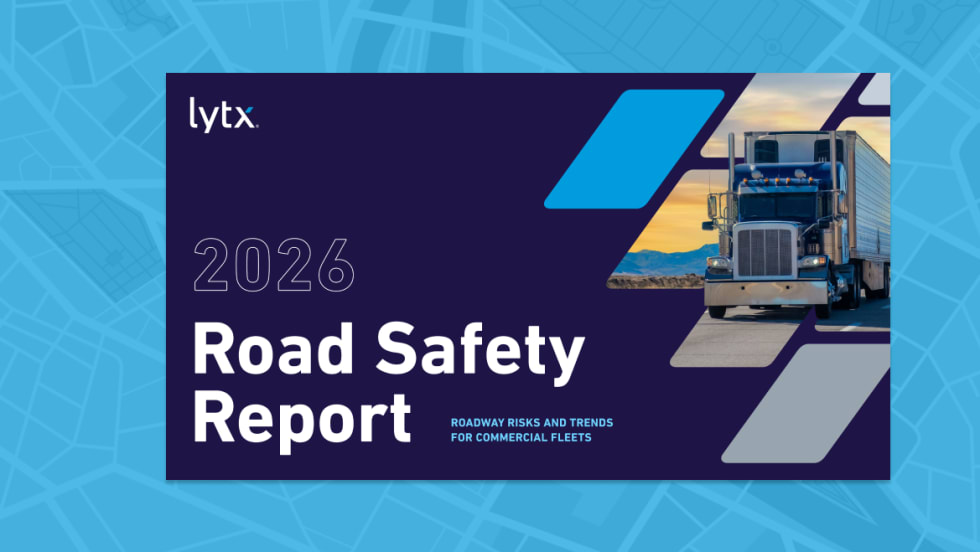
Lytx 2026 Road Safety Report
While serious crashes are declining, a rise in minor incidents and ongoing risk hotspots underscore the need for continued fleet safety investment.
Read More →
Behind-the-Wheel vs. Classroom Training: What Actually Changes Driver Behavior?
Fleets have more driver data than ever, so why isn't behavior changing? Training requires more than reports and coaching — it requires real-world practice.
Read More →
Distracted Driving in the Age of Smart Tech – Part 1
A two-part conversation with Stefan Heck on how AI is transforming the fight against distracted driving. As fleets adopt smarter tools, the focus shifts from reacting to preventing risk. In Part 1, we look at where AI is making an impact for fleets today.
Read More →