




Eight EV Automakers Step Up to Improve Post-Crash Safety
Six months ago, the National Transportation Safety Board recommended EV manufacturers clarify how to suppress a high-voltage lithium-ion battery fire after a crash. Several have done so while others are still in progress.

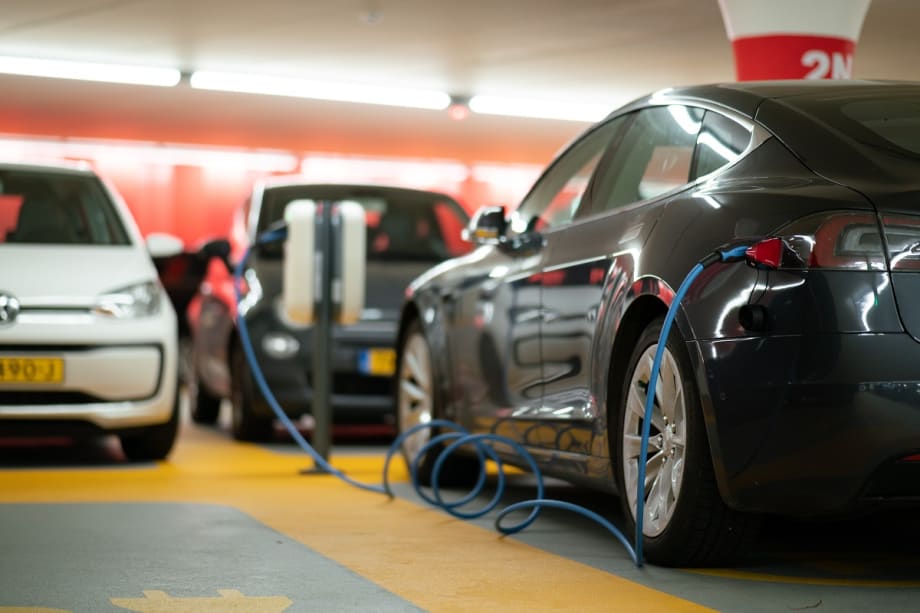
Electric vehicles bring with them different safety challenges than traditional vehicles such as fire risks associated with high-voltage lithium-ion batteries.
Photo: Unsplash.com/Michael Fousert
Eight out of 22 electric vehicle (EV) manufacturers have successfully completed actions to improve EV safety based on recommendations issued by the National Transportation Safety Board (NTSB) in January of this year.
Specifically, automakers Honda, Hyundai, Mitsubishi, Porsche, Proterra, Van Hool, Volkswagen, and Volvo have taken key steps to improve their emergency response guides and incorporate vehicle-specific information for fighting high-voltage lithium battery fires in their electric vehicles.
As more fleets begin to transition to EVs, there will be new safety challenges to understand and address. These latest NTSB recommendations were intended to save the lives of both first responders and EV crash victims. The objective of the recommendation was to get manufacturers to clarify how to suppress a high-voltage lithium-ion battery fire after a crash.
The recommendation came on the heels of a report issued by NTSB. The report identified two key safety issues. The first concern was the inadequate content of EV manufacturers’ emergency response guides. The second concern was about gaps in safety standards and research related to high-voltage lithium-ion batteries in high-speed, high-severity collisions.
The risks associated with fires in EVs powered by high-voltage lithium-ion batteries are significant. For starters, they can pose an electric shock to emergency responders. Moreover, damaged cells in the battery can experience thermal runaway — uncontrolled increases in temperature and pressure — which can lead to battery recognition/fire from the stranded energy that remains in a damaged battery.
Twelve additional manufacturers are making progress toward implementing the NTSB recommendations, according to the agency. These include BMW, BYD, Stellantis, Ford, General Motors, Gillig, Kia, Mercedes-Benz, Nissan, Subaru, Tesla, and Toyota. Two EV makers — Nova Bus Corporation and Karma Automotive — have yet to respond.
More Safety

Fleet Manager’s Ultimate Playbook: Navigating the New Standard in OEM Connectivity
Rising operating costs, driver safety concerns, and unplanned downtime are putting unprecedented pressure on modern fleets. Discover how fleet managers use embedded OEM connectivity and real-time vehicle data to cut TCO, prevent downtime, and protect drivers without aftermarket telematics hardware.
Read More →
From Driver Well-Being to EV Charging | AF News Recap
Mental health belongs in the fleet safety conversation. This week, we’re looking at five ways fleets can support employee well-being before a crisis, plus Holman’s expansion in Mexico, new one-day Fleet Forward passes, and why EV charging demand is outpacing infrastructure growth.
Read More →
Nexar-Nauto Merger Aims to Give Fleets Better Safety Intelligence Through Larger Driving Dataset
Stefan Heck tells Automotive Fleet that combining more than 10 billion miles of driving history with Nexar's AI models will give fleets deeper insights into driver risk and roadway conditions than either company could provide independently.
Read More →
Don't Wait for a Crisis: 5 Ways to Build Mental Health Into Your Fleet Safety Program
For Suicide Prevention Month, fleet and safety leaders have an opportunity to put mental health where it belongs: at the center of workplace safety.
Read More →
How Camera Data Can Strengthen a Fleet’s Insurance Renewal
Insights from a commercial insurance carrier and a broker show how fleets can turn video telematic data, driver coaching, and improved claims results into a stronger case at insurance renewal.
Read More →
The Safest Fleets Aren’t the Ones with the Most Technology
You’ve made the telematics investment. Here’s how to capture the other half of its value and build the safest fleet on the road.
Read More →
Hidden in Plain Sight: Fleet Compliance Risks
Fleet compliance isn't just about having policies — it's about consistently enforcing them. This practical guide reveals six hidden compliance risks common in public sector and shared fleet operations and outlines proven strategies to improve visibility, accountability, and audit readiness
Read More →
NETS Sets 2026 Fleet Safety Benchmark Conference for Indianapolis
The Sept. 15–17 program will feature fleet benchmarking data, case studies, emerging technologies, and implementation strategies while running alongside the NSC Safety Congress & Expo.
Read More →
Off-the-Job Crashes Account for 43% of Employers’ $61.7 Billion Crash Burden
NETS quantifies costs dispersed across fleet, risk, HR, and other departments while providing new per-crash benchmarks for employers.
Read More →
Ram Recalls More Than 1.27 Million 1500 Pickups for Seat Belt Anchor Issue
The recall affects certain 2019-2026 Ram 1500 pickups that may have improperly attached second-row seat belt buckle anchors.
Read More →