




Daimler Trucks Plans Return to Iranian Market
Daimler Trucks is setting the course for its return to the Iranian market, having signed letters of intent with its local cooperation partners Iran Khodro Diesel (IKD) and the Mammut Group.
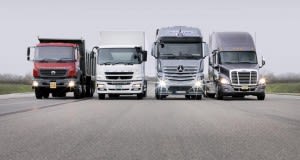
Photo: Daimler
Photo: Daimler
Daimler Trucks is setting the course for its return to the Iranian market, having signed letters of intent with its local cooperation partners Iran Khodro Diesel (IKD) and the Mammut Group. Prior to the sanctions, Daimler said it sold up to 10,000 vehicles per year in Iran, most of them commercial vehicles.
Daimler AG has already had successful business relations with IKD for the past 50 years. IKD is a subsidiary of Iran Khodro Industrial Group, which has more than a 50-percent market share in Iran and has been cooperating with Daimler for over half a century. The areas of cooperation include a joint venture for local production of Mercedes-Benz trucks and powertrain components plus the establishment of a sales company for Mercedes-Benz trucks and components, according to the company.
Furthermore, there are plans for Daimler to return as a shareholder in the former engine joint venture Iranian Diesel Engine Manufacturing Co. (IDEM). In addition to this, both partners are looking at establishing a joint venture for local sales of Mercedes-Benz commercial vehicles. Daimler and IKD are about to benefit from each other’s competitive advantages to satisfy the large demand for trucks, according to the company.
With its growth potential following many years of sanctions and the pent-up demand in the transport sector, Iran offers promising opportunities for Daimler Trucks. Despite the sanctions, Iran was one of the largest national economies in the Middle East, with a nominal gross domestic product (GDP) of 415 billion U.S. dollars in 2014. Industry accounts for almost half of the Iranian national economy. The Ministry of Industry, Mine and Trade estimates that about 200,000 commercial vehicles will be replaced in the coming years – some 56,000 of them in the next three to five years alone, according to the automaker.
By signing the letter of intent, Daimler Trucks has started the process for a comprehensive re-entry into the Iranian market considering the persistent sanctions regime and further export control regulations. The first Mercedes-Benz Actros and Axor trucks could be supplied to the country in the form of CKD (completely knocked down) kits before the end of the year. In addition to this, Daimler Trucks is pursuing the aim of establishing an even firmer foothold in the local market by revitalizing the engine cooperation with IDEM and establishing a sales joint venture. Furthermore, Daimler Trucks is aiming to establish a sales joint venture to professionalize all sales and after-sales activities in Iran. Daimler Trucks likewise intends to open a representative office in Tehran during the first quarter of 2016. With these commitments, Daimler Trucks is therefore committed to assist with the country’s economic and social development.
In addition to the plans for Mercedes-Benz trucks, Daimler Trucks said it also sees great opportunities for Mitsubishi FUSO – especially in the light-duty-truck segment. To open up this market, Daimler and Mayan have signed a distribution agreement for the FUSO brand. Mayan is part of the Mammut Group. The Dubai-based Mammut Group is a truck bodybuilder and distributor. Mayan will be responsible for opening up the Iranian market in close cooperation with FUSO.
Daimler said its commercial vehicle business in in the Middle East and North Africa (MENA) is organized through a regional center. From its base in Dubai, Daimler Commercial Vehicles Middle East & North Africa (DCV MENA) is supporting 19 countries – from Morocco to Pakistan. The new company is responsible for business in the region with the group’s entire commercial vehicle portfolio – from the Mercedes-Benz Citan city van to the Mercedes-Benz Actros heavy-duty truck.
More Global Fleet
GeoFencing Adds to Your Truck Security Arsenal
Geofencing is a familiar fleet tool today, but its early adoption marked a major shift in vehicle tracking, route monitoring, and the debate over employee privacy.
Read More →
Holman Takes Full Ownership of ARIZA in Mexico
Holman is bringing its Mexican fleet management operation fully under its own brand after more than 30 years as a joint venture. The change gives multinational fleet customers a single Holman operation across the U.S., Canada, and Mexico.
Read More →
5 Tire Maintenance Tips to Help Prevent Work Truck Downtime
Regular tire checks can do more than extend tread life. These five maintenance practices can help work truck fleets catch problems early, reduce costs, and prevent downtime.
Read More →

Proven Ways to Reduce Work Truck Downtime
The age-old problem of downtime will always be a reality, but with new strategies at hand, fleets have more ways to keep trucks on the road longer.
Read More →


Cameras, Safety and Insurance: From Reactive Claims to Real-Time Prevention (Part 2 of 2)
Part Two: Commercial auto remains one of the most challenging and costly lines of coverage for fleet operators and insurers alike. Continue learning more about how to effectively address these issues from Onur Aksan, Enterprise Business Development Executive, Geotab
Read More →
Cameras, Safety and Insurance: From Reactive Claims to Real-time Prevention
Commercial auto remains one of the most challenging and costly lines of coverage for fleet operators and insurers alike. Learn more about how to effectively address these issues from Onur Aksan, Enterprise Business Development Executive, Geotab.
Read More →
Fleet Costs Are Rising: Here’s How Leaders Are Responding
Fleet leaders are under pressure to reduce costs, adapt to economic uncertainty, and make smarter decisions. See how peers across North America are responding with real data, proven strategies, and forward-looking insights. Download the 2026 Market Pulse Report to benchmark your strategy and uncover where you can gain an edge.
Read More →
Enterprise Fleet Management Surpasses 900,000 Vehicles in U.S. & Canada
Enterprise Mobility connects with mobility solutions around the globe
Read More →