




Collision Avoidance May Have Lessened Truck Crash Damage
A collision avoidance system might have prevented or lessened the severity of a 2016 crash between a tractor-trailer and an SUV that killed six people and injured five, according to a new report from the National Transportation Safety Board.

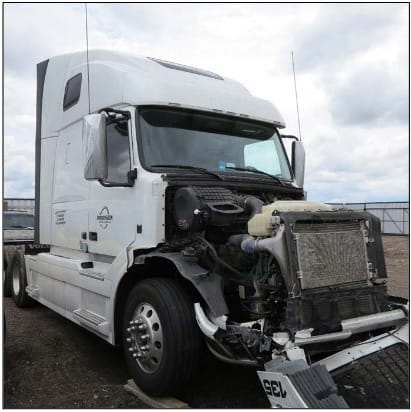
The truck after the crash. The NTSB said the driver may have been fatigued, and that collision avoidance/collision mitigation technology could have prevented or reduced the severity of the crash. Photo: NTSB
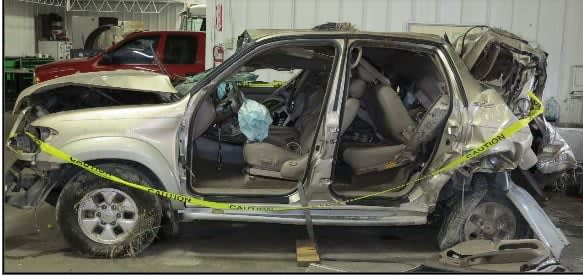
The NTSB said the SUV was overloaded and had mechanical problems causing it to travel at only around 40 mph.Photo: NTSB
A collision avoidance system might have prevented or lessened the severity of a 2016 crash between a tractor-trailer and an SUV that killed six people and injured five, according to a new report from the National Transportation Safety Board.
NTSB says its report on the crash illustrates the need to implement 15 safety recommendations associated with the NTSB’s Most Wanted List of transportation safety improvements for fatigue, occupant protection and collision avoidance.
A seven-passenger sport utility vehicle, with a total of 11 occupants, was struck from behind by a tractor-trailer on I-70 near Goodland, Kansas, June 29, 2016, at about 2:15 a.m. Survivors of the crash said they believed the SUV was traveling near the posted minimum speed limit of 40 mph. Engine data on the tractor-trailer showed it was on cruise control traveling near the posted maximum speed limit of 75 mph at the time of impact.
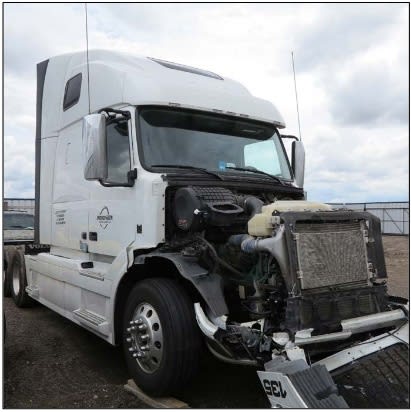
The truck after the crash. The NTSB said the driver may have been fatigued, and that collision avoidance/collision mitigation technology could have prevented or reduced the severity of the crash.Photo: NTSB
The truck was operated by Precision Truck Lines Inc. and occupied by a 27-year-old male driver with three years of experience, on his second trip for the company. The truck driver took evasive action by applying the brakes and steering to the left, when he was about 100 feet away from the SUV. The investigation found that more than half the driver’s logbook entries were inconsistent with other documentation, and there is evidence that after working a daytime schedule the week before the crash, he inverted his sleep/wake schedule on this trip and was driving through the night and apparently had gotten no more than five hours of rest during the 21.5-hour-long period before the crash occurred.
Precision Truck Lines was issued an unsatisfactory safety rating after a compliance review following the crash, and eventually its operating authority was revoked.
The NTSB determined that the truck driver’s failure to take effective action to avoid the crash, due to his fatigue and his surprise at encountering the slow-moving SUV, led to the crash. The SUV driver’s decision to continue traveling at a reduced speed on the highway without the use of flashing hazard lights also contributed to the crash, and the overloading of the seven-passenger SUV and the lack of a collision avoidance system on the truck contributed to the severity of the crash.
“The causal and contributing factors to this tragic and completely preventable crash demonstrate why the issues of fatigue, occupant protection and collision avoidance are on the NTSB’s Most Wanted List of Transportation Safety Improvements,” said Rob Molloy, director of the NTSB’s Office of Highway Safety. “In this crash, a collision avoidance system, especially one capable of automatically applying the brakes, might have prevented this accident or at least lessened the severity of the crash.”
The 2016 Volvo truck involved in this crash was prewired for the Bendix Wingman Fusion collision mitigation system, but the carrier had not opted to buy it.
For years, the NTSB has been advocating for increased implementation of collision avoidance technologies. Reducing fatigue-related crashes is also a major advocacy issue for the board. Both items are on the 2017–2018 NTSB Most Wanted List.
The highway accident brief is available online at https://goo.gl/sEgSxN and the public docket for the investigation is available at https://goo.gl/18PEo6.
More Safety

Fleet Manager’s Ultimate Playbook: Navigating the New Standard in OEM Connectivity
Rising operating costs, driver safety concerns, and unplanned downtime are putting unprecedented pressure on modern fleets. Discover how fleet managers use embedded OEM connectivity and real-time vehicle data to cut TCO, prevent downtime, and protect drivers without aftermarket telematics hardware.
Read More →
From Driver Well-Being to EV Charging | AF News Recap
Mental health belongs in the fleet safety conversation. This week, we’re looking at five ways fleets can support employee well-being before a crisis, plus Holman’s expansion in Mexico, new one-day Fleet Forward passes, and why EV charging demand is outpacing infrastructure growth.
Read More →
Nexar-Nauto Merger Aims to Give Fleets Better Safety Intelligence Through Larger Driving Dataset
Stefan Heck tells Automotive Fleet that combining more than 10 billion miles of driving history with Nexar's AI models will give fleets deeper insights into driver risk and roadway conditions than either company could provide independently.
Read More →
Don't Wait for a Crisis: 5 Ways to Build Mental Health Into Your Fleet Safety Program
For Suicide Prevention Month, fleet and safety leaders have an opportunity to put mental health where it belongs: at the center of workplace safety.
Read More →
How Camera Data Can Strengthen a Fleet’s Insurance Renewal
Insights from a commercial insurance carrier and a broker show how fleets can turn video telematic data, driver coaching, and improved claims results into a stronger case at insurance renewal.
Read More →
The Safest Fleets Aren’t the Ones with the Most Technology
You’ve made the telematics investment. Here’s how to capture the other half of its value and build the safest fleet on the road.
Read More →
Hidden in Plain Sight: Fleet Compliance Risks
Fleet compliance isn't just about having policies — it's about consistently enforcing them. This practical guide reveals six hidden compliance risks common in public sector and shared fleet operations and outlines proven strategies to improve visibility, accountability, and audit readiness
Read More →
NETS Sets 2026 Fleet Safety Benchmark Conference for Indianapolis
The Sept. 15–17 program will feature fleet benchmarking data, case studies, emerging technologies, and implementation strategies while running alongside the NSC Safety Congress & Expo.
Read More →
Off-the-Job Crashes Account for 43% of Employers’ $61.7 Billion Crash Burden
NETS quantifies costs dispersed across fleet, risk, HR, and other departments while providing new per-crash benchmarks for employers.
Read More →
Ram Recalls More Than 1.27 Million 1500 Pickups for Seat Belt Anchor Issue
The recall affects certain 2019-2026 Ram 1500 pickups that may have improperly attached second-row seat belt buckle anchors.
Read More →