




Calif. May Put Passengers in Autonomous Cars
California state regulators recently proposed a pilot program that would allow passengers to ride in driverless vehicles, even without a safety driver present.
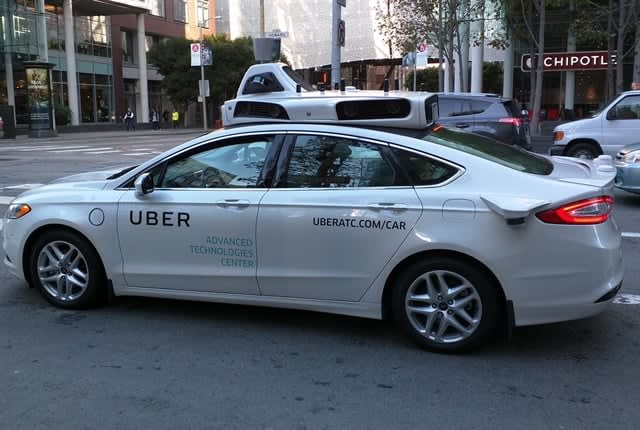
Photo of a Uber self-driving car courtesy of Wikimedia Commons.
California state regulators recently proposed a pilot program that would allow passengers to ride in driverless vehicles—even without a safety driver present—according to The Mercury News.
The state’s Public Utility Commission (PUC) submitted a proposal that calls for the establishment of two pilot test programs for autonomous vehicle passenger service by authorized transportation carriers or companies. One program would authorize testing with a driver, the other, without a driver.
Essentially, the driverless pilot program would enable authorized carriers to shuttle passengers as long as the service complies with all rules that govern the remote operations of a vehicle as established by California’s Department of Motor Vehicles (DMV), reports The Mercury News.
In addition, the passenger service must be offered free of charge during pilot testing and the service company must comply with all PUC and DMV permits.
The proposal comes on the heels of the first pedestrian fatality caused by an autonomous vehicle, when a self-driving Uber car struck and killed a woman in Tempe, Arizona on March 19.
Moreover, a recent poll conducted by SurveyUSA indicates that Californians remain skeptical about safety issues and autonomous vehicles.
Nearly a third of Californians said they felt “very unsafe” getting into an autonomous car, compared to 8% who said they felt “very safe,” according to an ABC Eyewitness news report regarding the poll.
Moreover, 58% of Californians surveyed said that self-driving cars piloted by computers—and without a human driver—should not be allowed on the streets of their neighborhood. Seniors and residents from rural areas were particularly emphatic about keeping autonomous vehicles out of their communities, reports ABC.
SurveyUSA interviewed 1,100 state of California adults from March 22-25—less than one week after the fatal Uber incident.
More Global Fleet
GeoFencing Adds to Your Truck Security Arsenal
Geofencing is a familiar fleet tool today, but its early adoption marked a major shift in vehicle tracking, route monitoring, and the debate over employee privacy.
Read More →
Holman Takes Full Ownership of ARIZA in Mexico
Holman is bringing its Mexican fleet management operation fully under its own brand after more than 30 years as a joint venture. The change gives multinational fleet customers a single Holman operation across the U.S., Canada, and Mexico.
Read More →
5 Tire Maintenance Tips to Help Prevent Work Truck Downtime
Regular tire checks can do more than extend tread life. These five maintenance practices can help work truck fleets catch problems early, reduce costs, and prevent downtime.
Read More →

Proven Ways to Reduce Work Truck Downtime
The age-old problem of downtime will always be a reality, but with new strategies at hand, fleets have more ways to keep trucks on the road longer.
Read More →


Cameras, Safety and Insurance: From Reactive Claims to Real-Time Prevention (Part 2 of 2)
Part Two: Commercial auto remains one of the most challenging and costly lines of coverage for fleet operators and insurers alike. Continue learning more about how to effectively address these issues from Onur Aksan, Enterprise Business Development Executive, Geotab
Read More →
Cameras, Safety and Insurance: From Reactive Claims to Real-time Prevention
Commercial auto remains one of the most challenging and costly lines of coverage for fleet operators and insurers alike. Learn more about how to effectively address these issues from Onur Aksan, Enterprise Business Development Executive, Geotab.
Read More →
Fleet Costs Are Rising: Here’s How Leaders Are Responding
Fleet leaders are under pressure to reduce costs, adapt to economic uncertainty, and make smarter decisions. See how peers across North America are responding with real data, proven strategies, and forward-looking insights. Download the 2026 Market Pulse Report to benchmark your strategy and uncover where you can gain an edge.
Read More →
Enterprise Fleet Management Surpasses 900,000 Vehicles in U.S. & Canada
Enterprise Mobility connects with mobility solutions around the globe
Read More →