




Cadillac CT6 Adds Tech for Hands-Free Highway Driving
Cadillac Super Cruise, available this fall, relies on a driver attention system and LiDAR map data and works together with the car’s network of cameras and radar sensors.

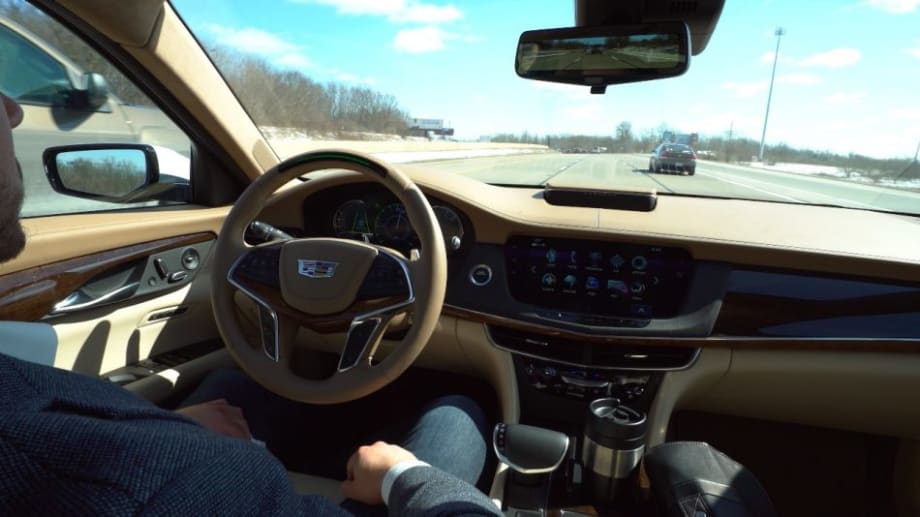
Photo: Cadillac
The 2018-model year Cadillac CT6 will feature Super Cruise — new advanced driver assistance technology that lets motorists take their hands off the steering wheel during highway travel without risking the sudden loss of control, according to Cadillac.
Super Cruise’s hands-free capability and driver attention system will help drivers safely complete common tasks in the car, such as using the navigation system, adjusting the audio system or taking a phone call, the automaker explained in a released statement.
Super Cruise uses two advanced technology systems — a driver attention system and precision LiDAR map data. The systems work together with the network of cameras and radar sensors in the CT6. Super Cruise adds automatic lane-centering to CT6’s suite of active safety technologies, enabling automatic control of speed and steering during highway driving.
The system, designed to promote driver safety and convenience, will be available this fall.
“When we were developing Super Cruise we knew it was important to keep the driver engaged during operation,” said Barry Walkup, chief engineer of Cadillac Super Cruise. “That’s why we’ve added a driver attention function, to insist on driver supervision.”
The driver attention system, which uses a small camera located on top of the steering column, focuses solely on the driver and works with infrared lights to track head position to determine where the driver is looking whenever Super Cruise is in operation. If the system detects the driver has turned attention away from the road ahead for too long, Super Cruise will prompt the driver to return focus to the road ahead. If the driver does not immediately refocus on the road, Super Cruise will continue to safely steer until a further escalation of alerts prompts the driver to resume supervision.
If the system determines continued inattentiveness, a steering wheel light bar guides the driver to look at the road or take back control of the wheel. Additional alerts can include visual indicators in the instrument cluster, tactile alerts in Cadillac’s Safety Alert Seat and audible alerts, if necessary.
In the rare instance of an unresponsive driver, the Cadillac CT6 uses the full capability of onboard driver assistance technologies to bring the car to a controlled stop and contacts OnStar to alert first responders, if necessary.
The Cadillac CT6 uses the real-time data provided by the cameras and sensors to govern steering, braking and acceleration. Super Cruise adds to this formula using advanced laser technology in development for future autonomous vehicles: a LiDAR-scanned map database.
Combined with the real-time data from cameras and GPS sensors, the precision map governs system use and enables it in only the areas where appropriate road conditions are detected. The combination of real-time data with precision mapping also improves vehicle control through curves and hills, according to Cadillac.
This advanced map data restrains Super Cruise use to divided, limited-access highways — highways with defined on-ramps and off-ramps. This approach focuses Super Cruise’s benefit on highway travel. It eliminates variables such as intersections and other less predictable potential hazards that can be prevalent on rural roads or city streets.
“The development of Super Cruise reflects a responsible and safety-oriented approach to the rollout of this advanced technology,” said Johan de Nysschen, Cadillac president.
The precision LiDAR map was developed specifically for Super Cruise. Engineers mapped every mile of limited-access highway in the U.S. and Canada, providing detailed information to the car about the road ahead. This pairs with more accurate GPS, measuring real-time location in a fashion four to eight times more precise than traditional GPS.
“American drivers travel twice as many miles on urban and suburban highways as they do on rural roads,” Walkup said. “Super Cruise allows hands-free driving and operates only within the environment where it has the most benefit. While it is technically possible for the technology to drive hands-free on other kinds of streets and roads, we feel strongly that this targeted approach is the best to build consumer and regulatory confidence and enthusiasm for advanced mobility.”
Super Cruise will be offered as an option on the 2018 Cadillac CT6 prestige sedan, starting this fall in the U.S. and Canadian markets.
More Safety

Nexar-Nauto Merger Aims to Give Fleets Better Safety Intelligence Through Larger Driving Dataset
Stefan Heck tells Automotive Fleet that combining more than 10 billion miles of driving history with Nexar's AI models will give fleets deeper insights into driver risk and roadway conditions than either company could provide independently.
Read More →
Don't Wait for a Crisis: 5 Ways to Build Mental Health Into Your Fleet Safety Program
For Suicide Prevention Month, fleet and safety leaders have an opportunity to put mental health where it belongs: at the center of workplace safety.
Read More →
How Camera Data Can Strengthen a Fleet’s Insurance Renewal
Insights from a commercial insurance carrier and a broker show how fleets can turn video telematic data, driver coaching, and improved claims results into a stronger case at insurance renewal.
Read More →
The Safest Fleets Aren’t the Ones with the Most Technology
You’ve made the telematics investment. Here’s how to capture the other half of its value and build the safest fleet on the road.
Read More →
Hidden in Plain Sight: Fleet Compliance Risks
Fleet compliance isn't just about having policies — it's about consistently enforcing them. This practical guide reveals six hidden compliance risks common in public sector and shared fleet operations and outlines proven strategies to improve visibility, accountability, and audit readiness
Read More →
NETS Sets 2026 Fleet Safety Benchmark Conference for Indianapolis
The Sept. 15–17 program will feature fleet benchmarking data, case studies, emerging technologies, and implementation strategies while running alongside the NSC Safety Congress & Expo.
Read More →
Off-the-Job Crashes Account for 43% of Employers’ $61.7 Billion Crash Burden
NETS quantifies costs dispersed across fleet, risk, HR, and other departments while providing new per-crash benchmarks for employers.
Read More →
Ram Recalls More Than 1.27 Million 1500 Pickups for Seat Belt Anchor Issue
The recall affects certain 2019-2026 Ram 1500 pickups that may have improperly attached second-row seat belt buckle anchors.
Read More →
How Better Visibility Cut Speeding Violations by 48%
Fleet leaders don't need more data, they need clearer visibility into what the data is saying. This case study explores how one utility replaced speeding-event counts with a single metric — miles driven in violation — to strengthen safety and significantly reduce speeding violations.
Read More →
Operation Safe Driver Week: Why the Industry's Oldest Safety Campaign Still Matters to Fleets
A look at how a 2007 enforcement initiative became one of the most consequential weeks on the fleet safety calendar, and what it means for your drivers in 2026.
Read More →