




Buick Verano, Encore to Feature Active Safety Systems
DETROIT – Buick’s lineup will continue to expand in the coming year with two all-new models – the 250-horsepower (187 kW) Verano Turbo luxury sedan and the Encore luxury crossover. In the 2013 model year, each model receives new active safety systems.
DETROIT – Buick’s lineup will continue to expand in the coming year with two all-new models – the 250-horsepower (187 kW) Verano Turbo luxury sedan and the Encore luxury crossover. Both Verano and Encore offer 10 standard air bags and body structures that consist of more than 60% high-strength steel. In the 2013 model year, each model also receives new active safety systems.
Unlike passive safety features – such as safety belts and air bags designed to protect occupants when a crash occurs -- active safety systems use sounds, visual warnings and automated actions to help prevent crashes.
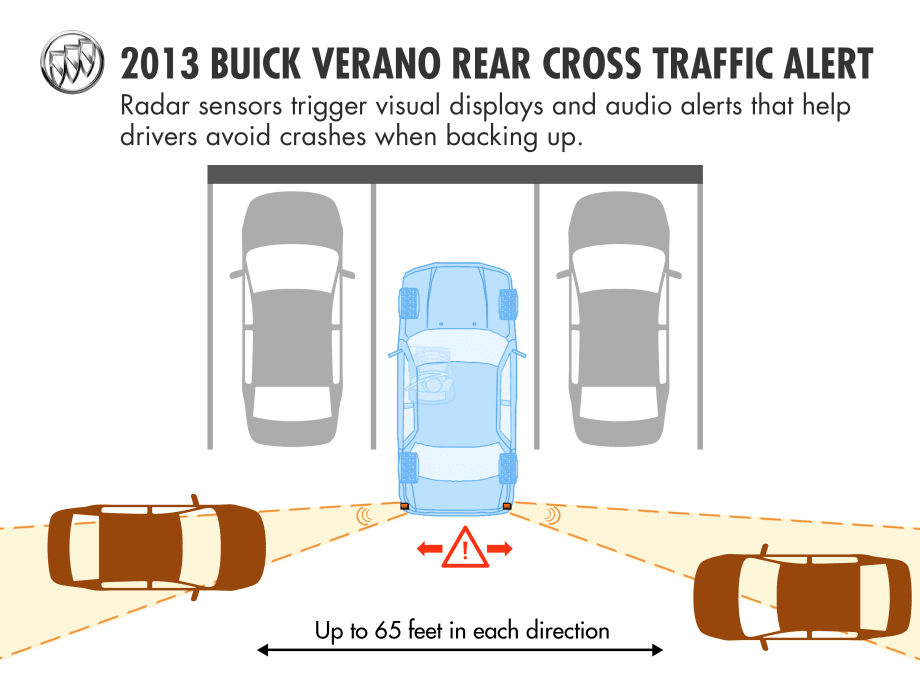
Later this summer, Verano will make standard a Rear Vision Camera on all models and an optional safety package that includes Side Blind Zone Alert and Rear Cross Traffic Alert. These two technologies share a set of radar sensors hidden in the corners of the rear bumper that may help drivers avoid crashes when changing lanes or backing.
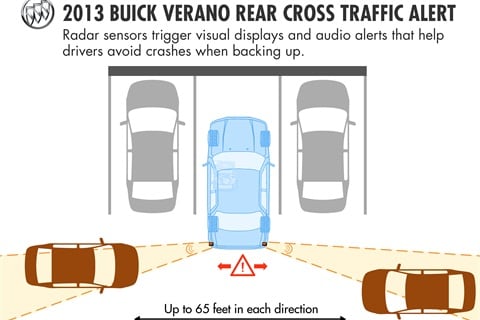
Rear Cross Traffic Alert senses cross traffic up to 65 feet away that may not be visible to the driver when backing out of a parking space or driveway. The driver is alerted with a red directional arrow displayed on the Rear Vision Camera screen and three directional beeps.
“We want to integrate our backing visual warnings onto that screen so drivers know where to look and can quickly see for themselves what’s causing the warning,” said Raymond Kiefer, General Motors active safety technical fellow. “That way, they can react quickly to what the camera, radar and ultrasonic sensors are detecting.”
Side Blind Zone Alert technology makes its way to the Verano from the larger LaCrosse luxury sedan and Enclave luxury crossover SUV. It cautions drivers when a vehicle is in a blind zone in an adjacent lane. According to sales data, it is among Buick’s most popular active safety features.
Encore, which arrives early in 2013, will offer the combination of Forward Collision Alert and Lane Departure Warning. Both features use a single forward-looking camera sensor.
“Studies suggest that people can use changes in object size as they approach to estimate how long until they collide,” said Kiefer. “Buick’s single-camera detection system works much like a human eye, with state-of-the-art image processing equipment analyzing 10-12 scene images per second to decide if the changes in the size of a vehicle ahead suggest a crash may be just a few seconds away.”
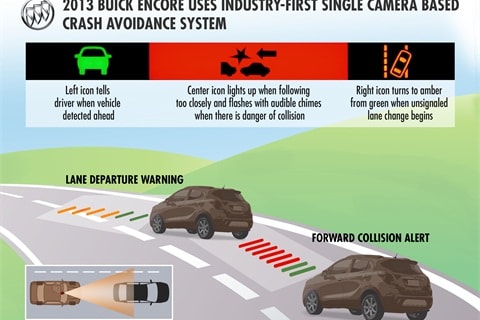
Forward Collision Alert can be adjusted to near, medium and far timing settings. Although an “Off” setting is also provided, the majority of owners report they keep the system active.
At speeds above 25 mph, Forward Collision Alert gives audible and visual warnings when a collision may be imminent. Lane Departure Warning alerts drivers when they may have crossed a detected lane marker without using a turn indicator when driving at speeds over 35 mph. It, too, can be deactivated with the push of a button.
Like every current Buick, Encore will be offered with a Rear Vision Camera.
Enclave will debut this year with safety innovations of its own, including a front center air bag. Every Buick also comes standard with six months of an OnStar Directions and Connections plan, which includes Automatic Crash Response and roadside assistance.
Every 2012 Buick model is rated a Top Safety Pick by the Insurance Institute for Highway Safety, and every Buick model tested by the U.S. government’s New Car Assessment Program this year has received a Five Star Overall Vehicle Score.
More Safety

Nexar-Nauto Merger Aims to Give Fleets Better Safety Intelligence Through Larger Driving Dataset
Stefan Heck tells Automotive Fleet that combining more than 10 billion miles of driving history with Nexar's AI models will give fleets deeper insights into driver risk and roadway conditions than either company could provide independently.
Read More →
Don't Wait for a Crisis: 5 Ways to Build Mental Health Into Your Fleet Safety Program
For Suicide Prevention Month, fleet and safety leaders have an opportunity to put mental health where it belongs: at the center of workplace safety.
Read More →
How Camera Data Can Strengthen a Fleet’s Insurance Renewal
Insights from a commercial insurance carrier and a broker show how fleets can turn video telematic data, driver coaching, and improved claims results into a stronger case at insurance renewal.
Read More →
The Safest Fleets Aren’t the Ones with the Most Technology
You’ve made the telematics investment. Here’s how to capture the other half of its value and build the safest fleet on the road.
Read More →
Hidden in Plain Sight: Fleet Compliance Risks
Fleet compliance isn't just about having policies — it's about consistently enforcing them. This practical guide reveals six hidden compliance risks common in public sector and shared fleet operations and outlines proven strategies to improve visibility, accountability, and audit readiness
Read More →
NETS Sets 2026 Fleet Safety Benchmark Conference for Indianapolis
The Sept. 15–17 program will feature fleet benchmarking data, case studies, emerging technologies, and implementation strategies while running alongside the NSC Safety Congress & Expo.
Read More →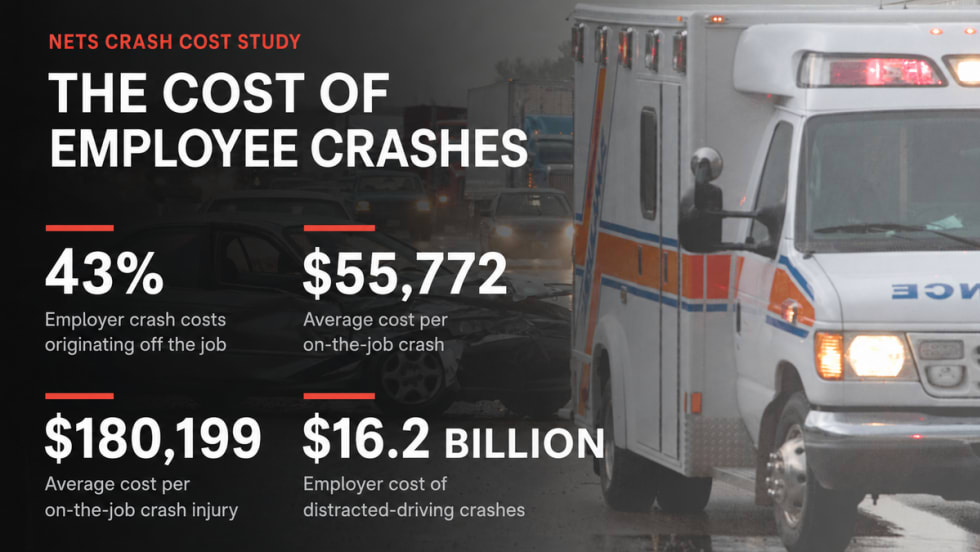
Off-the-Job Crashes Account for 43% of Employers’ $61.7 Billion Crash Burden
NETS quantifies costs dispersed across fleet, risk, HR, and other departments while providing new per-crash benchmarks for employers.
Read More →
Ram Recalls More Than 1.27 Million 1500 Pickups for Seat Belt Anchor Issue
The recall affects certain 2019-2026 Ram 1500 pickups that may have improperly attached second-row seat belt buckle anchors.
Read More →
How Better Visibility Cut Speeding Violations by 48%
Fleet leaders don't need more data, they need clearer visibility into what the data is saying. This case study explores how one utility replaced speeding-event counts with a single metric — miles driven in violation — to strengthen safety and significantly reduce speeding violations.
Read More →
Operation Safe Driver Week: Why the Industry's Oldest Safety Campaign Still Matters to Fleets
A look at how a 2007 enforcement initiative became one of the most consequential weeks on the fleet safety calendar, and what it means for your drivers in 2026.
Read More →