




Autonomous Driving Tech Designed for Russian Conditions
Russia is advancing self-driving research and demonstrations. Moscow-based Cognitive Technologies has developed plug-and-play autonomous vehicle technology designed system specifically for Russian driving conditions.

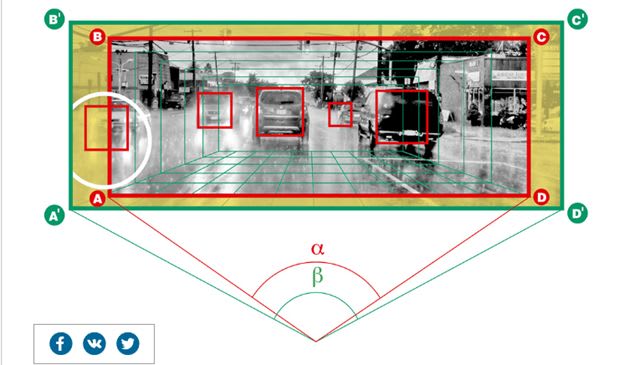
When the object (in the white circle) gets in the border of the camera’s field of view (ABCD), it is very difficult to recognize. Self- driving vehicle’s Artificial intelligence complements the knowledge about the current traffic situation with the RAM data (modeling human hippocampal function). A'B'C'D Picture ', recorded a moment earlier, contains information about the object, sufficient for its recognition. Photo: Cognitive Technologies
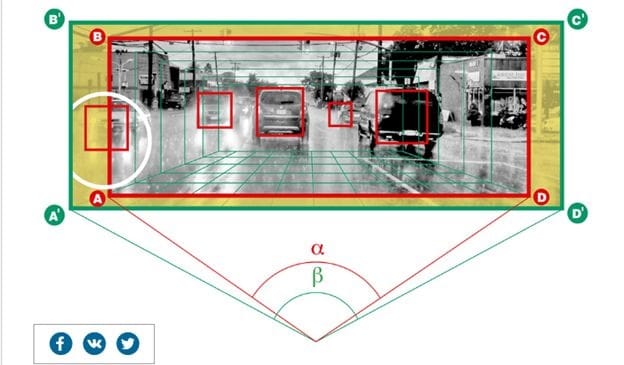
When the object (in the white circle) gets in the border of the camera’s field of view (ABCD), it is very difficult to recognize. Self- driving vehicle’s Artificial intelligence complements the knowledge about the current traffic situation with the RAM data (modeling human hippocampal function). A'B'C'D Picture ', recorded a moment earlier, contains information about the object, sufficient for its recognition. Photo: Cognitive Technologies
Autonomous vehicle technology is currently being tested around the globe — with the U.S., Western Europe, and Japan being some of the leading hotspots with high-profile demonstrations of the autonomous vehicles.
Russia is also contributing to the self-driving research and demonstrations. Moscow-based Cognitive Technologies has developed autonomous vehicle technology designed specifically for Russian driving conditions, including heavy weather, such as snow and rain, poor road markings, and various road obstacles, such as humans and animals.
The C-Pilot autonomous driving system, which was unveiled in August, can be installed as an aftermarket solution. The self-driving vehicle prototype includes numerous safety features to warn the driver about road or driving conditions, including lane departure warning, traffic sign recognition, collision warning, blind-spot monitoring, and pedestrian protection, according to a company representative.
The company expects to introduce the system outside of the Russian market to manufacturers and fleets in the second quarter of 2017, and sign contracts with automotive manufacturers and Tier 1 suppliers by 2020, according to the company representative.
The system is designed to function similar to the human brain’s hippocampus, allowing the system to learn from its environment, according to a company release.
While many aspects of the C-Pilot system are similar to other systems being developed, one key difference of Cognitive Technologies’ system is that it's chip free, meaning that it can interface with any vehicle the same way a mobile device does. It can be updated numerous times and remotely, according to the company representative.
Another advantage the Russian system has over some of the others available in other markets is that it can recognize images on the border of the image, according to a company release.
The company is also working with Russian truck manufacturer KAMAZ to test an autonomous truck on a closed track — Russian traffic laws currently prohibit autonomous vehicles on private roads, according to a Cognitive Technologies representative — and has performed simple maneuvers, such as turning, turning around, snaking motion, and others. The field tests are being carried out in poor driving conditions such as low visibility and with road obstacles.
Beyond the traditional automotive market, Cognitive Technologies has been working with agricultural farm equipment manufacturer Rostselmash and Souz Agro, the largest agricultural holdings of the Republic of Tatarstan, to develop agricultural self-driving technologies.
More Global Fleet
Holman Takes Full Ownership of ARIZA in Mexico
Holman is bringing its Mexican fleet management operation fully under its own brand after more than 30 years as a joint venture. The change gives multinational fleet customers a single Holman operation across the U.S., Canada, and Mexico.
Read More →
Proven Ways to Reduce Work Truck Downtime
The age-old problem of downtime will always be a reality, but with new strategies at hand, fleets have more ways to keep trucks on the road longer.
Read More →
The Top 300 Commercial Fleets
The Top 300 Commercial Fleets: See the List
Read More →

Cameras, Safety and Insurance: From Reactive Claims to Real-Time Prevention (Part 2 of 2)
Part Two: Commercial auto remains one of the most challenging and costly lines of coverage for fleet operators and insurers alike. Continue learning more about how to effectively address these issues from Onur Aksan, Enterprise Business Development Executive, Geotab
Read More →
Cameras, Safety and Insurance: From Reactive Claims to Real-time Prevention
Commercial auto remains one of the most challenging and costly lines of coverage for fleet operators and insurers alike. Learn more about how to effectively address these issues from Onur Aksan, Enterprise Business Development Executive, Geotab.
Read More →
Fleet Costs Are Rising: Here’s How Leaders Are Responding
Fleet leaders are under pressure to reduce costs, adapt to economic uncertainty, and make smarter decisions. See how peers across North America are responding with real data, proven strategies, and forward-looking insights. Download the 2026 Market Pulse Report to benchmark your strategy and uncover where you can gain an edge.
Read More →
Enterprise Fleet Management Surpasses 900,000 Vehicles in U.S. & Canada
Enterprise Mobility connects with mobility solutions around the globe
Read More →
Automotive Fleet's Guide to Fleet Electrification
Unlock the secrets to a successful transition to electric fleets with Automotive Fleet's comprehensive Fleet Electrification Guide!
Read More →
Sumitomo Rubber Industries to Acquire Viaduct
Viaduct will join Sumitomo as an independent subsidiary. Partnership strengthens global reach and accelerates AI-driven innovation for fleets and manufacturing.
Read More →