




Albertsons' Zero-Emission Refrigerated Grocery Delivery Fleet
The VNR Electric models from Volvo Trucks North America are the first zero tailpipe emission, battery-electric Class 8 trucks to be deployed in Albertsons' company-wide fleet.

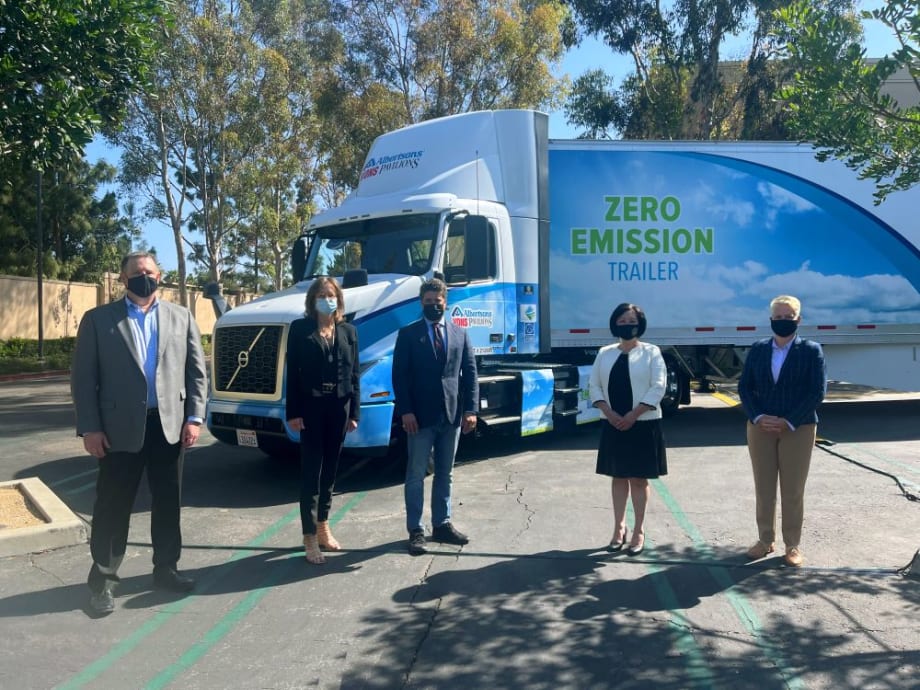
Event speakers pictured from left to right: Tim Burke, Vice President of Transportation, Albertsons Cos; Dee Dee Myers, Senior Advisor and Director of the Governor’s Office of Business and Economic Development (GO-Biz); Gideon Kracov, Board Member, California Air Resources Board; Lisa Bartlett, Orange County Supervisor and South Coast Air Quality Management District Governing Board Member; and Christina Ameigh, Regional Vice President of Sales - West, Volvo Trucks North America.
Photo: Volvo Trucks
Albertsons Companies, the second-largest grocery chain in the U.S., took delivery of two Volvo VNR Electric trucks at its distribution center in Irvine, California. The VNR Electric models from Volvo Trucks North America are the first zero tailpipe emission, battery-electric Class 8 trucks to be deployed in Albertsons' company-wide fleet, and will be serving Albertsons, Vons, and Pavilions stores in Southern California.
Albertsons has procured electric-powered transport refrigeration units from Advanced Energy Machines to pair with its Volvo VNR Electrics, enabling Albertsons Cos. to make the first commercial 100% zero-emission grocery delivery with a Class 8 truck in the U.S.
The inaugural delivery took place May 28 at a LEED-certified Albertsons store in Irvine.
“We are thrilled to continue our long-term partnership with Albertsons Cos. as they begin their journey toward fleet electrification and achieve this momentous accomplishment of a fully zero-emission grocery delivery,” said Peter Voorhoeve, president, Volvo Trucks North America. “Albertsons’ commitment to corporate sustainability is demonstrated by the steps it is taking to reduce its carbon footprint in its stores and fleet. We are confident that the Volvo VNR Electrics Albertsons is deploying in Southern California will enable the company to not only reduce its emissions, but to make reliable daily deliveries to its grocery stores throughout the region.”
Albertsons Cos. operates 1,400 Class 8 trucks nationwide, all of which are certified under the U.S. Environmental Protection Agency SmartWay program as meeting high transportation sustainability and efficiency standards. The Southern California fleet, which is made up entirely of trucks manufactured by Volvo Trucks, covers 335 stores in the region, running from the Central Coast to the California-Mexico border.
Increasing its transportation sustainability is just one way in which Albertsons Cos. reduces its environmental impact. Albertsons Cos. maintains sustainability goals in all sectors of its operations, including energy use, plastics and packaging, and recycling and waste reduction. In April, Albertsons Cos. committed to setting a science-based target to reduce carbon emissions.
The company’s emissions reduction target will include their direct operations and value chain in order to support the goals of the United Nations’ Paris Agreement and prevent the worst impacts of climate change. In order to meet their climate goals, Albertsons Cos. will leverage innovative technology, like Volvo VNR Electric trucks, and continue to implement expansive energy- efficiency projects and produce renewable energy.
“The partnership Albertsons has built with Volvo Trucks has enabled our fleet to be on the forefront of innovation and to demonstrate our leadership in sustainable transportation,” said Tim Burke, vice president of transportation, Albertsons Cos. “We look forward to operating Volvo VNR Electric trucks in our Southern California routes, as they will not only help improve air quality in the communities in which we operate, but the quiet motors will also provide a better working environment for our drivers and grocery store staff.”
The Volvo VNR Electrics Albertsons acquired through Volvo Financial Services are part of the Volvo LIGHTS (Low Impact Green Heavy Transport Solutions) project, an innovative collaboration between Volvo Trucks North America, the South Coast Air Quality Management District (South Coast AQMD), and 12 other organizations to develop a robust support ecosystem to successfully introduce battery-electric trucks and equipment into the North American transport industry at scale.
“By taking this major step, Albertsons has demonstrated the viability of a sustainable, zero-emission goods delivery future,” said Lisa Bartlett, Orange County Supervisor and South Coast AQMD governing board member. “South Coast AQMD commends Albertsons and the Volvo LIGHTS project for helping us reach this milestone, paving the way for future fleets to improve air quality throughout the South Coast Air Basin.”
To help Albertsons maximize vehicle uptime, TEC Equipment, Volvo Trucks’ largest West Coast dealership and a Volvo LIGHTS project partner, will provide contracted maintenance and repairs through the premier Volvo Gold Contract service offering at its location in Fontana.
TEC Equipment, as well as dealers throughout the Western U.S., will receive continued battery-electric vehicle support and access to expert knowledge about the VNR Electric model with the addition of a new Volvo Trucks training facility in Hayward, California. This 9,600-square-foot location will facilitate programs for Volvo Trucks’ employees, dealer technicians, sales staff, and aftermarket personnel, as well as owner-operators and fleet customers.
Originally posted on Work Truck Online
More Operations

What's Best Handled by an FMC, and What's Better Done Directly?
Fleet managers continue to rely on FMCs for essential services but are taking a closer look at where working directly with suppliers can improve efficiency and responsiveness.
Read More →
Fleet Meets: Erin Gilchrist
Meet Erin Gilchrist, the inaugural Mike Antich Spirit of Fleet Award winner, as she shares insights on leadership, mentorship, the power of industry connections, and why people remain at the heart of fleet's future.
Read More →
How 2026 Fleet Visionary Jamie McKay Manages 2,400 Vehicles Across 37 States
How do you keep 2,400 vehicles running across 37 states? Fleet Visionary Award winner Jamie McKay shares how collaboration, flexibility, and a few simple strategies help her tackle fleet management challenges at Aptive Pest Control.
Read More →

Managing Fleet Costs in an Era of Permanent Volatility
Fleet operating costs have risen more than 20% since 2020, raising a key question: When does extending a vehicle's service life stop making financial sense?
Read More →
The Next Evolution of Fleet Management: Autonomous Operations
This opening keynote session at the Fleet Forward Conference highlights the future of autonomous driving for fleets.
Read More →
How to Reduce the Total Cost of Risk From Catalytic Converter Theft
A stolen catalytic converter can cost fleets far more in downtime and lost productivity than in repairs. A total-cost-of-risk approach can help fleet managers quantify their exposure and prioritize theft prevention.
Read More →
Personal-Use Charges Rise as Vehicle Values Fall | AF News Recap
Personal-use charges are climbing, wholesale used-vehicle values are declining, and commercial fleet sales growth is slowing. This week, we're breaking down the latest fleet data, plus how Element Fleet Management is helping Waymo prepare for its first Canadian robotaxi market.
Read More →
Here's When You Should Make an Exception to Fleet Policy
Fleet policies are designed to create consistency, but not every driver or situation fits neatly within standard rules.
Read More →
AI-Native or AI-Acquired: What Should Fleet Managers Look for in an AI Platform?
Six questions can help fleet managers look beyond AI marketing claims to evaluate integration, data access, and real-world operational performance.
Read More →
A buyer's guide to fleet management software in 2027
Buying fleet management software in 2027 means looking beyond features and price. As fleet operations, technology and expectations evolve, this guide explores what today’s fleet professionals should consider when choosing a system that can deliver value now and adapt to what comes next.
Read More →