




AAA Unveils EV-Charging Roadside Assistance Truck
RALEIGH, NC - AAA has unveiled a roadside assistance truck that can provide Level 2 and Level 3 charging to electric vehicles.
RALEIGH, NC - AAA has unveiled a roadside assistance truck that can provide Level 2 and Level 3 charging to electric vehicles.
During a news conference at the Plug-In 2011 Conference & Exposition, AAA said it will initially deploy the trucks with mobile electric vehicle charging capability in six metropolitan areas across the U.S. as a pilot program. The urban areas are Portland (Ore.), Seattle, the San Francisco Bay area, Los Angeles, Knoxville (Tenn.), and the Tampa Bay area. The phased rollout will begin later this summer and continue into the fall.
"While these six areas are part of the initial pilot program, we've had tremendous interest from AAA clubs across the country to offer this service to their members, and we anticipate expanding the program to additional areas in the months following initial deployment," said John Nielsen, AAA director of auto repair, buying services and consumer information.
The pilot program will include AAA roadside assistance vehicles equipped with different mobile EV-charging technologies. This will allow the motor club to evaluate various technologies in different environments around the country.
The truck unveiled at Plug-In 2011 is powered by Green Charge Networks. The vehicle features a removable lithium-ion battery pack for mobile charging. Other vehicles will be equipped with generators powered by alternative fuels and other power sources.
The truck is similar to AAA's other light services vehicles -- a notable difference from mobile charging vehicles recently unveiled in other countries. Officials demonstrated how the truck is equipped to allow AAA's technicians to provide traditional roadside assistance, such as battery testing, jump starts and replacements, tire changes, fuel delivery and lockout service.
"AAA has been a leader in addressing the needs of motorists for more than a century, and the introduction of mobile electric vehicle charging continues that tradition," said Marshall L. Doney, AAA automotive vice president. "As the electric vehicle market continues to emerge, AAA is ready to help alleviate some 'range anxiety' with the ability to provide a charge to electric vehicles on the roadside that gets drivers back on the go quickly."
AAA will provide 10 to 15 minutes of charge time to members with discharged electric vehicles, which will allow the vehicle to drive three to 15 miles to a charging station where they can further charge their vehicle.
The first Nissan Leaf and Chevrolet Volt were delivered to customers in December 2010, and manufacturers estimate production by year-end to be a combined 40,000 vehicles with an additional 145,000 planned for 2012. Current manufacturer projections have 1.2 million electric vehicles on the road by 2015.
There are three charging levels for electric vehicles. Level 1 is a standard 120-volt household outlet, which would take roughly 20 hours to fully charge a Nissan Leaf. Level 2 is 240 volts AC (alternating current). This is commonly found in household electric clothes dryers and can charge a Nissan Leaf in approximately six hours. Level 3 is DC (direct current) charging at high voltage -- up to 500 volts DC. This allows a large amount of energy to be delivered to an electric vehicle in a very short period of time. A "depleted" Nissan Leaf could go to 80 percent state-of-charge in roughly 30 minutes with Level 3 charging.
More Safety

How Better Visibility Cut Speeding Violations by 48%
Fleet leaders don't need more data, they need clearer visibility into what the data is saying. This case study explores how one utility replaced speeding-event counts with a single metric — miles driven in violation — to strengthen safety and significantly reduce speeding violations.
Read More →
Operation Safe Driver Week: Why the Industry's Oldest Safety Campaign Still Matters to Fleets
A look at how a 2007 enforcement initiative became one of the most consequential weeks on the fleet safety calendar, and what it means for your drivers in 2026.
Read More →
Nexar-Nauto Merger Aims to Give Fleets Better Safety Intelligence Through Larger Driving Dataset
Stefan Heck tells Automotive Fleet that combining more than 10 billion miles of driving history with Nexar's AI models will give fleets deeper insights into driver risk and roadway conditions than either company could provide independently.
Read More →
From Silos to Solutions: Relationship Management for Safer Fleets
From telematics adoption and driver accountability to policy consistency and risk mitigation, this episode breaks down what it really takes to build a safer fleet culture without slowing business down.
Read More →
IIHS Launches First Commercial Vehicle Safety Evaluations
The Insurance Institute for Highway Safety has begun evaluating heavy-duty pickups and cargo vans for driver protection. Which models earned top marks?
Read More →
Reducing Risk by Eliminating Phone Use Behind the Wheel
Hosted with the cofounder of Lifesaver Mobile, this episode addresses phone use behind the wheel and how to design a driving environment that actually helps prevents accidents.
Read More →
Cameras, Safety and Insurance: From Reactive Claims to Real-Time Prevention (Part 2 of 2)
Part Two: Commercial auto remains one of the most challenging and costly lines of coverage for fleet operators and insurers alike. Continue learning more about how to effectively address these issues from Onur Aksan, Enterprise Business Development Executive, Geotab
Read More →
How 5-Second Telematics Data Is Changing Fleet Safety
This episode connects with Steve Santostasi of Ford Pro and covers how a few seconds of data can make a difference in fleet safety.
Read More →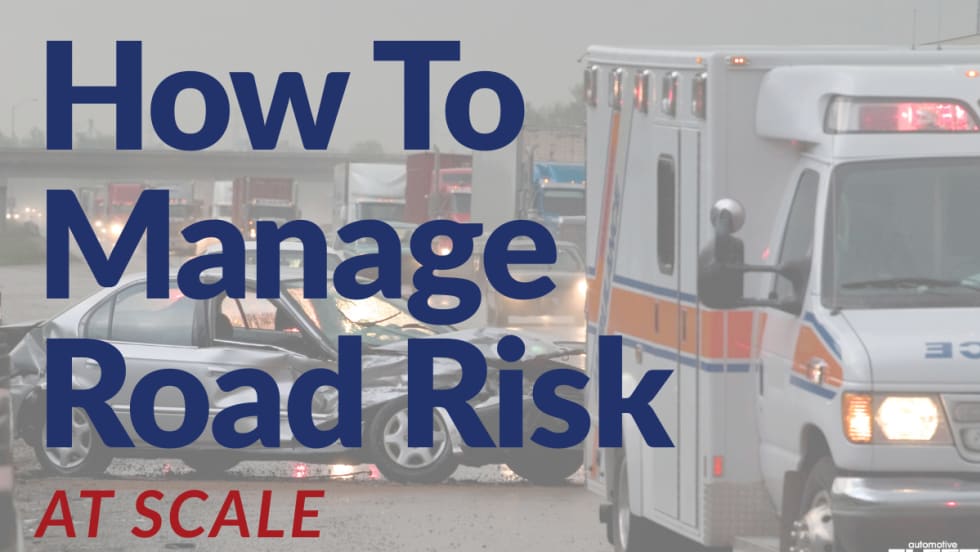
Managing Road Risk at Scale: Why Fleet Safety Needs a Data-Driven Framework
Insights from the FIA Road and Driver Safety Indexes reveal how to manage road risk on a larger scale.
Read More →
Stellantis Recalls 1.3 Million Jeep Vehicles Worldwide Over Fire Risk
Stellantis is recalling more than 1.3 million Jeep Wrangler and Gladiator models worldwide over a fire risk linked to power steering pump wiring.
Read More →