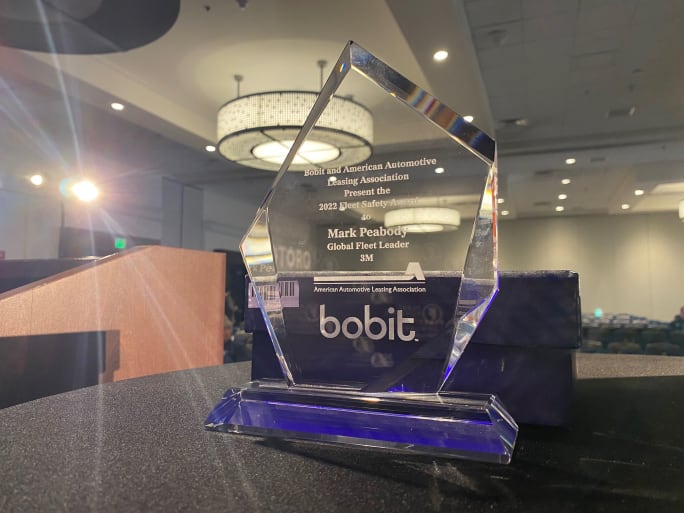
The award, presented at the 2022 Fleet Safety Conference in Santa Clara, Calif., is bestowed annually to a fleet or risk manager whose leadership and innovation have enhanced the safety of fleet drivers, their organizations, and the general public.
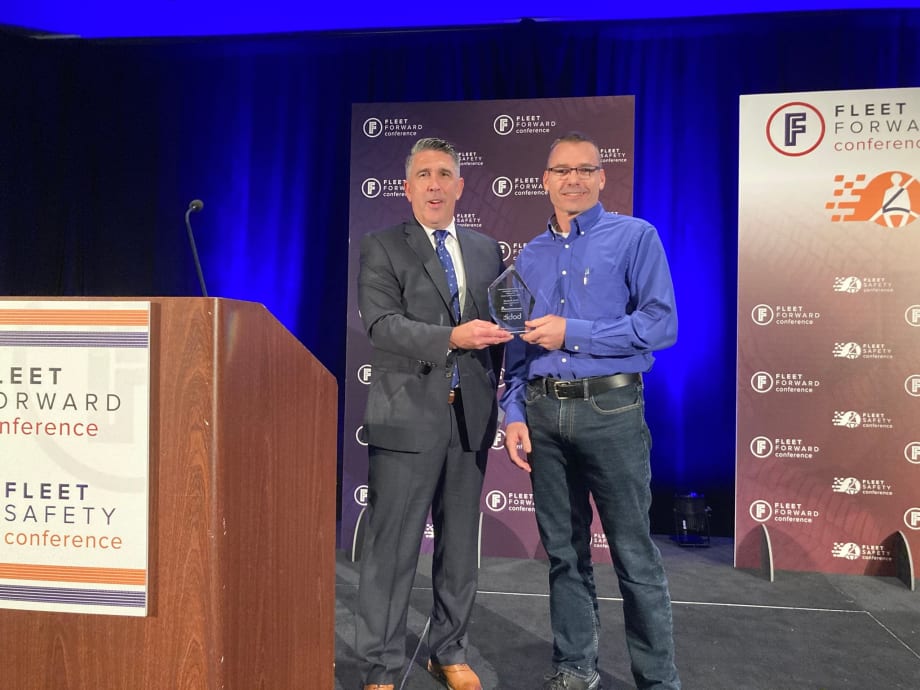
Mike Joyce (left), executive director of AALA, presents the 2022 Fleet Safety Award to Mark Peabody, global fleet manager, 3M.
Photo: Chris Brown
3 min to read
Mark Peabody, global fleet manager at 3M, has won the 2022 Fleet Safety Award. Peabody accepted the award at the 2022 Fleet Safety Conference, convened in conjunction with the Fleet Forward Conference in Santa Clara, Calif., on Nov. 11.
Ad Loading...
The award, presented by Automotive Fleet and sponsored by American Automotive Leasing Association (AALA), is bestowed annually to a fleet or risk manager whose leadership and innovation have enhanced the safety of fleet drivers, their organizations, and the general public. The award comes a $1,000 scholarship from AALA that the winner can retain or designate as desired.
Ad Loading...
Mike Joyce, executive director of AALA, took the stage first to explain the award.
“We have noticed the uptick in fatalities on our nation’s highways during the past several years, and as ‘fleet’ we have ways in which we can help to reduce fatalities and build a culture of safety into all of our organizations,” Joyce said.
Joyce cited these statistics: An estimated 20,175 people died in motor vehicle traffic crashes, an increase of about 0.5% as compared to 20,070 fatalities NHTSA projected for the first half of 2021. Fortunately, NHTSA projects that the second quarter of 2022, from April to June, had the first decline in fatalities after seven consecutive quarters of year-to-year increases in fatalities that began in the third quarter of 2020.
Joyce quoted U.S. Transportation Secretary Pete Buttigieg: "Traffic deaths appear to be declining for the first time since 2020, but they are still at high levels that call for urgent and sustained action. These deaths are preventable, not inevitable, and we should act accordingly," said "Safety is our guiding mission at the Department of Transportation, and we will redouble our efforts to reduce the tragic number of deaths on our nation’s roads."
Peabody then took the podium and accepted the award.
Ad Loading...
Peabody’s Acceptance Speech
Peabody first recounted his own fleet safety incident 26 years ago, in which he ended up driving off a mountain road. His supervisor, as part of his protocols to process the accident, did not make asking him if he was okay a priority.
“Working in fleet, I can get caught up in the process, procedures, savings, data, statistics, but, for me, I need to be reminded that people are the ‘why’ behind everything we do,” he said. “People matter most.”
Peabody said that four years ago he embarked on a cross-functional team goal to reduce accidents that involved a six-sigma process that focused on policy and communications. Peabody’s team completed extensive benchmarking and leveraged the NETS 10-Step program to reduce crash risk. The team also created a fleet safety committee to review high-risk cases.
Though improvements were slow in coming, Peabody shared that as of February 2022 there are zero high-risk drivers in the 3M fleet and that incidents per million miles have dropped by more than 25% over the past four years.
“Changing behavior and creating a safety culture takes time but the results are worth it, and this brings us back to people. Our team and partners have improved people’s lives by reducing accidents,” he said. “That is something we can all be proud of.”
Ad Loading...
Peabody concluded: “So, if you get a call from one of your drivers who says they drove off a mountain, maybe your first question should be ‘Are you ok?’”
The Fleet Safety Award nominating process involves nominations by AALA fleet member companies or self-nominations, an application process to understand applicants’ safety initiatives and policies, and a review process by AALA’s fleet management executives to determine the winner. The award comes a $1,000 scholarship from AALA that the winner can retain or designate as desired.
Photo: Louis Prejean
Award Nomination Process
The Fleet Safety Award nominating process begins with each of the AALA fleet member companies submitting nominees they feel best exemplify the award qualifications. Individuals and companies can self-nominate.
2022 Fleet Safety Award Finalists
Josh Nelson, Safety Manager, B&G Transportation
Michael Duffy, Transportation Operations & Fleet Manager, University of Virginia Facilities Management
Cindy Fraley Hunter, Road Safety Senior Manager for the Americas, Johnson & Johnson
Eric Richardson, Deputy Chief Fleet Management Officer, NYC Fleet
Kelly Pierce, Manager, Fleet, Cable One
Mark Peabody, Global Fleet Manager, 3M
Mike Camnetar, Global Shared Services / Fleet Services Manager, General Mills
Laura Villanueva, Operations Supervisor (Sped, Training and Safety), Klein ISD
Trevor Phelps, Fleet Manager, Power Home Remodeling Group; Power Home Craftsmanship
Mike Miller, Sr. Vice President, EHS, Sustainability, Risk and Procurement, Advance Auto Parts
Ken Foster, Director of Global Fleet Operations, Global Supply Management & Fulfillment-Fleet Management, Johnson Controls Inc.
Dustin Hames, Fleet Director / Operational Advisor, LUMA Energy
Rachel Johnson, Fleet Specialist, Region Americas, Konecranes
Tom Karnowski, Vice President – Environment, Health, Safety (EHS), USIC, LLC
The nomination application requests total number of fleet vehicles; how often they obtain motor vehicle records that report driving history; crash/collision rate and related improvements; safety measures, company philosophy, and safety-related vehicle options; as well as the use of telematics.
Additionally, the application looks to understand how the company safety policy was created, how it is enforced, and how these dedicated employees help to establish a culture of safety within their organizations. Through this process, AALA’s fleet management executives review the nominees and chose the winner.
Rising operating costs, driver safety concerns, and unplanned downtime are putting unprecedented pressure on modern fleets. Discover how fleet managers use embedded OEM connectivity and real-time vehicle data to cut TCO, prevent downtime, and protect drivers without aftermarket telematics hardware.
Mental health belongs in the fleet safety conversation. This week, we’re looking at five ways fleets can support employee well-being before a crisis, plus Holman’s expansion in Mexico, new one-day Fleet Forward passes, and why EV charging demand is outpacing infrastructure growth.
Stefan Heck tells Automotive Fleet that combining more than 10 billion miles of driving history with Nexar's AI models will give fleets deeper insights into driver risk and roadway conditions than either company could provide independently.
Insights from a commercial insurance carrier and a broker show how fleets can turn video telematic data, driver coaching, and improved claims results into a stronger case at insurance renewal.
Fleet compliance isn't just about having policies — it's about consistently enforcing them. This practical guide reveals six hidden compliance risks common in public sector and shared fleet operations and outlines proven strategies to improve visibility, accountability, and audit readiness
The Sept. 15–17 program will feature fleet benchmarking data, case studies, emerging technologies, and implementation strategies while running alongside the NSC Safety Congress & Expo.