




2013 Hyundai Santa Fe to Come in Five and Seven-Passenger Versions
COSTA MESA, CA – Hyundai announced details on its all-new 2013-MY Santa Fe, the third generation of the vehicle, which the automaker is launching the Santa Fe in five- and seven-passenger versions.
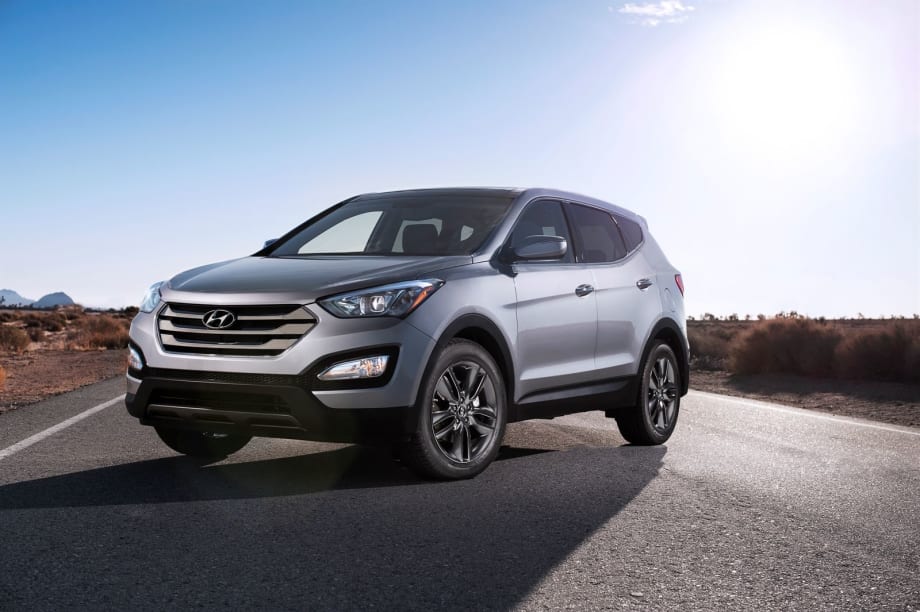
The 2013 Santa Fe Sport.
The 2013 Santa Fe Sport.
COSTA MESA, CA – Hyundai announced details on its all-new 2013-MY Santa Fe, the third generation of the vehicle, which the automaker is launching the Santa Fe in two different versions. The first is the Santa Fe Sport, a five-passenger model that’s roughly the same size as the current Santa Fe and the second is a new, seven-passenger model called the Santa Fe that features a longer wheelbase and three rows of seating. Some of the highlights of the new model include all-new crossover vehicle architecture, weight reduction of 266 lbs., and a new 2.4L engine lineup, among a number of comfort and connectivity features.
Performance
Hyundai is offering a 2.4L gasoline direct injection (GDI) engine or a 2.0L GDI for the five-passenger Santa Fe Sport. The 2.4L gets EPA-estimated mpg of 22 city, 33 highway, 26 combined and can produce up to 190 hp and 181 lb. ft. of torque. The 2.0L engine can produce 264 hp and gets mpg of 21 city, 31 highway, 25 combined. The LWB version of the 2013 Santa Fe is powered by the company’s 3.3L GDI V-6 engine (also used in the Hyundai Azera).
All the engines in the all-new 2013-MY Santa Fe lineup are matched with the automaker’s six-speed automatic transmission with SHIFTRONIC manual control. Also, all models come with an Active ECO system that modifies engine and transmission control to smooth out throttle response and improve fuel economy.
When it comes to handling, the Santa Fe offers Hyundai’s Active Cornering All-Wheel-Drive (ACC AWD) system that controls engine torque and braking in conjunction with the Vehicle Stability Management System. Other handling features include Hyundai’s Hillstart Assist Control (HAC) and Downhill Brake Control (DBC), which help drivers maneuver on inclines.
Exterior
The Santa Fe follows the automaker’s “fluidic design” philosophy and features what Hyundai calls its “Storm Edge” design concept. The Santa Fe uses a three-bar hexagonal front grille, LED headlight accents, and has a low stance, a rising beltline, a roof spoiler, and wraparound taillights.
The LWB version of the Santa Fe features a shape that is designed to highlight the added passenger and cargo room behind the second-row seat. It also has its own B-pillar back and grille design, 18-inch alloy wheels, dual exhaust tips, and a flush-mounted tow hitch design.
For the overall design of the vehicle, Hyundai focused on weight reduction as a way to improve fuel economy. For the sake of comparison, the 2013 Santa Fe Sport 2.4L FWD weighs 266 lbs. less than the previous generation 2012 Santa Fe four-cylinder. The Santa Fe Sport 2.0L Turbo weighs 333 lbs. less than the 2012 Santa Fe V-6 FWD it replaces.
Interior
Inside, both Santa Fe models offer heated rear seats, available eight-way power driver seats and standard 40:20:40 folding rear seat back. Also standard on all Santa Fe models with cloth seating is a YES Essentials seat fabric treatment that provides soil-resistant, anti-odor and anti-static properties. Other interior details include an optional panoramic sunroof, a push-button starter with proximity key (optional on 2.4L models, standard on Turbo models), a heated steering wheel and sliding second row seats (optional on Santa Fe Sport). On the LWB Santa Fe, the heated steering wheel is optional but the sliding second row seats are standard.
On the LWB Santa Fe, the vehicle offers second-row space that provides an extra 1.9 inches of legroom and cargo capacity that offers an extra 5.6 cu. ft. and houses second-row HVAC controls and vents to increase family comfort, while also offering a standard 50:50 split folding third-row bench seat with 31.5 inches of legroom.
The Santa Fe offers a number of storage features, such as an overhead console sunglass holder, two front and two rear seat cupholders, door bottle holders, cooled glovebox, enlarged central storage console, front storage bin, front seat- back pockets, a cargo under tray, and floor board storage.
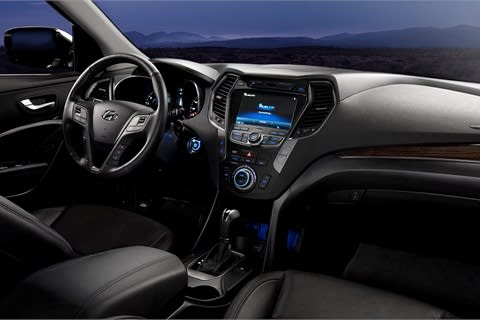
The interior of the Santa Fe Sport.
Safety
When it comes to safety features, all FWD models offer a standard Vehicle Stability Management (VSM) system, which manages Electronic Stability Control and the vehicle’s Motor-Driven electric Power Steering. VSM helps manage vehicle stability during sudden lane changes and fast cornering. Hyundai adds torque and brake vectoring to the AWD models of the Santa Fe.
The Santa Fe features seven airbags, including a driver’s knee airbag and side curtain airbags with rollover sensors. When the vehicle’s sensors detect a potential rollover, its control module triggers the head-curtain side airbags and safety belt pre-tensioners in order to help protect passengers against serious injury.
The vehicle’s braking package that offers ABS, Brake Assist, which provides maximum braking force when the vehicle’s sensors detect a panic stop, and Electronic Brake-force Distribution to automatically adjust the braking force to the front and rear axle. The vehicle also offers passive safety features including a Lower Anchors and Tethers for Children (LATCH) system for children’s seats and three-point seatbelts for all positions.
Infotainment and Connectivity
Inside, the Santa Fe models offer an optional 8-inch touchscreen display with navigation. The third generation of the display features a simplified user interface, according to Hyundai, enhanced voice recognition, and improved navigation screens. The automaker also integrated HD Radio technology into all of its displays.
All Santa Fe models offer a choice of four audio systems. The standard system features an AM/FM/Satellite Radio/CD/MP3 audio system with six-speakers and iPod/USB/auxiliary input jacks and wireless audio streaming. The next level of audio system features a 4.3-inch full-color LCD touchscreen with HD Radio technology and a rear-view camera. The third option features the optional touchscreen display and navigation system, a rear-view camera and either a Dimension 10-speaker premium audio system or the Infinity 550-watt, Logic 7 audio system with 12 speakers. A SiriusXM Satellite Radio interface is integrated into each head unit. Hyundai also offers a Bluetooth hands-free phone system with voice recognition, address book download, and audio streaming as standard. Blue Link turn-by-turn navigation is standard on all Santa Fe models.
More Operations

A buyer's guide to fleet management software in 2027
Buying fleet management software in 2027 means looking beyond features and price. As fleet operations, technology and expectations evolve, this guide explores what today’s fleet professionals should consider when choosing a system that can deliver value now and adapt to what comes next.
Read More →
What Will Shape the Next Era of Fleet Management?
EVs, AI, and autonomous vehicles are reshaping fleet management. Discover what’s ahead—and how fleet leaders can prepare for the next era.
Read More →
How Fleets Can Recruit and Train Veterans for Technician Roles
Here's how the technician shortage has affected uptime for fleets, and what to do about it.
Read More →

Avis Budget Group Deploys Neology Toll Management Technology Across Major Brands
Neology’s neoFleet platform will manage toll transactions and toll-authority operations for vehicles across Avis, Budget, Payless, Budget Truck and Zipcar.
Read More →
Fleet Personal-Use Charges Edge Higher in 2026
Nearly eight in 10 surveyed fleets allow personal use of company vehicles, while just over half of respondents report charging employees for the privilege.
Read More →
The Future of Fleet + What’s Changing Right Now | AF News Recap
Could developments overseas offer a preview of what’s coming for U.S. fleets? This week, we’re looking at the future of AI, autonomy, and electrification, plus Ford Pro’s new certified pre-owned program, smarter vehicle offboarding, and a new way for fleets to manage toll expenses.
Read More →
How to Handle Vehicle Offboarding
What do fleet managers need to do when a driver leaves?
Read More →
Fleet Manager’s Ultimate Playbook: Navigating the New Standard in OEM Connectivity
Rising operating costs, driver safety concerns, and unplanned downtime are putting unprecedented pressure on modern fleets. Discover how fleet managers use embedded OEM connectivity and real-time vehicle data to cut TCO, prevent downtime, and protect drivers without aftermarket telematics hardware.
Read More →
U.S. Bank Adds Verra Mobility Toll Management to Voyager Fleet Platform
The integration allows U.S. Bank Voyager fleet customers to manage toll payments and violations alongside fuel, EV charging and maintenance expenses.
Read More →
ADAS Prevents Crashes. But Repairs Cost More | AF News Recap
ADAS-equipped vehicles may crash less often, but they can cost more when they do. This week, we’re breaking down what that tradeoff means for fleets, plus Subaru’s first Forester Wilderness Hybrid, Nissan’s new e-POWER Rogue, and why Calstart has become Catalyst Mobility.
Read More →