





Related Photos: Mazda's Ice Academy
First-Ever Mazda Ice Academy Showcases i-ACTIV AWD System
The Mazda Ice Academy was designed to demonstrate Madza’s i-ACTIV all-wheel drive (AWD) on a dedicated ice course in Crested Butte, Colo. It was a very convincing demonstration of reactive vs. predictive on-demand AWD.
February 8, 2016
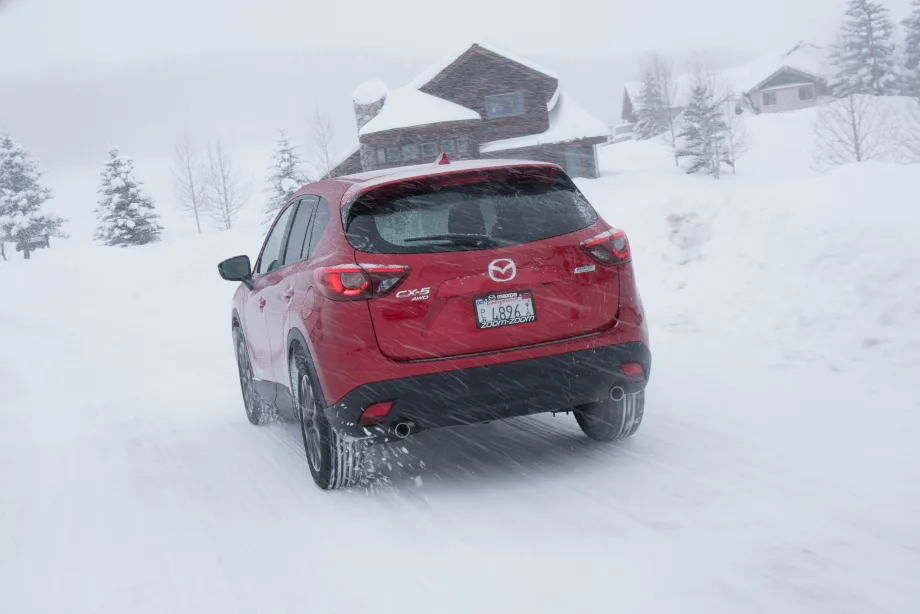
Wintery conditions allowed the i-ACTIV AWD system to provide a real-world demonstration of its capabilities. Photos courtesy of Mazda.
3 min to read
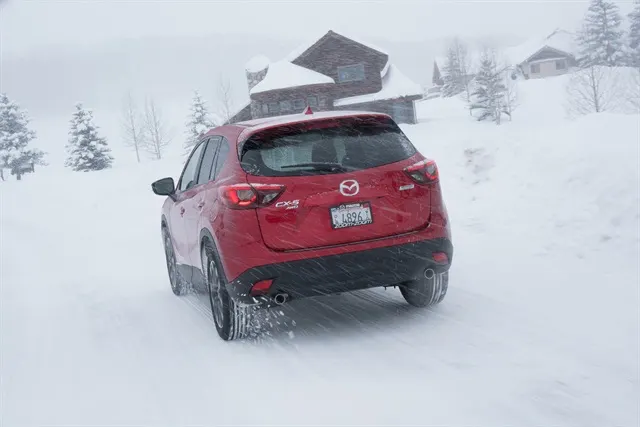
Wintery conditions allowed the i-ACTIV AWD system to provide a real-world demonstration of its capabilities. Photos courtesy of Mazda.
Mazda held its first-ever Mazda Ice Academy in Crested Butte, Colorado, the first week of February to demonstrate its i-ACTIV all-wheel drive (AWD) on a purpose-built ice driving course. Attending the event were two waves of journalists and a separate dealer group.
At 8,885-feet elevation, the wintery conditions of Crested Butte allowed the i-ACTIV system to provide a real-world demonstration of its grip and steering control in inclement conditions while driving on snow-covered, icy roads.
The temperature during the daylong test was -6F (without windchill).
The Mazda Ice Academy had three purpose-built ice tracks, which were designed to function as modules to test various aspects of the Mazda i-ACTIV AWD performance and capabilities versus competitive AWD models.
The first module I drove was a tire comparison of all-season tires versus winter tires. The tire test was conducted with vehicles equipped with all-season Yokohamas versus a CX-3 equipped with Bridgestone Blizzak winter tires.
The module featured a slalom to test the cornering grip and traction, which concluded with a “panic” brake-stopping test. The difference between the all-season Yokohama tires and the Bridgestone Blizzak winter tires was very noticeable. The Blizzak tires provided superior grip and traction due to their cross-hatched tread pattern to ‘hold’ snow in its tread, and a multi-cell “hydrophilic surface compound” to break the surface tension of water.
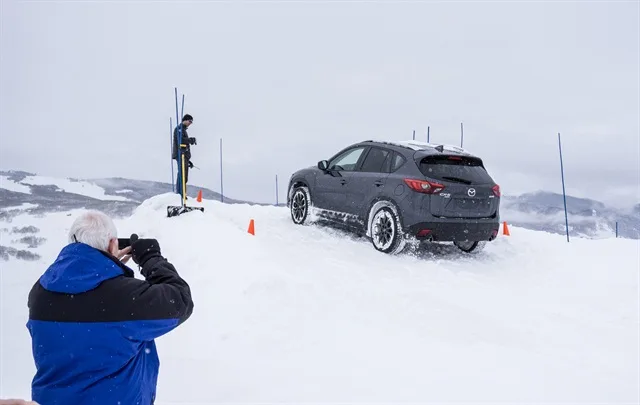
Climbling a snow-covered hill, starting from a dead stop mid-way up.
The second module I drove was a hill ascent test. The exercise featured the Mazda CX-3 and Mazda CX-5, and two AWD competitive models. The test compared the performance and capability of the different AWD models to climb a snow-covered hill, starting from a dead stop mid-way up the hill. The i-ACTIV system excelled in this exercise, effortlessly negotiating the hill with no loss of traction.
The third module included a slalom with traction control turned off on a drift test track while driving an MX-5 convertible with the top down. Needless to say, it was a huge thrill and a great opportunity to hone your skills in negotiating under-steer and over-steer driving situations.
The event also featured an urban driving loop through Crested Butte, switching out between Mazda models and competitive products at the end of each loop.
The concluding event featured exhilarating “hot laps” with a professional driver behind the wheel of an MX-5 pushing it to its limits into wild drifts on an icy slalom.
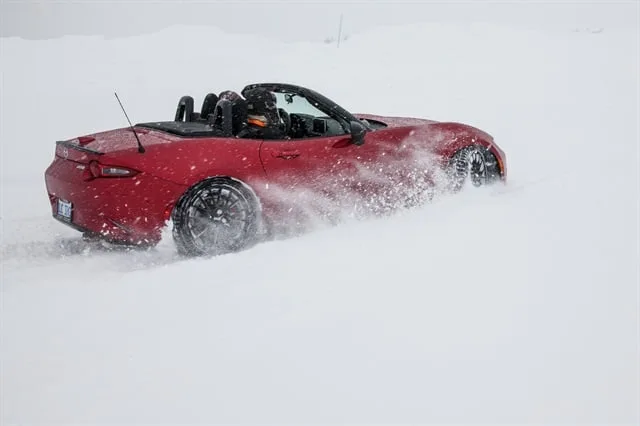
Driving a slalom with traction control turned off in a convertible MX-5 with the top down.
Mazda’s predictive i-ACTIV all-wheel drive technology was introduced in the 2013 Mazda CX-5, the first sixth-generation vehicle with a full integration of SKYACTIV Technologies.
Subsequent models with i-ACTIV AWD include CX-3, which went on sale in 2015, and the all-new CX-9, which will go on sale in 2016.
Mazda’s innovative i-ACTIV AWD works similarly in all models in which it is implemented, complementing Mazda’s Jinba Ittai—“horse and rider as one”—and Hoshiru Yorikobi — “joy derived from driving” — philosophies. These two philosophies were incorporated in the design and engineering of the i-ACTIV AWD to allow for precise control and spirited driving dynamics. The i-ACTIV AWD successfully implements both of these philosophical tenets.
In normal operation, vehicles route approximately 98 percent of their power to the front wheels, but torque transfer can reach as much as 50:50 front-to-rear if the vehicle determines more power is needed for the rear wheels.
Where many systems are touted as sending power from “the wheels that slip to the wheels that grip” — a reactive AWD system — Mazda’s i-ACTIV AWD is predictive, analyzing road, engine, transmission, weather, windshield wiper use, internal and external temperature, yaw sensors, steering, and other conditions more than 200 times per second to determine optimal torque transfer.
The Mazda i-ACTIV AWD uses 27 different sensors that feed to a central control module to determine how wheels need to be driven.
As they say, the proof is in the doing and the Mazda i-ACTIV AWD accomplished this with ease to allow drivers to confidently drive on the most challenging snow-covered and icy roads.
Subscribe to Our Newsletter
More Blog Posts

Fleet Review: 2026 Outback Is More SUV, Still an Outback
The redesigned Outback trades its station-wagon profile for a roomier, more conventional SUV shape while retaining the comfort and safety technology that give it fleet appeal.
Read More →
Why Should Fleets Choose the 2026 Mercedes-Benz GLC 300 SUV?
The GLC 300 offers corporate fleets attainable luxury, comfort, and practicality that transitions seamlessly to family duty.
Read More →
Fleet Review: Volvo EX90 & the Software-Defined Vehicle
Volvo’s new three-row electric SUV is designed for the corporate (and family) class.
Read More →
Fleet Review: Mercedes-Benz EQB 250+
With a reasonable entry point and the refinement of a Mercedes, The EQB 250+ defines “practical luxury” for fleets.
Read More →
Fleet Review: Volvo XC60 & XC90 PHEVs
Volvo’s XC60 and XC90 plug-in hybrid models are stylish, safe, sustainable — and surprisingly fast.
Read More →
Fleet Review: Volvo XC40 Recharge
The Volvo XC40 Recharge offers fleets the familiar premium Volvo experience, electrified.
Read More →
The 2023 Ford Mustang Mach-E Offers a Smooth Ride for New EV Drivers
A look at the bells and whistles on the car, plus how it drives, from the perspective of someone who’s never driven an EV.
Read More →
The 2022 Bolt EUV Lowers TCO While Meeting Sustainability Goals
The 2022 Bolt EUV expands Chevrolet’s EV lineup as a utility-type vehicle with a range of 250 miles on a full charge. It will be sold alongside the 2022 Bolt EV model. The Bolt EUV is approximately six inches longer than the Bolt EV.
Read More →
2021 Cadillac Escalade is C-Suite Material
The 2021 Cadillac Escalade 4WD Sport Platinum is the most expensive model sold by General Motors. But its brand cachet makes it the ideal pinnacle fleet vehicle to help retain high-value senior execs with a high-value luxury SUV.
Read More →
2021 GMC Yukon AT4 Excels as an Off-Road Crew Vehicle
Powered by a 5.3L V-8, generating 355 horsepower and 383 lb.-ft. of torque, the engine is paired to a10-speed automatic transmission. It is ideal for off-road work applications and can transport an eight-person work crew with tools and equipment.
Read More →