




2019 Ford Transit Connect
The 2019 Ford Transit Connect is available in either a cargo or passenger configuration and in short- or long-wheelbase models. The 2019 model can be ordered with a new 2.0L I-4 gasoline engine, optional 1.5L turbodiesel, or fleet-only 2.5L I-4.


The 2019 Transit Connect features a new standard 2.0L gasoline direct injection I-4 engine, and a new, optional 1.5L EcoBlue turbocharged direct injection diesel.
Photo by Mike Antich.
The front-wheel-drive Ford Transit Connect compact van was significantly updated for the 2019 model-year. It is available in either a cargo or passenger configuration that can be ordered in short- or long-wheelbase models.
Automotive Fleet recently test drove the 121-inch long-wheelbase Transit Connect XLT cargo van model.
When comparing the 2018 model to the 2019 model, the major changes were under the hood. The 2019 Transit Connect features an all-new powertrain and its first diesel engine. There is a new standard 2.0L gasoline direct injection I-4 engine, and a new, optional 1.5L EcoBlue turbocharged direct injection diesel. Both engines feature standard Auto Start-Stop and are paired with a new 8-speed SelectShift automatic transmission. To help improve fuel efficiency, there is an EcoMode for both the 2.0L gasoline and 1.5L diesel.
There is also an alternative fuel option, where fleets can opt for a 2.5L iVCT I-4 gasoline engine with CNG/LPG gaseous fuel prep package.
Cargo-Carrying Capabilities
The 2019 Transit Connect cargo van has 103.9 cubic feet of cargo volume in short-wheelbase model and 128.6 cubic feet for the long wheelbase model.
The Transit Connect cargo van has ample functionality. The cargo van is configured with wide dual sliding side doors that are effortless to open and has 180 degree swing-out rear cargo doors allowing loading with no door constrictions. A low liftover from the ground to the floor of the cargo compartment makes loading easier, less fatiguing, and more ergonomic for employees.
Driving the Van
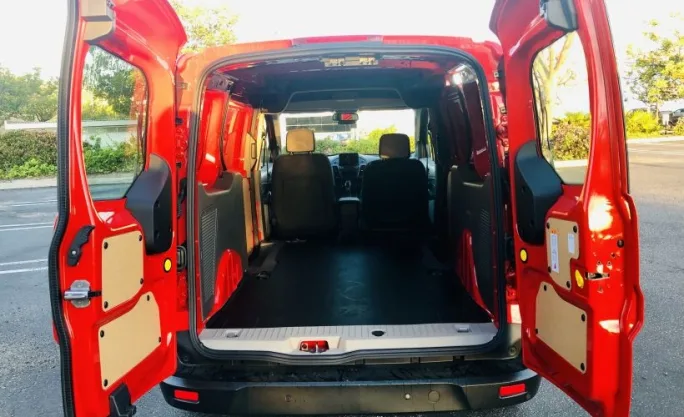
The 2019 Transit Connect cargo van has 103.9 cubic feet of cargo volume in short-wheelbase model and 128.6 cubic feet for the long wheelbase model.
Photo by Mike Antich.
Behind the wheel, the Transit Connect drives easily and handles like a passenger car. The Transit Connect has responsive handling, especially important in congested urban applications. With many employees operating from the vehicle the entire workday, driving is less fatiguing with the electric power-assisted steering.
When operating in areas with hilly terrain, the Transit Connect offers Hill Start Assist as standard equipment, which helps prevent needless roll-back accidents in tight traffic-congested roads. Also standard is a rear-view camera to help minimize collisions while backing, which is the leading cause of fleet-related accidents.
The driver and passenger seats in the cargo van are comfortable and supportive of body contours, while providing ample head clearance. Because the seats are mounted at a typical car height, a high step-up isn’t required, which is appreciated by drivers who enter and leave the vehicle numerous times during a workday.
The Transit Connect offers a smooth ride over pothole streets with its front suspension independent Macpherson-strut and a twist-beam with stabilizer bar in the rear. Our test drive showed it has excellent stopping power with its power front/rear disc brakes with Anti-lock Brake System.
The Transit Connect is equipped with a 15.8-gallon fuel tank, which gives it an all-day driving capability that minimizes the need for fill-ups during the work day.
A huge fuel efficiency and safety benefit is a tire pressure monitoring system, which notifies employees when they are driving on under-inflated tires.
2019 Ford Transit Connect Specs:
Engines: 2.0L I-4, 2.5L I-4 (fleet only), or 1.5L I-4 turbodiesel
Transmissions: 8-speed or 6-speed (fleet only) automatic
Cargo Capacity: 103.9 cu.-ft. (SWB) or 128.6 cu.-ft. (LWB)
More Blog Posts

Fleet Review: 2026 Outback Is More SUV, Still an Outback
The redesigned Outback trades its station-wagon profile for a roomier, more conventional SUV shape while retaining the comfort and safety technology that give it fleet appeal.
Read More →
Why Should Fleets Choose the 2026 Mercedes-Benz GLC 300 SUV?
The GLC 300 offers corporate fleets attainable luxury, comfort, and practicality that transitions seamlessly to family duty.
Read More →
Fleet Review: Volvo EX90 & the Software-Defined Vehicle
Volvo’s new three-row electric SUV is designed for the corporate (and family) class.
Read More →
Fleet Review: Mercedes-Benz EQB 250+
With a reasonable entry point and the refinement of a Mercedes, The EQB 250+ defines “practical luxury” for fleets.
Read More →
Fleet Review: Volvo XC60 & XC90 PHEVs
Volvo’s XC60 and XC90 plug-in hybrid models are stylish, safe, sustainable — and surprisingly fast.
Read More →
Fleet Review: Volvo XC40 Recharge
The Volvo XC40 Recharge offers fleets the familiar premium Volvo experience, electrified.
Read More →
The 2023 Ford Mustang Mach-E Offers a Smooth Ride for New EV Drivers
A look at the bells and whistles on the car, plus how it drives, from the perspective of someone who’s never driven an EV.
Read More →
The 2022 Bolt EUV Lowers TCO While Meeting Sustainability Goals
The 2022 Bolt EUV expands Chevrolet’s EV lineup as a utility-type vehicle with a range of 250 miles on a full charge. It will be sold alongside the 2022 Bolt EV model. The Bolt EUV is approximately six inches longer than the Bolt EV.
Read More →
2021 Cadillac Escalade is C-Suite Material
The 2021 Cadillac Escalade 4WD Sport Platinum is the most expensive model sold by General Motors. But its brand cachet makes it the ideal pinnacle fleet vehicle to help retain high-value senior execs with a high-value luxury SUV.
Read More →
2021 GMC Yukon AT4 Excels as an Off-Road Crew Vehicle
Powered by a 5.3L V-8, generating 355 horsepower and 383 lb.-ft. of torque, the engine is paired to a10-speed automatic transmission. It is ideal for off-road work applications and can transport an eight-person work crew with tools and equipment.
Read More →