




Related: Daimler Invests in 'Highly Automated' Trucks with New Autonomous Technology Group
Will AVs Save the World? History Says It's No Sure Thing
As we look to electric AVs to atone for the sins of the auto, we need to ask what social, environmental, and economic threats we might be missing.
by Staff
June 20, 2019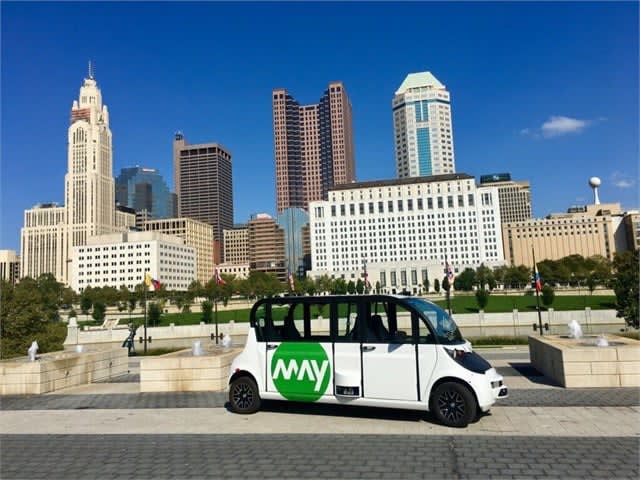
Researchers at the University of Texas modeled traffic in the Austin area and found that one shared autonomous vehicle could do the work of nine conventional vehicles, with wait times between 20 seconds and five minutes.
Photo courtesy of May Mobility.
5 min to read
Electric autonomous vehicles will clear streets of the traffic jams and pollution and save lives, curing the ills wrought by private autos, right?
Maybe not, history teaches. Believe it or not, the early automobile was proclaimed to be the “environmental savior” of a crisis caused by horses. Yes, horses.
Mobility by Horse
In 1900, cities were “drowning” in horse waste. Some 120,000 horses in New York City produced 60,000 gallons of urine and 2.5 million pounds of manure daily, overwhelming streets. Dead horses were left to rot. Fly-borne illness killed 20,000 people per year. England faced the “The Great Horse Manure Crisis of 1894,” with The Times predicting that, in 50 years, “every street in London will be buried under nine feet of manure.”
“The Horseless Age” was a nickname for the movement to accelerate the introduction of automobiles to save us from the devastation wrought by mobility by horse.
Environmental savior? It hardly seems possible today, as auto emissions are major cause of global warming that threatens the planet’s survival.
Are We Missing Something?
Did anyone see this coming in 1900? As we look to electric AVs to atone for the sins of the auto, we need to ask what social, environmental, and economic threats we might be missing. Here are some less than rosy possible outcomes from the widespread of AVs. First, they might not make traffic better.
A UC Santa Cruz study found autonomous vehicles would double traffic in San Francisco because cruising while empty (50 cents per hour) is cheaper than parking ($6 per hour in San Francisco).
A WEF/Boston Consulting Group report predicted Boston traffic would increase by 5%, mostly due to people using AVs in place of public transit.
Then, there are also possible negative environmental impacts, mainly due to the energy and materials required to manufacture electric vehicles.
It takes twice the energy to build electric vehicles, and they must travel approximately 77,761 miles to break even with a gas vehicles’ carbon footprint.
The vehicles’ lithium-ion batteries are difficult to recycle — 95% to 98% wind up in landfills.
Mines for the minerals used in the batteries are in places like the Democratic Republic of Congo, Russia, and China, some with dubious environmental and labor standards.
There are efforts underway to avoid some of these negative outcomes.
WEF formed the Global Battery Alliance to create manufacturing standards to ease recycling, calm demand, and divert spent batteries from landfills.
Humanitarian organizations are pressing battery manufactures to monitor labor practices of suppliers.
Cities are already limiting vehicle access to central business districts to force pooling and investing in bicycle and pedestrian “superhighways.”
Sharing the Future
There is also a good bit of data to indicate that these negative outcomes can be avoided if the primary model of personal transit shifts from individual vehicles to shared services. An Australian government report found that in theory “AVs would roam the city, filling in gaps in the timetables and fixed routes of a superior and cheaper public transport network.” However, “For this scenario to work, AVs must be shared and not privately owned.”
Researchers at the University of Texas modeled traffic in the Austin area and found that one shared autonomous vehicle could do the work of nine conventional vehicles, with wait times between 20 seconds and five minutes.
Five minutes appears to be a magic number for ride-sharing. Researchers at MIT and Cornell University looked at 150 million New York City taxi trips found that 95% could be shared with just a five-minute delay in trip time, and that the overall impact would make trips 40% faster, due to reduced traffic.
Could it work? A study of Chicago taxi trips conducted by Bestmile using its fleet orchestration platform simulated how a shared service would perform in comparison to the citywide taxi service. We found that 200 shared vehicles could do the work of the city’s 2,700 taxis, also with an average wait time of —you guessed it — five minutes.
Can We Get There from Here?
A 10-fold decrease in the number of vehicles would go a long way toward reducing the energy and materials needed to build them. Will the public adopt shared electric autonomous services? The “shared” part seems to most to be a bigger barrier than the electric part. The services will have to be more convenient than driving. A study by ticketing platform Masabi found “convenience” to be the number one factor in people consider when choosing how to get around — more important than cost. A delay of five minutes could be a powerful incentive for using a shared service, considering that it takes 13 to 32 minutes just to find a place to park in the world’s cities.
A 100-Year View
Achieving the kind of efficiency these studies promise at scale, though, is not easy. Look at peer-to-peer ride-hailing services like Uber and Lyft. They have made congestion 180% worse in cities as they travel twice the miles empty than they do carrying passengers. Vehicles — horses or autos — alone don’t solve environmental or congestion problems. For electric autonomous vehicles it is the nature and quality of the services they provide — economically, socially, and environmentally — that will determine whether, 100 years from now, we’re not desperately searching an alternative.
Anne Mellano is the VP of operations and co-founder of Bestmile.
This article was originally published by Metro Magazine.
Subscribe to Our Newsletter
More Fleet Forward

Fleet Forward Conference Introduces One-Day Passes for 2026
New one-day registration gives fleet professionals the flexibility to attend Tuesday, Wednesday, or Thursday, with passes available for $199 through Sept. 18.
Read More →
Vibe Coding: When Fleet Managers Become Software Builders
Five fleet professionals — none with programming skills — discuss how they’re using AI to build fleet solutions in-house and in a fraction of the time.
Read More →
Fleet Forward Conference Tackles Fleet Industry’s Growing Leadership Gap
This session will examine succession planning, knowledge transfer, and the skills the next generation of fleet leaders will need as veteran professionals leave the industry.
Read More →
2026 Fleet Manager of the Year Finalists Announced
Who are the 2026 Fleet Manager of the Year finalists?
Read More →
John Rossant to Deliver Opening Keynote at 2026 Fleet Forward Conference
The CoMotion founder will draw on developments across Europe, China, the Middle East, and other international markets to identify trends that could influence how U.S. fleets plan for the coming decade.
Read More →
How to Build Custom Fleet Tools With AI and Vibe Coding [Webinar]
A new Automotive Fleet webinar explores how fleet managers are using AI and vibe coding to automate routine work and create simple operational tools without traditional programming skills.
Read More →
Is Fleet Ready for Its New Disruptors?
Three emerging leaders from a corporate fleet, public fleet, and the automotive supply chain will bring new ideas and a willingness to challenge industry norms to the Fleet Forward Conference stage.
Read More →
NAFA Announces 2026 Fleet Safety Symposium Education Program
Register for NAFA’s Fleet Safety Symposium and save $200 on your Fleet Forward Conference registration.
Read More →
Fleet Managers Take the Lead in Hands-On AI Workshop at FFC
The fleet manager-led session will show how to use “vibe coding” to build practical fleet tools without a traditional programming background.
Read More →
NETS Crash-Cost Data and CoolSys’ 80% Loss Reduction Take Center Stage at FFC
NETS will present findings from its latest Cost of Crashes research, then CoolSys safety leader and author Shawn Martinez will explain how the company built a safer driving culture across 3,500 employees.
Read More →