Fleet FAQ:
Can we use ChatGPT for free? Yes! The OpenAI chatbot is free to use but does have its limitations compared to a paid version.
 MENU
MENU SEARCH
In this experiment, ChatGPT was used to plan a delivery route with a series of variables that were updated via a conversation with the program. However, information inputted into the program is part of the public domain, bringing privacy issues for fleets to the fore.
Stephen Joos of Fluid Truck has been figuring out how to use ChatGPT in a fleet application. His route optimization experiment yielded results, though it took a lot of massaging of the program.
Photo: Canva
There’s nothing better than having an interactive conversation and walking away better educated on a relevant subject, and then be able to act on it. This is ChatGPT at its most useful.
Have you heard of ChatGPT? The founding company, Open AI, describes this solution at the highest level as “an AI-powered chatbot developed by OpenAI, based on the GPT (Generative Pretrained Transformer) language model. It uses deep learning techniques to generate human-like responses to text inputs in a conversational manner.”
OpenAI was founded in December 2015 as a joint venture to develop AI tools to help empower people. According to the company, its large-scale, unsupervised language model generates coherent paragraphs of text. But, at the most basic, a language model is trained and uses statistics and probability techniques to predict and create a sequence of words.
If that still didn't clear it up for you, its founder does a much better job explaining the world’s most publicized app than we could here.
In fleet, conversations with computers and technology aren’t new: Conversations with computers and integrated use of fleet technologies have been around in our industry for decades. Fleet managers are experts in using search engines for research and programs for more efficient fleet management.
In 2020, WEX launched a voice command solution for Amazon Alexa, allowing fleet managers to receive information and data verbally. But Alexa and other voice assistants aren’t truly powerful AI systems for fleet. While Alexa uses natural language processing and can learn your preferences, it is still just a piece of software responding to what it is coded to do.
ChatGPT can actually compose essays, write computer programming, reply to customer service complaints, and create jokes. But, it's all based on human feedback and input.
So how can ChatGPT and fleet AI tools be used?
Stephen Joos, vice president of strategy and corporate development at Fluid Truck, has been tinkering with the program to find out. Fluid Truck is an on-demand commercial vehicle rental platform with 24/7 mobile access to trucks, vans, EVs, and more.
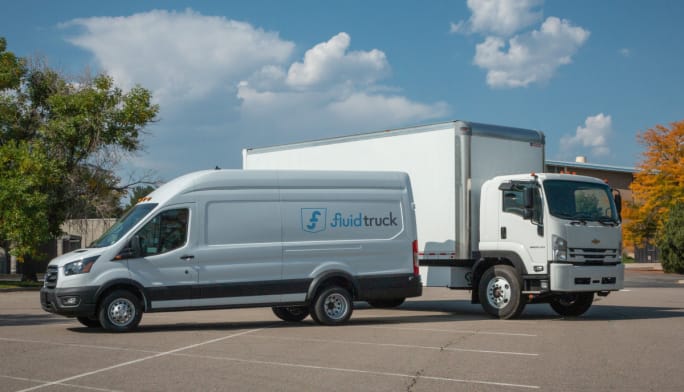
Fluid Truck offers a wide array of vehicle rental options from vans to trucks, including EVs.
With Fluid Truck's focus on on-demand commercial vehicle rental platform for trucks and vans, efficiency is essential. One reason for Joos’s pursuit was to uncover new ways Fluid could help its customers and potential customers — from fleets and drivers to gig workers, and independent contractors — become more efficient, he said.
“I’ve been following the hype like everybody else and playing around with the program,” he said.
Joos created a spreadsheet of about 60 restaurants in the Denver area, with addresses, number of packages, and cubic feet of cargo space for the fleet's delivery vehicles. He copied and pasted the data from the spreadsheet into ChatGPT.
“I didn't even know how it would work,” Joos said. “(The program) digested it and said, ‘Hey, it looks like you're trying to do something with routes. Here's what I can do.’”
Joos then prompted ChatGPT to show how many drivers would be needed based on the inputted data, assuming the use of a cargo van with 400 cubic feet of cargo space and four hours to complete the work. First, the program returned snippets of code, as if Joos were a software developer.
“I was like, I don't need code,” he said, “I need you to solve the problem.”
The program responded that Joos would need four drivers. Joos then asked for, and received, a route list for each driver in a form that could be sent to the drivers.
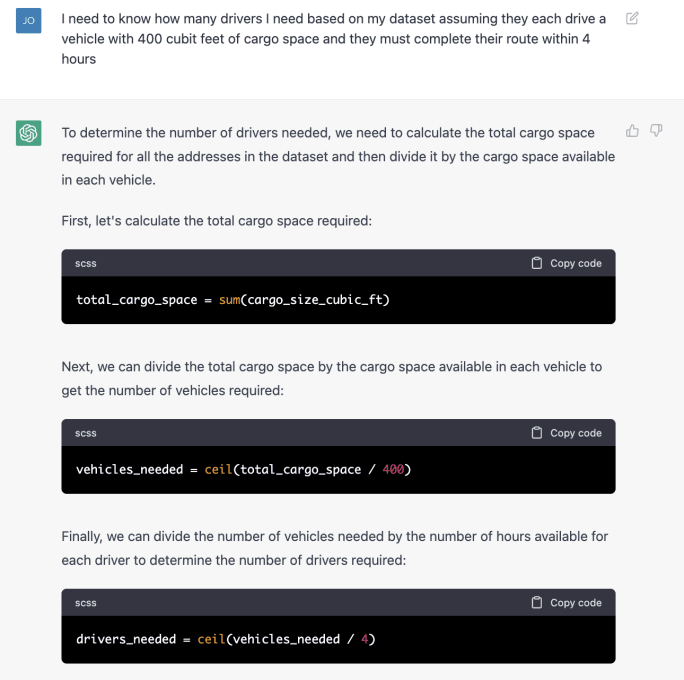
Stephen Joos of Fluid Truck used ChatGPT to create delivery routes with addresses, number of packages, and cubic feet of cargo space of the vehicles and four hours to complete the work. The program produced code that could be used by a software development team.
Source: ChatGPT
Using the same inputs, he switched the vehicle type from ICE to electric to see how the current routing would change. He input EV constraints around range and payload capacity. At first, feedback from the program said he’d need only three drivers.
“And I said, ‘Well, that that can't be correct, it should be more.’ And it literally said, ‘Actually, you're right, you need more drivers. It is eight drivers needed.”
This is one area fleets need to be aware of: ChatGPT is an AI chatbot tool that works on deep learning models and is still learning over time.
“When they say it's conversational in nature, it is,” Joos said. “It is very conversational. But it did get some of the calculations wrong.”
He surmised it was forgetting to include certain constraints, though he admitted it could’ve been that his prompts were created incorrectly. There are any number of variables to input into a routing program, but Joos understood he only scratched the surface with his ChatGPT experiment.
For fleet operators, ChatGPT technology might be leveraged in other areas with large data sets and problems to solve. Preventive maintenance is an example, Joos said, to more precisely understand when parts need to be replaced and group that around preventive maintenance schedules.
The AI engine could account for duty cycles, vehicles’ average lifecycles, servicing and parts replacement intervals, for instance.
As users converse with ChatGPT the AI refines itself. When the user keeps asking questions, the program can narrow focus on a specific question.
Just be aware that the program can occasionally produce false positives or wrong answers, according to its FAQ. “We'd recommend checking whether responses from the model are accurate or not,” the FAQ states.
Joos: Can you provide the optimized route for each driver?
ChatGPT: Yes, I can provide a visual representation. Here's the sequence of addresses.
Joos: What if the weather is cold, how many drivers do I need now?
ChatGPT: I need the delivery information.
Joos: You already have the delivery information.
ChatGPT: The number of drivers is three.
Joos: You previously told me seven drivers. The range of the EVs is reduced. So, the number of drivers should increase.
ChatGPT: Yes, that's correct.
Joos: Okay then, how many drivers?
ChatGPT: Okay, actually you need eight drivers.
There are, of course, many ways to optimize routes, stemming from the early days of Mapquest to off-the-shelf online programs to newer, sophisticated route optimization programs that factor numerous inputs such as location, vehicle dimensions, delivery priority, time windows, skills matching, route modifications, and more.
Joos doesn’t think that ChatGPT will usurp those programs. But it could work for small jobs, and the code it produces could be used by a software development team to integrate into a more sophisticated program.
At the time of the experiment, ChatGPT was trained only until 2021, so recent data was not incorporated. ChatGPT can’t manage real-time data such as weather or traffic for dynamic routing. (GPT-4 was just released, and OpenAI gives examples of how the newer version is solving problems with greater accuracy and performance.)
Here comes the warning: ChatGPT is set up to collect as much data as it can to learn and improve. The program collects:
User’s IP addresses.
Browser settings.
Data on how users interact with the site.
Inputted routes become part of ChatGPT’s database. According to the company’s privacy policy, user prompts are part of the system in the public domain. Therefore, other users have access to them.
Can another user connect the dots on intricate data sets and attach them to IP addresses and real humans? This isn’t yet clear, but the unknown could make interaction with the program a non-starter for many.
Joos is aware of the issue. “If you're providing data to the AI, you'll want to review the privacy policy and terms of use carefully to ensure the scope is limited to how you want to use it,” he said.
He referenced issues now coming to light in which artists are challenging the AI creation of content similar to their style. “It’s a gray area right now, but there will be lots of battles fought over the future of reference material and output,” he concluded.
Beyond routing, there are numerous other potential uses for ChatGPT in fleet. Recently, AssetWorks performed a test asked the AI system to deliver answers to several common fleet questions. Some examples included:
Can you build a preventive maintenace plan for a fleet of 500 light-duty vehicles?
How do I replace my current fleet of X vehicles with electric vehicles?
I am struggling to hire Gen-Z vehicle mechanics. How can i improve my recruiting process?
For each of the questions asked, ChatGPT provided a several step plan for the fleet manager to follow.
So, we tested it ourselves. We asked the system "I am an automotive fleet manager. I am struggling with driver retention. How do I keep my drivers on staff longer?" The generative models provided this input (this has not been edited):
Offer Competitive Compensation: One of the most effective ways to retain your drivers is to pay them well. Offer competitive wages and benefits packages that include health insurance, retirement plans, and other incentives that will make it more difficult for your drivers to leave.
Provide Career Advancement Opportunities: Offering career advancement opportunities can make your drivers feel like they have a future with your company. You can offer training programs, promote from within, or provide opportunities for drivers to take on more responsibility and earn higher wages.
Create a Positive Work Environment: A positive work environment can go a long way in retaining your drivers. Encourage teamwork, provide a safe and clean workplace, and create a culture of respect and appreciation.
Recognize and Reward Good Performance: Recognizing and rewarding your drivers for their hard work can help to keep them motivated and engaged. Provide bonuses, incentives, or other rewards for good performance, and make sure to recognize drivers publicly for their achievements.
Provide Opportunities for Flexibility: Providing flexible work arrangements, such as part-time or flexible schedules, can help to retain drivers who may have other commitments outside of work.
Listen to Your Drivers: Listen to your drivers' concerns and feedback, and take action to address their needs. By doing so, you can help to build a culture of respect and collaboration that can contribute to better driver retention.
We can't argue with those tips. What about you?

Fleet policies are designed to create consistency, but not every driver or situation fits neatly within standard rules.
Read More →
Six questions can help fleet managers look beyond AI marketing claims to evaluate integration, data access, and real-world operational performance.
Read More →
Buying fleet management software in 2027 means looking beyond features and price. As fleet operations, technology and expectations evolve, this guide explores what today’s fleet professionals should consider when choosing a system that can deliver value now and adapt to what comes next.
Read More →
EVs, AI, and autonomous vehicles are reshaping fleet management. Discover what’s ahead—and how fleet leaders can prepare for the next era.
Read More →
Here's how the technician shortage has affected uptime for fleets, and what to do about it.
Read More →
Neology’s neoFleet platform will manage toll transactions and toll-authority operations for vehicles across Avis, Budget, Payless, Budget Truck and Zipcar.
Read More →
Nearly eight in 10 surveyed fleets allow personal use of company vehicles, while just over half of respondents report charging employees for the privilege.
Read More →
Could developments overseas offer a preview of what’s coming for U.S. fleets? This week, we’re looking at the future of AI, autonomy, and electrification, plus Ford Pro’s new certified pre-owned program, smarter vehicle offboarding, and a new way for fleets to manage toll expenses.
Read More →
What do fleet managers need to do when a driver leaves?
Read More →
Rising operating costs, driver safety concerns, and unplanned downtime are putting unprecedented pressure on modern fleets. Discover how fleet managers use embedded OEM connectivity and real-time vehicle data to cut TCO, prevent downtime, and protect drivers without aftermarket telematics hardware.
Read More →