





Related: Waymo, UPS Pilot Self-Driving Deliveries in Phoenix
Waymo Outlines Plans to Integrate Autonomous Trucking in Fleets
While agnostic on deployment models and vague on timelines for deployment, Waymo is clear — its end goal is to be a technology provider, not a truck manufacturer or fleet owner.
July 14, 2020
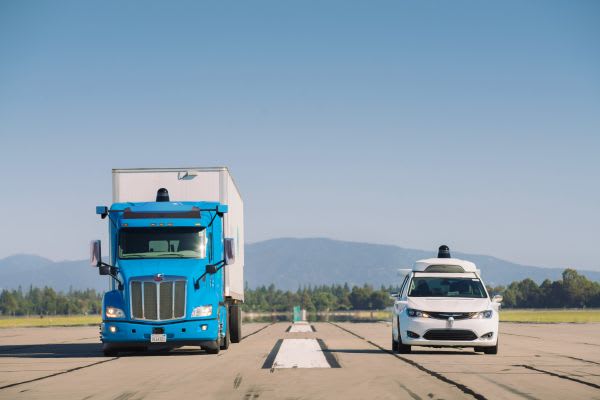
Waymo divides its autonomous initiatives into two divisions: Waymo Via, focused on goods delivery in both trucking and local delivery formats, and Waymo One, its consumer ride-hailing service.
Photo courtesy of Waymo.
6 min to read
For those in the fleet and transportation industries, the crescendo of news on autonomous technology, partnerships, and pilots has left many asking, often with crossed arms, “Ok, when?”
The answer is complicated.
Waymo is the oldest, and arguably largest player in autonomy. The Alphabet-backed company has completed over 15 billion miles in simulation, thousands of tests on private tracks, and over 20 million miles on public roads, both with a human safety operator onboard and fully driverless.
Yet regarding when we’ll see Level 4 autonomous trucks without a safety operator in the cab, “We have no timeline to share at this point in time,” said Vijaysai Patnaik, head of product, Self-Driving Trucks at Waymo, in a recent virtual roundtable discussion with journalists.
Closing its first external investment round of $3 billion in May, Waymo is well-capitalized and in it for the long haul.
Waymo divides its autonomous initiatives into two divisions: Waymo One, its consumer ride-hailing service, and Waymo Via, focused on goods delivery in both trucking and local delivery formats.
While autonomous trucking is relatively new (Waymo Via started in 2017) the company was an early autonomy pioneer when it commenced the Google self-driving car project in 2009.
Waymo Via launched its first self-driving truck pilot in 2018, delivering loads from Google's data center in Atlanta, Georgia. Following the pilot, Waymo has also tested on public roads in California and Arizona. The company is ramping up for tests in Texas and New Mexico soon.
The Southwestern states constitute Waymo’s initial footprint: “We are testing in these geographies with the ultimate goal of deploying fully driverless at scale in this region,” said Charlie Jatt, head of commercialization for Trucking at Waymo, during the roundtable.
On the local delivery front, Waymo Via is repurposing its Pacifica minivans operating in its ride-hailing fleet for pilots in metro Phoenix, Ariz. with Auto Nation and UPS.
For Auto Nation, Waymo is completing “hot shot” deliveries, on-demand runs of small car parts from Auto Nation stores to auto repair shops. Waymo is also delivering packages from consumer UPS stores to UPS sorting facilities.
Both the trucking and delivery pilots rely heavily on the technology developed for over 10 years in the car program. “We're not doing this for the first time as a company,” said Boris Sofman, director of engineering and head of Trucking & Perception at Waymo. Boris has a account“The fact that we've gone through so many iterations on the car side means we can move much more quickly and aggressively on the trucking side.”
Autonomous trucking, however, has unique challenges compared to ride-hailing and local delivery. Waymo uses the same computing system as it does on cars but adjusts for the unique shape of a truck and occlusions inherent in an articulated trailer.
With more emphasis on long-range perception, the autonomous test trucks have twice as many sensors.
Complex merging situations on highways often entail needing to create openings that don’t yet exist, Sofman said. Challenges around construction zones and weather are heightened. On surface streets, trucks need to cross double yellow lines and multiple lanes to complete turns.
“Driving an 80,000-lb. truck at 65 miles an hour, we need to be able to handle the rare but very important longtail challenges,” said Sofman.
Deployment Models
Waymo is calling its long-term business model “Driver as a Service.” While the title may sound ironic in an autonomous context, it’s time to start broadening the definition of “driver” beyond humans to include technology.
Waymo is working with the entire trucking ecosystem, from large trucking fleets and their shipping customers, to truck manufacturers, their Tier 1 suppliers, and maintenance providers. On the car side, Waymo is leveraging its relationship with Auto Nation as well as Avis Budget Group for their expertise in fleet management and maintenance.
For the near future, Waymo will offer services through its proprietary fleet of autonomous vehicles. Long-term, however, Waymo is setting the stage to be a technology provider, not a truck manufacturer or fleet owner.
“We really see ourselves as a technology company,” said Jatt. “The goal is to allow them (OEMs, fleets, support services) to do what they do best … We don't want to own and operate the trucks themselves because there is a robust and thriving ecosystem of trucking fleets.”
Two deployment models are emerging. The point-to-point model entails an automated truck picking up loads from a depot, distribution center, or terminal and dropping them off at their final destinations in a fully automated journey.
In the transfer hub model, the journey is a mix of automated and manual. The journey could start with a traditional truck picking up a load and taking it to an autonomous transfer hub situated close to the highway to minimize surface street driving. An autonomous truck would then take the load to another transfer hub, at which point a traditional truck would pick up the load and take it to its final destination.
There are pros and cons to each model. If the complexity of the journey can be minimized with simpler routes and fewer surface streets, the easier it will be to deploy and scale. But making the transfers to manual trucks adds time and operational overhead.
“I don't think it'll be black and white, there'll be some blending the two models,” said Jatt. “We're still exploring both internally and with our external partners the best combination and sequencing of these two solutions.”
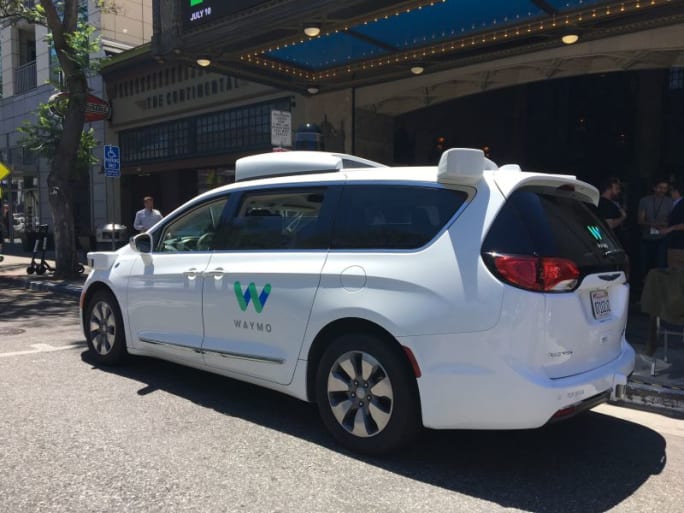
Photo by Chris Brown.
Back to the When
When can “regular” fleets, shippers, and carriers to start implementing autonomous transport with Waymo?
Many factors need to coalesce. Waymo is expanding its base of partnerships with fleets and shippers for pilots. “We are actively exploring those conversations now,” Patnaik said, which will give fleets exposure to the process of actually deploying self-driving trucks in their operations.
The technology, particularly the aforementioned longtail challenges in navigating streets, must be perfected through many more — perhaps millions — of simulated and on-road miles, which will hone the technology in conjunction with real-world safe deployment practices.
On the regulatory front, Waymo and the larger autonomous ecosystem are working closely with federal, state, and local legislators to deploy in a compliant manner. Education and exposure to autonomous vehicles on the road will foster comfortability with riding in and alongside autonomous vehicles on freeways and surface streets.
And then the models can begin to scale. “It'll definitely take some time for us to get there because there are a lot of pieces that need to fall into place,” said Jatt. “In the grand scheme of things, we're still very early in technology development, deployment, and commercialization.”
“The complexity and difficulty of actually getting to a point where you can move from a reliable demo with a safety driver to actually having the confidence to pull the safety driver out of the seat and take real customers and goods on public roads in fully autonomous mode,” Sofman said, “that complexity was way bigger than anybody expected.”
“I think anybody who started at Waymo in the early days massively underestimated those challenges and learned a ton on the way to get here.”
Subscribe to Our Newsletter
More Fleet Forward

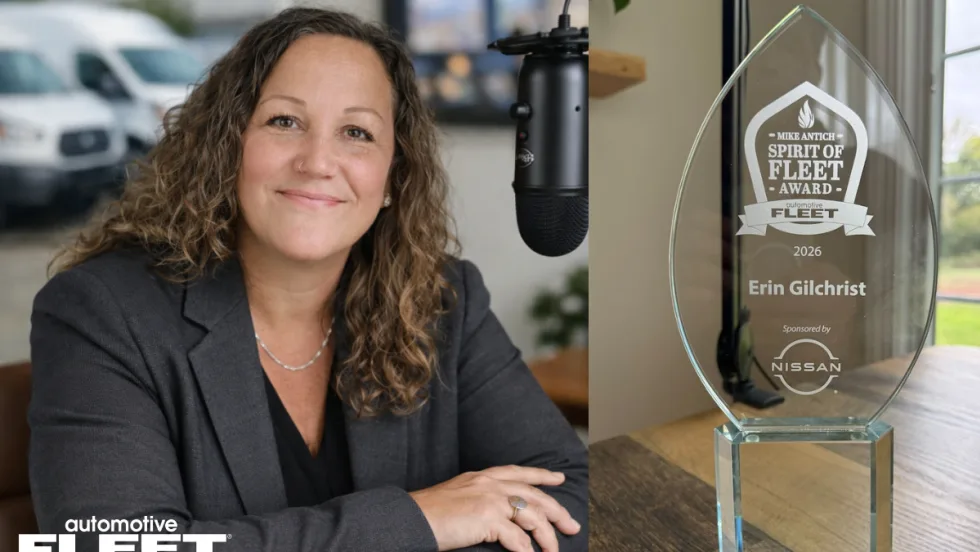
Erin Gilchrist Receives Mike Antich Spirit of Fleet Award
Last week at AFLA in Vegas, Erin Gilchrist received the inaugural, brand-new Spirit of Fleet Award.
Read More →
Dominika Leja Named the 2026 Fleet Manager of the Year
The AstraZeneca associate director of fleet was recognized for her leadership in fleet electrification, cost savings, and operational transformation.
Read More →
Jamie McKay Named the 2026 Fleet Visionary Award Winner
The Aptive Pest Control fleet manager was recognized for her approach to operations, data, lifecycle management, and driver needs.
Read More →
Fleet Forward Conference Introduces One-Day Passes for 2026
New one-day registration gives fleet professionals the flexibility to attend Tuesday, Wednesday, or Thursday, with passes available for $199 through Sept. 18.
Read More →
Vibe Coding: When Fleet Managers Become Software Builders
Five fleet professionals — none with programming skills — discuss how they’re using AI to build fleet solutions in-house and in a fraction of the time.
Read More →
Fleet Forward Conference Tackles Fleet Industry’s Growing Leadership Gap
This session will examine succession planning, knowledge transfer, and the skills the next generation of fleet leaders will need as veteran professionals leave the industry.
Read More →
2026 Fleet Manager of the Year Finalists Announced
Who are the 2026 Fleet Manager of the Year finalists?
Read More →
John Rossant to Deliver Opening Keynote at 2026 Fleet Forward Conference
The CoMotion founder will draw on developments across Europe, China, the Middle East, and other international markets to identify trends that could influence how U.S. fleets plan for the coming decade.
Read More →
How to Build Custom Fleet Tools With AI and Vibe Coding [Webinar]
A new Automotive Fleet webinar explores how fleet managers are using AI and vibe coding to automate routine work and create simple operational tools without traditional programming skills.
Read More →