




Uniform Company Grows a Uniform Fleet
This fleet manager reduced maintenance costs by replacing a myriad of old delivery truck models with one model of step van.

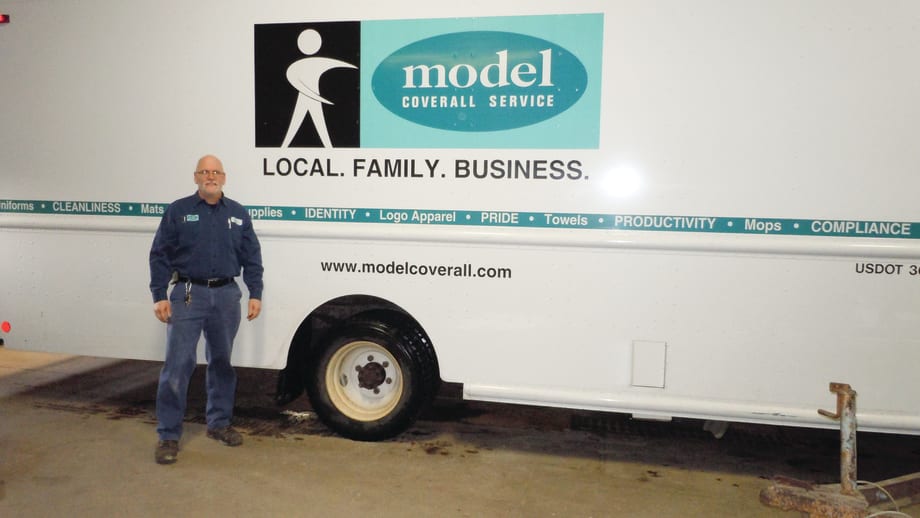
Joe Boyd is the fleet technician for Model Coverall Service.
When servicing a fleet, it can be expensive to maintain various types of vehicles. Joe Boyd of Model Coverall Service faced this issue.
After taking over the company’s fleet in 2011, Boyd soon discovered piles of unused parts in the garage area. “I probably have $5,000 worth of parts for trucks that we don’t have anymore.”
In operation for more than 91 years, this uniform rental service is divided among three locations in Grand Rapids, Mich., Lansing, Mich., and South Bend, Ind. The current delivery fleet consists of 20 step vans and four Sprinter vans.
Under Boyd’s direction, Model Coverall started purchasing the same van model to cut acquisition costs as well as costs for maintenance and parts.
“The company realized that it was more cost-effective to have similar vehicles than having 10 different vehicles,” says Boyd. “By standardizing the fleet, you can have a basic parts inventory that works for every truck.”
A Standardized Fleet
When Boyd started at Model in 2011, the company’s step vans were built on chasses made by Freightliner, Workhorse Custom Chassis and Morgan Olson. Referring to the fleet as “a mix pot of everything,” Boyd found various unused parts for all the old vans — a majority for the company’s old Workhorse vans on General Motors chassis.
“Before I got hired, the company would find a truck and buy it,” says Boyd. “Buying anything you can get your hands on will cost more in the long run. Inventory costs were up. Parts for certain brands cost more than other brands.”
When Boyd started to retire half a dozen of the step vans, the company made a switch to Freightliner MT45 step vans with Utilimaster bodies. The vans are leased through a dealer in Indiana, who sends the vans to Utilimaster for upfitting.
With most of the fleet now standardized, Boyd can limit his inventory of vehicle parts. For the parts that need regular replacing, such as oil filters and fuel filters, he keeps one of each on his shelf. He orders the bigger parts — including brake pads, shocks and rotors — as needed. This allows him to keep only about $1,000 worth of parts on hand.
Boyd isn’t afraid to shop around for the best prices on parts, sometimes using a third-party supplier such as Mill Supply.
Keeping Them Running
By properly maintaining the step vans, Boyd has been able to retire a few vans at 200,000 to 300,000 miles. “The chassis are solid on the trucks,” Boyd says, “but the aluminum bodies can still corrode.”
The company is considering refurbishing its trucks instead of replacing them, and is doing a cost analysis to see if the math pencils out. “If I can do a bumper-to-bumper restoration for $40,000 and I can ride it for another 200,000 to 300,000, it would be something we’d look at,” Boyd says.
Boyd came from a company that runs semi-trucks, which require conformity to federal regulations that Model does not. As such, Model hires salespeople that can drive, not truck drivers, Boyd says — and this makes staying on top of maintenance all the more difficult.
“Getting drivers to turn in their inspection sheets and report problems is probably the hardest thing that I deal with,” Boyd says. “They will run the trucks into the ground and then call me when the trucks aren’t working.”
This extra burden falls on Boyd, who checks every truck’s oil and tires each night. Boyd is working to enforce a new rule that drivers can’t go home until the manager has the pre- and post-trip inspections in hand.
“I let all the drivers know that if they don’t do their inspections and don’t turn them in to me, it’s your butt — not mine — when you get caught,” he says.
Originally posted on Work Truck Online
More Global Fleet

Holman Takes Full Ownership of ARIZA in Mexico
Holman is bringing its Mexican fleet management operation fully under its own brand after more than 30 years as a joint venture. The change gives multinational fleet customers a single Holman operation across the U.S., Canada, and Mexico.
Read More →
Proven Ways to Reduce Work Truck Downtime
The age-old problem of downtime will always be a reality, but with new strategies at hand, fleets have more ways to keep trucks on the road longer.
Read More →
The Top 300 Commercial Fleets
The Top 300 Commercial Fleets: See the List
Read More →

Cameras, Safety and Insurance: From Reactive Claims to Real-Time Prevention (Part 2 of 2)
Part Two: Commercial auto remains one of the most challenging and costly lines of coverage for fleet operators and insurers alike. Continue learning more about how to effectively address these issues from Onur Aksan, Enterprise Business Development Executive, Geotab
Read More →
Cameras, Safety and Insurance: From Reactive Claims to Real-time Prevention
Commercial auto remains one of the most challenging and costly lines of coverage for fleet operators and insurers alike. Learn more about how to effectively address these issues from Onur Aksan, Enterprise Business Development Executive, Geotab.
Read More →
Fleet Costs Are Rising: Here’s How Leaders Are Responding
Fleet leaders are under pressure to reduce costs, adapt to economic uncertainty, and make smarter decisions. See how peers across North America are responding with real data, proven strategies, and forward-looking insights. Download the 2026 Market Pulse Report to benchmark your strategy and uncover where you can gain an edge.
Read More →
Enterprise Fleet Management Surpasses 900,000 Vehicles in U.S. & Canada
Enterprise Mobility connects with mobility solutions around the globe
Read More →
Automotive Fleet's Guide to Fleet Electrification
Unlock the secrets to a successful transition to electric fleets with Automotive Fleet's comprehensive Fleet Electrification Guide!
Read More →
Sumitomo Rubber Industries to Acquire Viaduct
Viaduct will join Sumitomo as an independent subsidiary. Partnership strengthens global reach and accelerates AI-driven innovation for fleets and manufacturing.
Read More →