




Three Maintenance Musts for Chauffeurs
Knowing how to prevent and pre-empt equipment breakdowns essential to working behind the wheel
This time of year can certainly present its share of maintenance challenges for a livery company.
Although not formally trained as an automotive technician, I have gained a lot of firsthand experience working on our limousines and others in the past couple of decades. What I have found, often by “the school of hard knocks,” is that extreme temperatures, both hot and cold, can cause systems failures.
As professional chauffeurs, we must fully comprehend our critical role when it comes to doing our part to pre-empt or possibly prevent costly breakdowns. Losing use of a vehicle can hurt everyone involved, including the paying consumer, the chauffeur, and the company that they represent as well.
Let me state emphatically that I recognize that it is not possible to stop every potential problem. In fact, we are, by the very nature of our business, at the mercy of mechanical equipment. Every vehicle is manufactured using thousands of individual parts, which may fail at any time. With a little bit of care and diligence, we should do everything possible to minimize potential troubles, especially those which might have been avoided in the first place.
The saying “the buck stops here” is appropriate at our company. Whenever there is a major problem, I am usually the person called upon to resolve it.

The three major areas that have given me grief in extreme hot temperatures are:
1) vehicle climate control systems
2) failure of electrical components, and
3) automotive battery problems.
1 • Because we can not afford breakdowns, this is the time of year when I feel compelled to discuss vehicle limitations to our staff members. As a review, I remind them that although customer comfort is important, there can be a bit of a trade-off on hot and humid days. If chauffeurs leave their vehicles idling for long periods of time, then they are taking potential risks which would include the possibility of climate control system failure or having a vehicle’s engine overheat and stall.
As professional chauffeurs, we must be mindful of these risks, and be sure to shut down our assigned vehicle whenever a break in the action makes it possible. The rule of thumb that we use is to turn on the vehicle about 10-15 minutes before clients are expected to return. The down time would allow the engine of a vehicle, and any overworked air conditioning components, to cool down a bit before being called upon again.
Whenever an air conditioner runs on a stationary vehicle for long periods, the interior will heat up. Professional mechanics have told me that a vehicle must have moving air, passing through the condenser, to properly cool the interior. Auxiliary electric condenser fans supplied by many manufacturers definitely help when operating properly, but even they don’t solve the problem completely. The ideal situation for efficient cooling happens when a vehicle is moving instead of standing still.
2 • With electrical components in general, I believe excessive heat can be our enemy. This seems to be the time when various “gremlins” can wreak havoc. Professional chauffeurs should strongly consider carrying a fuse repair kit in their chauffeur bags. Also, it is important to know the exact location of the fuse panel on each vehicle you drive, as it may be well-hidden.
3 • We often take a vehicle’s battery for granted. It is designed to perform flawlessly, so it’s easy to forget about and overlook. Don’t solely rely on its appearance. I have discovered that I also must carefully remove the safety caps if it’s possible and check each cell individually. At first glance, a battery may seem to be fully charged, but I have seen many a failure when subjected to a load test, and ordinarily a dead cell is to blame.
This has been such a common occurrence that I actually keep an extra battery of every size found in our fleet on the shelf just as a precaution. Finally, check to see that terminals are clean, and that battery cables are tightened properly. These are some of the small things that can stop a vehicle dead and ruin a run. Remember, you must keep your cool when facing the heat of adversity.
SCOTT MEZGER is president of Executive Chauffeuring School Inc. in Cincinnati, the oldest such school in the country. He wrote and produced the Chauffeur Training video program, now updated, for LCT, and may be reached at (800) 380-8335.
Originally posted on Charged Fleet
More Global Fleet

Holman Takes Full Ownership of ARIZA in Mexico
Holman is bringing its Mexican fleet management operation fully under its own brand after more than 30 years as a joint venture. The change gives multinational fleet customers a single Holman operation across the U.S., Canada, and Mexico.
Read More →
Proven Ways to Reduce Work Truck Downtime
The age-old problem of downtime will always be a reality, but with new strategies at hand, fleets have more ways to keep trucks on the road longer.
Read More →
The Top 300 Commercial Fleets
The Top 300 Commercial Fleets: See the List
Read More →

Cameras, Safety and Insurance: From Reactive Claims to Real-Time Prevention (Part 2 of 2)
Part Two: Commercial auto remains one of the most challenging and costly lines of coverage for fleet operators and insurers alike. Continue learning more about how to effectively address these issues from Onur Aksan, Enterprise Business Development Executive, Geotab
Read More →
Cameras, Safety and Insurance: From Reactive Claims to Real-time Prevention
Commercial auto remains one of the most challenging and costly lines of coverage for fleet operators and insurers alike. Learn more about how to effectively address these issues from Onur Aksan, Enterprise Business Development Executive, Geotab.
Read More →
Fleet Costs Are Rising: Here’s How Leaders Are Responding
Fleet leaders are under pressure to reduce costs, adapt to economic uncertainty, and make smarter decisions. See how peers across North America are responding with real data, proven strategies, and forward-looking insights. Download the 2026 Market Pulse Report to benchmark your strategy and uncover where you can gain an edge.
Read More →
Enterprise Fleet Management Surpasses 900,000 Vehicles in U.S. & Canada
Enterprise Mobility connects with mobility solutions around the globe
Read More →
Automotive Fleet's Guide to Fleet Electrification
Unlock the secrets to a successful transition to electric fleets with Automotive Fleet's comprehensive Fleet Electrification Guide!
Read More →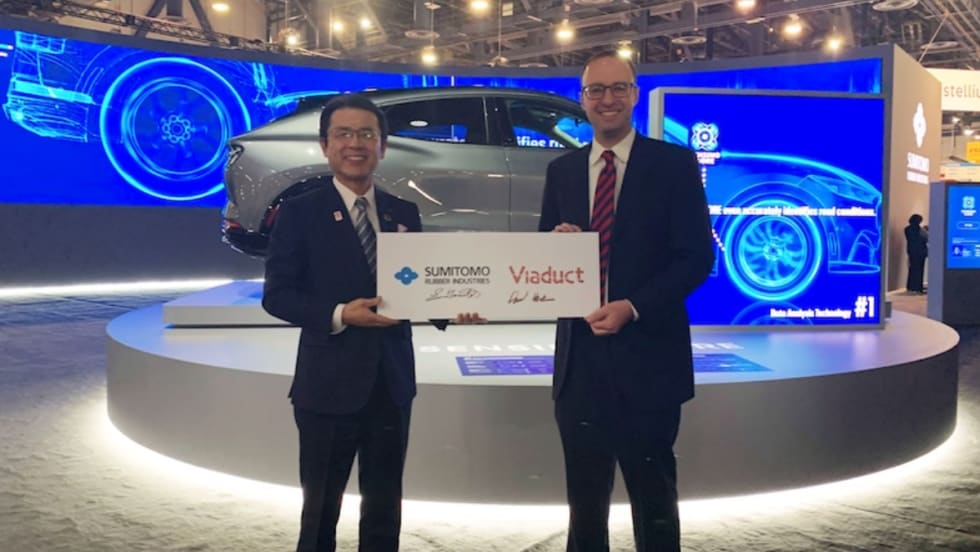
Sumitomo Rubber Industries to Acquire Viaduct
Viaduct will join Sumitomo as an independent subsidiary. Partnership strengthens global reach and accelerates AI-driven innovation for fleets and manufacturing.
Read More →