





More Info: Who Gets a Company Car? (In 2026 and Beyond)
The Car Seat and the Company Car: Why Your Fleet Needs A Child Safety Seat Policy
We spoke with Jenny Harty, a child passenger safety expert, about how fleet managers can bridge the child safety gap in their company policies.
February 4, 2026
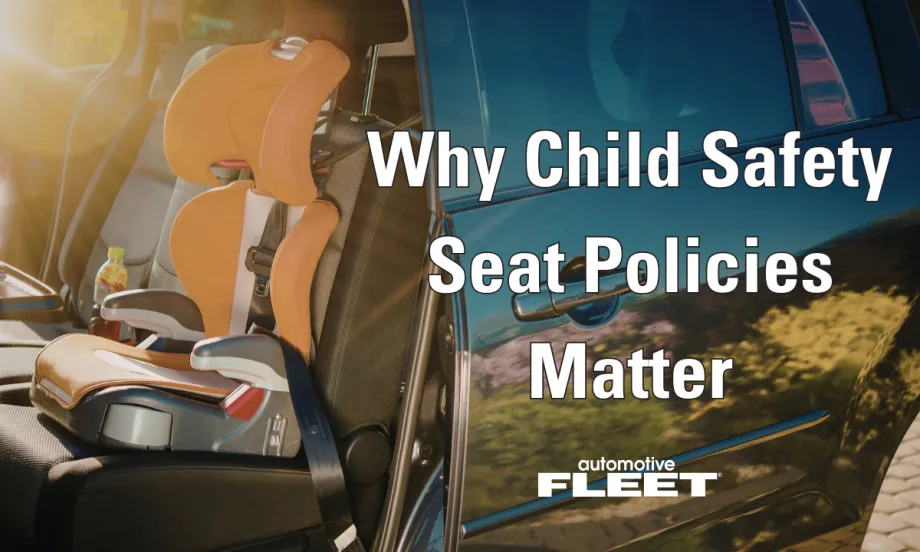
As company vehicles increasingly blur the line between work and personal use, employers must address child passenger safety, policy gaps, and risk exposure.
Credit: Automotive Fleet
6 min to read
Safety is always at the heart of fleet management. Safe driver training, policies, safety conventions, and safety departments all work together to help fleet managers keep their drivers safe and sound.
However, one aspect is often overlooked when evaluating and drafting policies and training to ensure a safer fleet. The company car.
It is not uncommon for companies to assign company cars to their employees, and those cars often become part of those employees' family transportation options.
Many fleet managers and companies have policies to address liability and safety concerns for employees, but almost none require child safety seats to be installed or offer training for employees to properly install them, creating exposure to liability.
Jenny Harty, a Certified Child Passenger Safety Technician (CPST), knows first-hand the importance of child safety seats, having been involved in a violent crash with a logging truck that hit her vehicle and then drove off.
Harty was in her vehicle with her family when the truck ran a stop sign, colliding with her vehicle and sending it into a ravine. Her daughter was saved because she was in a booster seat. This incident inspired Harty to fight for sensible car seat legislation and led her to write Francie & Fitz Booster Buddies, a children's book about booster and car seat safety.
We spoke with the subject-matter expert to get her take on how fleet managers can be proactive about child safety with company cars.
Q: Your personal experience changed the course of child passenger safety advocacy in Georgia after a serious crash saved your daughter’s life, thanks to a booster seat. How did that moment shape your views on broader safety implications for companies with fleet vehicles?
Harty: A violent hit-and-run with a logging truck changed everything for our family. Madison survived because she was properly restrained in a booster seat. We came close to losing our daughter. That experience opened my eyes to something bigger: safety isn’t just the presence of a law; it’s the presence of a culture. Even after helping pass the Georgia law named Madison’s Booster Seat Law, I realized legislation is only one part. True protection requires education, leadership, and systems built to prevent a crisis before it ever occurs. Fleet vehicles often go home with employees, giving companies a unique opportunity to influence the safety of entire families. Child passenger safety isn’t just a parental responsibility; organizations can play a powerful role in protecting children, too.
Q: Very few fleet policies include guidelines for child passenger restraints. Why should companies adopt explicit CPS policies?
Harty: Three reasons stand out:
1. Protect employees’ families. A take-home fleet vehicle is often the family vehicle. Children deserve the same level of protection that the company provides its drivers.
2. Reduce preventable risk and liability. If a child is improperly restrained in a company-owned vehicle, the organization may be exposed even when not in company use.
3. Demonstrate true safety leadership. State laws are often shaped by compromises to be passed. Companies committed to a strong safety culture must rise above minimums. Choosing the ceiling over the floor sends a clear message: we care about our people and the families who rely on them. A strong safety culture is built one step at a time, and this is one more meaningful piece of a comprehensive program.
Q: A fleet vehicle going home with an employee becomes a de facto family vehicle. How should fleet safety programs address this reality?
Harty: Hundreds of thousands of children ride in fleet vehicles every day. Policies must reflect this reality.
Practical steps include:
Requiring appropriate child restraints for any child riding in a company vehicle
Offering simple educational materials or quick-reference guides
Incorporating CPS expectations into annual fleet training
Hosting car seat check events with certified technicians
Placing a CPS reminder or guide in the glove compartment
State law provides the baseline, but families deserve more. Clear policies and hands-on support show employees that their company chooses the ceiling, prioritizing children’s safety with the highest standard of care.
Q: Your advocacy strengthened booster seat laws. How do you see that same kind of advocacy playing out within corporate safety cultures?
Harty: When we strengthened Georgia’s booster seat requirements, resulting in Madison’s Booster Seat Law, it was rooted in a simple belief I carried throughout the process: we have to protect those who can’t protect themselves.
After our crash, I knew how close we came to losing our daughter. That motivated me. And it’s the reason I am committed to doing everything I can to prevent another family from experiencing the unimaginable.
I see the same opportunity within corporate safety cultures. A company must protect the children who ride in its vehicles. Adopting best-practice child restraint standards is so important.
Companies committed to true safety should operate at the ceiling, not the floor. Leadership is about influence.
Strong, well-communicated fleet policies drive safer behavior and protect everyone in the vehicle. Choosing to exceed minimum requirements builds a safety culture that makes protecting families a priority— every time they’re on the road.
Q: Seat installation errors are common, and your CPST certification gives you insight into proper installation. What resources could fleets implement to reduce these errors?
Harty: Most misuse happens because parents were never taught proper installation. Fleets don’t need complex programs to close that gap.
A few simple resources include:
Short educational installation videos and helpful checklists
Booster seat readiness guides
Access to seat check opportunities
A CPS module in annual training
Hosting a car seat check event
Car seat and booster seat fit videos, guides, education, and information
Partnerships with certified technicians
Family-friendly materials like Francie & Fitz Booster Buddies to reinforce safe habits at home for the entire family.
Empowering parents with confidence leads to safer rides for every child.
Q: What is one actionable change fleet managers could implement tomorrow to improve child passenger safety?
Harty: Add strong language to fleet policy: Any child riding in a company vehicle must be properly restrained according to best-practice guidelines, not just state minimums. It immediately elevates safety expectations.
Companies can amplify their impact with small, meaningful initiatives. Francie & Fitz is a children's picture book that offers something fresh and easy for children to understand. Tools like a Family Safety Welcome Kit, a Read & Ride Safe Day with car seat checks, or a co-branded edition of the book show employees that their children matter to the company.
It’s an innovative way to bring safety into the home, build goodwill, and position any fleet as a leader in an area the industry has largely overlooked, building loyalty and connection that is unmatched.
Choosing best practice over minimum compliance is one of the simplest ways a fleet can save a child’s life
Subscribe to Our Newsletter
More Safety

What’s Next for Fleet? Safety, AI & Industry Recognition | AF News Recap
Could your company's culture be encouraging distracted driving? This week, we're exploring how workplace expectations affect driver safety, what AI, EVs, and autonomous vehicles could mean for the future of fleet management, and how fleet professionals can strengthen their award nominations.
Read More →
Does Your Fleet's Culture Encourage Distracted Driving?
What happens when the people responsible for enforcing safety rules are the ones setting the wrong example? The answer may reveal why some of the biggest risks to fleet drivers have little to do with what's written in the employee handbook.
Read More →
Sponsored•October 1, 2026
Fleet Manager’s Ultimate Playbook: Navigating the New Standard in OEM Connectivity
Rising operating costs, driver safety concerns, and unplanned downtime are putting unprecedented pressure on modern fleets. Discover how fleet managers use embedded OEM connectivity and real-time vehicle data to cut TCO, prevent downtime, and protect drivers without aftermarket telematics hardware.
Read More →
From Driver Well-Being to EV Charging | AF News Recap
Mental health belongs in the fleet safety conversation. This week, we’re looking at five ways fleets can support employee well-being before a crisis, plus Holman’s expansion in Mexico, new one-day Fleet Forward passes, and why EV charging demand is outpacing infrastructure growth.
Read More →
Nexar-Nauto Merger Aims to Give Fleets Better Safety Intelligence Through Larger Driving Dataset
Stefan Heck tells Automotive Fleet that combining more than 10 billion miles of driving history with Nexar's AI models will give fleets deeper insights into driver risk and roadway conditions than either company could provide independently.
Read More →
Don't Wait for a Crisis: 5 Ways to Build Mental Health Into Your Fleet Safety Program
For Suicide Prevention Month, fleet and safety leaders have an opportunity to put mental health where it belongs: at the center of workplace safety.
Read More →
How Camera Data Can Strengthen a Fleet’s Insurance Renewal
Insights from a commercial insurance carrier and a broker show how fleets can turn video telematic data, driver coaching, and improved claims results into a stronger case at insurance renewal.
Read More →
The Safest Fleets Aren’t the Ones with the Most Technology
You’ve made the telematics investment. Here’s how to capture the other half of its value and build the safest fleet on the road.
Read More →
Sponsored•August 7, 2026
Hidden in Plain Sight: Fleet Compliance Risks
Fleet compliance isn't just about having policies — it's about consistently enforcing them. This practical guide reveals six hidden compliance risks common in public sector and shared fleet operations and outlines proven strategies to improve visibility, accountability, and audit readiness
Read More →
NETS Sets 2026 Fleet Safety Benchmark Conference for Indianapolis
The Sept. 15–17 program will feature fleet benchmarking data, case studies, emerging technologies, and implementation strategies while running alongside the NSC Safety Congress & Expo.
Read More →