





Similar Story: Study Links Poor Visibility of Stopped Cars to Collisions
Study Looks at What Makes Drivers “Move Over” and Save Road Workers’ Lives
The AAA Foundation for Traffic Safety conducted two field studies to determine the effectiveness of various countermeasures designed to protect roadside workers.
February 22, 2023
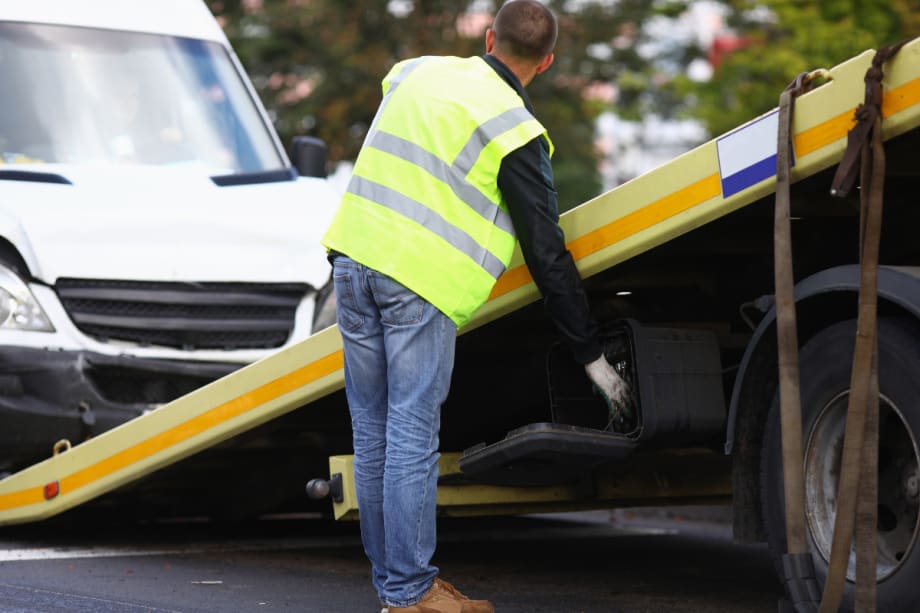
Over 60% of tow workers, emergency responders, and road maintenance workers said they had experienced a near miss while working at the roadside or scene of an accident.
Photo: Canva/Tsikhan Kuprevich
3 min to read
Some 60% of tow workers, emergency responders, and road maintenance workers said they had experienced a near miss while working at the roadside. What’s more, a stunning 15% survived being hit by a passing vehicle, according tothe AAA Foundation for Traffic Safety.
The fact is working on America’s roads can is a very dangerous job. Although all 50 states have Move Over laws, on average, two emergency responders are struck and killed every month by a driver who fails to obey the law by moving over to an adjacent lane and allowing the roadside rescuers the space to operate, according to the Bureau of Labor Statistics.
Moreover, roadside crashes are particularly deadly for tow workers. Government data shows that tow operators are killed at a rate of almost 43 deaths per 100,000 workers, compared to just three for all other industries.
To determine the effectiveness of various countermeasures to protect roadside workers, the AAA Foundation conducted two field studies on busy roads.
Countermeasure Study: Variable Message Sign
One field study focused on the effectiveness of an electronic vehicle-mounted variable message sign (VMS).
Video data was collected from one of the Alabama Service Assistance Patrol (ASAP) vehicles, which is equipped with a vehicle-mounted VMS, operating on a 25-mile stretch of interstate in west central Alabama. Over 50 hours of videos were collected in a three-month period in 2021 and 40 different ASAP vehicle stops at various locations were observed.
Data from each stop was segmented according to whether the VMS was active or inactive. When active, the VMS displayed a flashing diamond sign.
The findings show that VMS is highly effective. During the study, when VMS was activated, drivers changed lanes and slowed down more than when the VMS was not operating. In fact, the odds of a vehicle moving over to an appropriate lane were 95% higher when the VMS was used.
Also noteworthy, passenger vehicles were more responsive to the VMS than trucks or buses, although both were more likely to move over when VMS was active than when it was not. In addition, if a vehicle was making a lane change, its speed also tended to be lower than those who stayed in a lane. The researchers believe this may be due to the fact that drivers who did move over recall the slogan, “slow down” and “move over.”
Countermeasure Study: Flares, Cones, and Tow Truck Light Patterns
In another study, the AAA Foundation set out to evaluate the extent to which motorists passing a tow truck slowed down and moved over, day and night, in response to the deployment of flares or cones in combination with two different tow truck light systems.
The findings are interesting. As it concerns getting drivers to move over, it appears that the presence of a tow truck displaying lights makes the most impact on drivers.
Specifically, during the day, the presence of the tow truck displaying the daytime light pattern appeared to motivate some 25% of vehicles to shift from lane 1 into lanes 2 or 3, in comparison to when the truck and client vehicle were not present.
At night, both the daytime and nighttime light patterns were associated with large and significant lane shifts — increases of 41% and 40%, respectively.
Conversely, neither flares nor cones produced a significant change in the occupancy of lane 1 during the day. However, when flares were added to the truck displaying the daytime light pattern at night, the occupancy of lane 1 decreased significantly. The addition of cones, however, produced only a very small additional reduction that did not reach statistical significance.
Finally, when paired with the nighttime light pattern at night, both flares and cones yielded a large and statistically reliable shift of vehicles out of lane 1 beyond what occurred with the truck alone.
While both field studies shed some light on effective countermeasures, the researchers say there is a need for additional research on countermeasures to improve the safety of towing and recovery personnel.
Subscribe to Our Newsletter
More Safety

What’s Next for Fleet? Safety, AI & Industry Recognition | AF News Recap
Could your company's culture be encouraging distracted driving? This week, we're exploring how workplace expectations affect driver safety, what AI, EVs, and autonomous vehicles could mean for the future of fleet management, and how fleet professionals can strengthen their award nominations.
Read More →
Does Your Fleet's Culture Encourage Distracted Driving?
What happens when the people responsible for enforcing safety rules are the ones setting the wrong example? The answer may reveal why some of the biggest risks to fleet drivers have little to do with what's written in the employee handbook.
Read More →
Sponsored•October 1, 2026
Fleet Manager’s Ultimate Playbook: Navigating the New Standard in OEM Connectivity
Rising operating costs, driver safety concerns, and unplanned downtime are putting unprecedented pressure on modern fleets. Discover how fleet managers use embedded OEM connectivity and real-time vehicle data to cut TCO, prevent downtime, and protect drivers without aftermarket telematics hardware.
Read More →
From Driver Well-Being to EV Charging | AF News Recap
Mental health belongs in the fleet safety conversation. This week, we’re looking at five ways fleets can support employee well-being before a crisis, plus Holman’s expansion in Mexico, new one-day Fleet Forward passes, and why EV charging demand is outpacing infrastructure growth.
Read More →
Nexar-Nauto Merger Aims to Give Fleets Better Safety Intelligence Through Larger Driving Dataset
Stefan Heck tells Automotive Fleet that combining more than 10 billion miles of driving history with Nexar's AI models will give fleets deeper insights into driver risk and roadway conditions than either company could provide independently.
Read More →
Don't Wait for a Crisis: 5 Ways to Build Mental Health Into Your Fleet Safety Program
For Suicide Prevention Month, fleet and safety leaders have an opportunity to put mental health where it belongs: at the center of workplace safety.
Read More →
How Camera Data Can Strengthen a Fleet’s Insurance Renewal
Insights from a commercial insurance carrier and a broker show how fleets can turn video telematic data, driver coaching, and improved claims results into a stronger case at insurance renewal.
Read More →
The Safest Fleets Aren’t the Ones with the Most Technology
You’ve made the telematics investment. Here’s how to capture the other half of its value and build the safest fleet on the road.
Read More →
Sponsored•August 7, 2026
Hidden in Plain Sight: Fleet Compliance Risks
Fleet compliance isn't just about having policies — it's about consistently enforcing them. This practical guide reveals six hidden compliance risks common in public sector and shared fleet operations and outlines proven strategies to improve visibility, accountability, and audit readiness
Read More →
NETS Sets 2026 Fleet Safety Benchmark Conference for Indianapolis
The Sept. 15–17 program will feature fleet benchmarking data, case studies, emerging technologies, and implementation strategies while running alongside the NSC Safety Congress & Expo.
Read More →