




Sophistication, Personal Touch Ingredients Of Success
Donlen Leasing Corporation, a Lincolnwood, Illinois company, teams personal contact with computer sophistication to provide a unique blend of services to its customers. Donlen leasing projected to double business every five years; sustains growth without aacquiring other leasing companies.
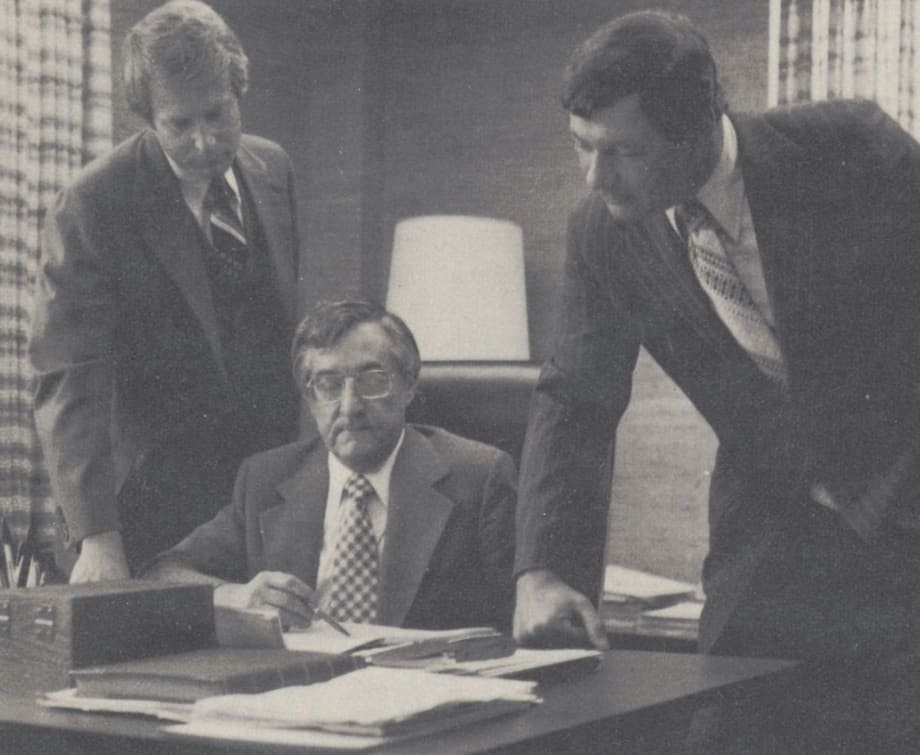
Gary Tepas (left), VP/sales, goes over one of the many computer reports used by Donlen with Leonard Vine (center), executive VP and Laurence Franceschi, VP/marketing.
Donlen Leasing Corporation, a Lincolnwood, Illinois company, teams personal contact with computer sophistication to provide a unique blend of services to its customers. Donlen leasing projected to double business every five years; sustains growth without aacquiring other leasing companies.
This professional yet personal approach to leasing and managing fleets has proved successful and as a result the company manages over 12,000 vehicles throughout the United States and Canada, according to Don Rappeport, the firm's president.
Gary Tepas (left), VP/sales, goes over one of the many computer reports used by Donlen with Leonard Vine (center), executive VP and Laurence Franceschi, VP/marketing.
Laurence Franceschi, vice president-marketing, forecasts that the company's expansion rate is such that the business will double in size every five years. Donlen prides itself on the fact that this growth has been through the firm's own efforts rather than by acquisition of other leasing firms.
Donlen Leasing was founded in 1965 as a full-service lessor specializing in full-maintenance, closed-end leases. The closed-end, full-maintenance leases have given way to open-end leases with emphasis on fleet and expense management. Only about 50 cars remain on the full-maintenance leases for old-time clients.
Recognizing the changing market and the need for diverse management programs, Donlen offers innovative computer programs aimed at assisting today's sophisticated businessman. The programs aid in budgeting, evaluating used vehicle trends, reporting costs and focusing on the top priority of energy.
By using computer technology to monitor trends in depreciation, maintenance costs and fuel expenses, Donlen is able to provide the information needed to make decisions that will keep fleet costs at a minimum, while utilizing all available resources.
Gary Tepas, vice president of sales for Donlen, said a key decision was made in the late 1960s by the company to recommend that clients reposition their fleets into two-door specialty cars rather than the standard business sedans.

Don Rappeport
"Donlen was probably one of the first to deviate from the typical business sedan that was used in the 1950s and '60s. In the late '60s and '70s, we really were the market leader in putting our clients in specialty-type cars. We were much more responsive to market trends than competition that sometimes waited and watched before they made recommendations to their clients. It really paid dividends. Accounts we put in these specialty cars dramatically reduced depreciation expenses compared to those firms which retained typical business sedans.
The information used to help make such decisions is being expanded to include makes and models by geographic areas which show where the various styles are most popular. "We want to give them [the clients] as much information as possible so they can make a sensible business decision," Tepas said.
With the pending energy situation, such of the emphasis is placed on gas mileage statistics. These statistics indicate to the fleet operator how well or how poorly the vehicle is performing and give an indication of the driving habits of those assigned to the various vehicles. The internal reports used by Donlen monitor gas consumption by various models and powerplants. This information is used to make recommendations concerning future fleet purchases.
According to Leonard Vine, executive vice president of the firm, there are three basic programs available with about a half dozen variations that can be tailored to the client's specific needs.
The first basic plan is a national account program in which fleet management customers can purchase tires, batteries, glass and repair services through Donlen. The customer can take advantage of lower prices on these items through Donlen's volume purchases. Donlen supplies the customer with purchase orders and authorizes requests for tires and services. Charges for services are made directly to Donlen, which in turn bills the customer. By having the billing for such expenses come from one source, fleets are better able to monitor costs.
The second plan offered by Donlen is a maintenance management service combined with a finance lease which encompasses all aspects of fleet management. Donlen provides driver manuals, repair and tire purchase forms for drivers, supervises and controls repair costs and tire purchases for each vehicle and fleet operators directly contact Donlen on toll-free telephone lines for all major repairs and purchases.
When a vehicle is serviced, Donlen pays the invoice directly to the servicing facility and then sends one monthly bill to the customer with supporting receipts. Donlen also audits all maintenance and repair invoices and reimburses all drivers directly for out-of-pocket expenses. Data listing all expenses for tires and maintenance, as well as depreciation, rent, insurance, license and tax charges are sent to the fleet operator along with a monthly average cost for the entire fleet. Additional data is also available on gas, oil, tolls and parking.
The final basic plan is similar to the maintenance management service arrangement except that it offers a much more detailed breakdown of expenses. This program is also available to non-leasing clients who wish to have a detailed computer report of their operation. This plan reports monthly variable costs, variable cost per mile, fixed cost, personal use credit, total unit cost, cost per mile, insurance recovery and average monthly expenses.
Tepas said a survey of customers showed Donlen offers two advantages over other leasing companies. The first is Donlen's willingness to custom-design computer reports rather than use canned reports. The second is the high quality of the redesigned reports which are issued quickly.
Ben Bilski, vice president-operations, has incorporated another unique feature for Donlen Leasing - the use of a Xerox telecopier to place fleet orders daily. Bilski said the telecopier speeds up the ordering process to four or five hours rather than the five days it would take if the orders were sent by mail. Orders are taken continuously and every afternoon the machine is activated and orders are processed. Avoiding mail delays is a priority, according to Bilski, who added that the telecopier allows Donlen to process an order instantly.
Along with the sophisticated gadgetry, Donlen believes in personal contact and counsel for its clients. Rather than using account executives, Rappeport said Donlen uses a management team concept. Each department head is available to the clients concerning the particular facet of the operation they deal with. For example, Rappeport said if a customer has a car coming off lease that won't, be sold for the amount projected at the beginning of the lease contract, he will be counseled by Richard Routson, who is in charge of used car disposal. An explanation will be made as to why the car is not getting market value. "That's so the customer doesn't get any surprises at the end of the lease," Rappeport said. Routson said that a majority of the time the customer gets a refund on an open-end lease.
For the 1978 model year, Donlen sees a major pivotal point for fleet administrators moving from larger to smaller, more fuel-efficient vehicles. Rappeport said his management team works with the clients early in the spring to provide the client with enough data to firm up a policy for the approaching model year and that by July, almost 80-percent of the clients were prepared to order for 1978. Early decisions enable delivery of new cars to be made in the early fall, traditionally a time of strong used car sales.
By responding to today's changing market, Donlen has expanded while enjoying one of the lowest client turnover rates in the industry.
More Operations

Fleet Has a Talent Pipeline Problem. What Comes Next? | AF News Recap
Where will fleet’s next generation of leaders come from? This week, we’re looking at the industry’s talent pipeline, what certification can add to a fleet career, how to build an award-worthy track record, and the return of Automotive Fleet’s Personal Use Survey.
Read More →
Smith System Launches Driver Risk Management Program
Fleets have more driver data than ever, but identifying risky behavior doesn't necessarily correct it. Smith System's new Driver Risk Management program combines monitoring, training, and follow-up coaching to help fleets connect risk signals with driver intervention.
Read More →
Automotive Fleet Opens 2026 Personal Use Survey for Commercial Fleet Managers
Less than two weeks left! Commercial and corporate fleet managers are invited to share how their organizations handle company vehicle personal-use policies, charges, and driver eligibility.
Read More →
From AI Prompts to AI-Generated Safety Songs | AF News Recap
Can better prompts make AI more useful for fleet managers? This week, we’re breaking down smarter fleet analysis, an AI-assisted experiment that turned safety training into music, and what happened to fuel prices in August.
Read More →
How to Write Better AI Prompts for Fleet Analysis
Include these six elements in your fleet prompts to generate more relevant analysis and accurate answers.
Read More →
Fleet Meets: Eric Kilgore
This edition of the Fleet Meets series features one of the industry's best leaders driving multi-market and national operations.
Read More →
Why Reactive Fleet Management Is Becoming Too Expensive to Sustain
Research highlights a growing need for proactive management strategies to address rising costs in fleet operations effectively.
Read More →
What Your Fleet KPIs Aren’t Telling You
Tracking fleet metrics is only useful when the data leads to better decisions. This guide helps fleet leaders assess cost, utilization, and downtime more accurately, identify performance gaps, and prioritize the actions that can improve operational results.
Read More →
Hidden in Plain Sight: Fleet Compliance Risks
Fleet compliance isn't just about having policies — it's about consistently enforcing them. This practical guide reveals six hidden compliance risks common in public sector and shared fleet operations and outlines proven strategies to improve visibility, accountability, and audit readiness
Read More →
Turning Fleet Payment Data into Executive Insights
Does data alone drive results in operations?
Read More →