




Sandra Lee Receives First Fleet Safety Award
The 20-plus-year health and safety veteran is responsible for the safety of the company’s 33,000 drivers spread around the globe. She currently serves as chairperson of NETS.


Sandra Lee, director, Worldwide Fleet Safety for Johnson & Johnson.

Sandra Lee, director, Worldwide Fleet Safety for Johnson & Johnson.
At the 2013 Fleet Safety Conference, Sandra Lee, director, Worldwide Fleet Safety for Johnson & Johnson, received the second annual Fleet Safety Award, which is sponsored by the American Automotive Leasing Association (AALA) in conjunction with Automotive Fleet magazine.
Lee is responsible for Johnson & Johnson’s SAFE Fleet and fleet safety policies for the company’s more than 33,000 drivers around the globe.
At a lunchtime presentation during the conference, Network of Employers for Traffic Safety (NETS) Executive Director Jack Hanley accepted the award on behalf of Lee, who was unable to attend the conference. AALA’s Executive Director Pam Sederholm, presented the award to Hanley on Lee’s behalf.
Hanley said Lee expressed “surprise and gratitude for this terrific award.”
According to Hanley, Johnson & Johnson’s fleet safety programs are part of its overall sustainability efforts, which include employees, family members, and the community at large in all of the company’s worldwide markets.
“Sandy leads a corporate road safety program recognized around the world for its breadth, width, and results,” Hanley said. “She combines strategic vision with tactical clarity to ensure Johnson & Johnson’s fleet safety program keeps Johnson & Johnson’s business drivers around the world safe today and in the future.” Lee is the NETS chairperson for 2012 and 2013.
According to her official bio, Lee’s background includes more than 20 years of experience in the fields of health, wellness, and safety. Prior to her current position overseeing the health and safety of Johnson & Johnson’s fleet, she was the company’s health & safety director with responsibility for health and safety services provided to North America Consumer Companies within Johnson & Johnson and for facilitating global ergonomics risk reduction efforts within this group. Her experience also includes managing the delivery of health, wellness, and employee assistance program services for U.S. employees in manufacturing and R&D environments.
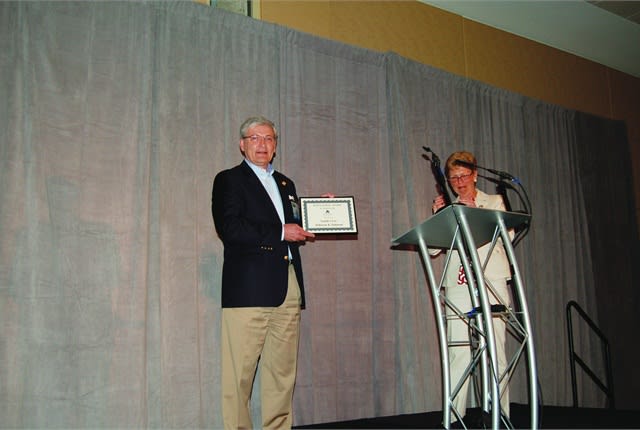
NETS Executive Director and Fleet Safety Conference keynoter Jack Hanley accepts the second-annual Fleet Safety Award on the behalf of Johnson & Johnson’s Sandra Lee, from AALA President Pamela Sederholm.
As chairperson of NETS, among her numerous contributions, Lee has supported NETS’ role as a member of the United Nations Road Safety Collaboration, a steering group for the Decade of Action for Road Safety 2011-2020. Lee also has helped to shape NETS’ Strength in Numbers Fleet Safety Benchmark program and is a current steering committee member of NETS’ annual Drive Safely Work Week campaign.
The Fleet Safety Award seeks to recognize candidates who have shown leadership, innovation, and measurable results in enhancing the safety of their employees, those traveling with them, as well as everyone else who shares the road with them.
AALA’s Sederholm said all of the Fleet Safety Award nominees were well qualified. “We were very pleased with the caliber of this year’s nominees,” she said.
The 2013 Fleet Safety Conference attracted nearly 300 professionals involved in fleet safety.
Modern Transportation Services was the recipient of the first annual Fleet Safety Award in 2012.
More Safety

Fleet Manager’s Ultimate Playbook: Navigating the New Standard in OEM Connectivity
Rising operating costs, driver safety concerns, and unplanned downtime are putting unprecedented pressure on modern fleets. Discover how fleet managers use embedded OEM connectivity and real-time vehicle data to cut TCO, prevent downtime, and protect drivers without aftermarket telematics hardware.
Read More →
From Driver Well-Being to EV Charging | AF News Recap
Mental health belongs in the fleet safety conversation. This week, we’re looking at five ways fleets can support employee well-being before a crisis, plus Holman’s expansion in Mexico, new one-day Fleet Forward passes, and why EV charging demand is outpacing infrastructure growth.
Read More →
Nexar-Nauto Merger Aims to Give Fleets Better Safety Intelligence Through Larger Driving Dataset
Stefan Heck tells Automotive Fleet that combining more than 10 billion miles of driving history with Nexar's AI models will give fleets deeper insights into driver risk and roadway conditions than either company could provide independently.
Read More →
Don't Wait for a Crisis: 5 Ways to Build Mental Health Into Your Fleet Safety Program
For Suicide Prevention Month, fleet and safety leaders have an opportunity to put mental health where it belongs: at the center of workplace safety.
Read More →
How Camera Data Can Strengthen a Fleet’s Insurance Renewal
Insights from a commercial insurance carrier and a broker show how fleets can turn video telematic data, driver coaching, and improved claims results into a stronger case at insurance renewal.
Read More →
The Safest Fleets Aren’t the Ones with the Most Technology
You’ve made the telematics investment. Here’s how to capture the other half of its value and build the safest fleet on the road.
Read More →
Hidden in Plain Sight: Fleet Compliance Risks
Fleet compliance isn't just about having policies — it's about consistently enforcing them. This practical guide reveals six hidden compliance risks common in public sector and shared fleet operations and outlines proven strategies to improve visibility, accountability, and audit readiness
Read More →
NETS Sets 2026 Fleet Safety Benchmark Conference for Indianapolis
The Sept. 15–17 program will feature fleet benchmarking data, case studies, emerging technologies, and implementation strategies while running alongside the NSC Safety Congress & Expo.
Read More →
Off-the-Job Crashes Account for 43% of Employers’ $61.7 Billion Crash Burden
NETS quantifies costs dispersed across fleet, risk, HR, and other departments while providing new per-crash benchmarks for employers.
Read More →
Ram Recalls More Than 1.27 Million 1500 Pickups for Seat Belt Anchor Issue
The recall affects certain 2019-2026 Ram 1500 pickups that may have improperly attached second-row seat belt buckle anchors.
Read More →