




Ready for Your Drone Delivery License?
Commercial drone deliveries are destined to integrate with fleet, but new regulations remain barriers to speedy implementation.

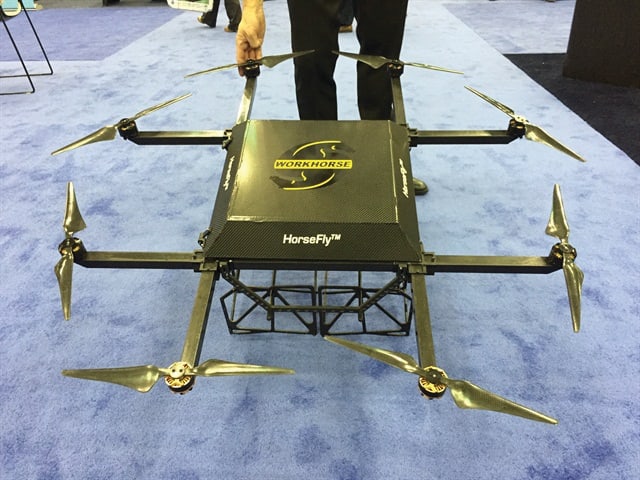
The HorseFly drone from Workhorse Custom Chassis delivers 10-lb. packages for 2 cents a mile.
The package delivery truck parks in a neighborhood. The driver removes three 5-lb. packages and attaches each to a drone. With the swipe of an iPad, the drones deploy from the roof of the truck. Using GPS, each drone finds its way autonomously to its delivery point, releases the package, and flies back to the truck.
A drone could similarly be deployed from a neighborhood warehouse or retail store to travel within 10 miles and deliver its package before returning to base.
These commercial uses of unmanned aerial vehicles (UAVs) are technologically possible today, and they promise to greatly reduce delivery expense. However, new rules from the Federal Aviation Administration (FAA) that took effect Aug. 29 governing commercial drone activity have essentially put drone deliveries on hold for now, at least in the U.S.
The HorseFly drone from Workhorse Custom Chassis delivers 10-lb. packages for 2 cents a mile.
In its rulemaking, the FAA eased some restrictions such as the requirement that drone pilots need commercial aviation licenses. This change will drive acceleration of other commercial applications in engineering, agriculture, insurance, emergency response, and real estate. However, drones are still required to stay within unaided sight of the pilot. They also must be under the control of a pilot instead of flying autonomously, which essentially eliminates manpower savings.
The main worry is safety — that autonomous flight and collision avoidance have not yet been perfected. While autonomous drones are today capable of landing to an accuracy of one meter, there are still many variables, including weather and human interference. Indeed, the Teamsters lobbied against pilots manning multiple drones until safety risks can be overcome.
Testing hasn’t stopped; it’s just migrated outside of the U.S. Amazon has relocated its drone testing headquarters to Canada and is conducting further tests in Europe. A Domino’s franchise in New Zealand has partnered with drone delivery company Flirtey to test drone pizza delivery in Auckland. In Germany, DHL is testing fully automated drone deliveries, including loading and unloading of packages.
Chinese online retailer JD.com is working with Wal-Mart to deliver packages of up to 33 lbs. in rural areas of China and over a distance of 12 miles. Each flight costs less than a dime, according to the company.
Right now, the U.S. seems content to let other countries do the heavy lifting when it comes to testing. Ironically, the quickest facilitator to drone delivery in the U.S. might be to prevent China from winning the drone “arms race.”
With these concerns, there may be another scenario that’s more palatable to the FAA: The Marines have already conducted thousands of delivery missions in Afghanistan using Lockheed Martin’s K-MAX unmanned aircraft system, which can handle up to 6,000 lbs. of cargo. In a commercial setting, this autonomous helicopter could be used similarly to an over-the-road big rig going warehouse to warehouse, landing on designated pads and thereby alleviating some safety concerns.
As drone deliveries become assimilated into the fleet and logistics business models, fleet operators will start addressing issues such as how to obtain the equivalent of a commercial driver’s license, drone pilot training, the potential redeployment of drivers as pilots, and union issues. This new delivery model may facilitate changes to the size and location of warehouses based on drone’s range limitations.
There is now a drone trade group (the Small UAV Coalition), drone trade publications, and even a commercial drone trade show, which convened in November in Las Vegas. The promise of commercial drone deliveries is great: they purport to reduce carbon output, alleviate vehicle congestion in urban environments, and cut delivery costs to pennies.
The industry will ultimately solve these challenges and drones will become an extension of transportation and delivery fleet services. But the present issues surrounding autonomous drone use foreshadows an even larger one for fleets — how to assimilate into the world of driverless vehicles.
Originally posted on Work Truck Online
More Global Fleet
GeoFencing Adds to Your Truck Security Arsenal
Geofencing is a familiar fleet tool today, but its early adoption marked a major shift in vehicle tracking, route monitoring, and the debate over employee privacy.
Read More →
Holman Takes Full Ownership of ARIZA in Mexico
Holman is bringing its Mexican fleet management operation fully under its own brand after more than 30 years as a joint venture. The change gives multinational fleet customers a single Holman operation across the U.S., Canada, and Mexico.
Read More →
5 Tire Maintenance Tips to Help Prevent Work Truck Downtime
Regular tire checks can do more than extend tread life. These five maintenance practices can help work truck fleets catch problems early, reduce costs, and prevent downtime.
Read More →

Proven Ways to Reduce Work Truck Downtime
The age-old problem of downtime will always be a reality, but with new strategies at hand, fleets have more ways to keep trucks on the road longer.
Read More →


Cameras, Safety and Insurance: From Reactive Claims to Real-Time Prevention (Part 2 of 2)
Part Two: Commercial auto remains one of the most challenging and costly lines of coverage for fleet operators and insurers alike. Continue learning more about how to effectively address these issues from Onur Aksan, Enterprise Business Development Executive, Geotab
Read More →
Cameras, Safety and Insurance: From Reactive Claims to Real-time Prevention
Commercial auto remains one of the most challenging and costly lines of coverage for fleet operators and insurers alike. Learn more about how to effectively address these issues from Onur Aksan, Enterprise Business Development Executive, Geotab.
Read More →
Fleet Costs Are Rising: Here’s How Leaders Are Responding
Fleet leaders are under pressure to reduce costs, adapt to economic uncertainty, and make smarter decisions. See how peers across North America are responding with real data, proven strategies, and forward-looking insights. Download the 2026 Market Pulse Report to benchmark your strategy and uncover where you can gain an edge.
Read More →
Enterprise Fleet Management Surpasses 900,000 Vehicles in U.S. & Canada
Enterprise Mobility connects with mobility solutions around the globe
Read More →