





Related: 3 Reasons AV Fleets Will Proliferate Private Sites First
Penske, Waymo Share Vision for Future of Autonomous Trucking
Penske’s Bill Combs and Waymo’s Charlie Jatt believe the trucking industry can reap the benefits before achieving Level 5 autonomy through repositioning warehouses that are optimized for AVs, employing tele-operations, and adapting automated safety technologies available now.
March 3, 2020
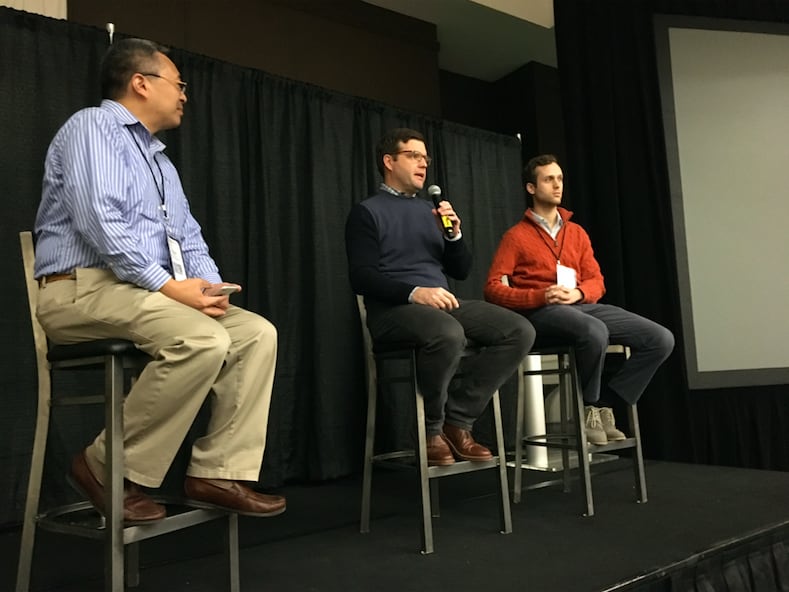
Bill Combs of Penske (center) and Charlie Jatt of Waymo (right) discussed autonomous trucking at the 2020 Autonomous Vehicles Silicon Valley Conference, which convened Feb. 26-28 at the Pullman Hotel, San Francisco Bay.
Photo by Chris Brown.
5 min to read
There’s widespread consensus in the automotive industry that Level 5 autonomy — in which driverless vehicles can operate in any environment with no human involvement — won’t be feasible any time soon from a technological and regulatory standpoint.
Indeed, autonomous vehicle (AV) guru and founder of VSI Labs, Phil Magney, has been quoted as saying “Solving 95% of the autonomous vehicle use cases is ‘easy’ — it’s the remaining 5% that’s the hard part.”
In this context, how can the trucking industry reap the benefits of autonomy sooner than later?
At the 2020 Autonomous Vehicles Silicon Valley Conference, Bill Combs, VP, Connected Vehicle Strategy & Experimentation fleet at Penske Transportation Solutions, and Charlie Jatt, commercial trucking lead at Waymo, offered potential business models, use cases, and challenges for autonomous trucking. The conference convened Feb. 26-28 at the Pullman Hotel, San Francisco Bay.
While robotaxis have captured the public’s imagination as well as the backlash of driverless car fatigue, Jatt said that the enterprise environment of trucking “presents a tremendous business use case for fleets” when it comes to autonomous transportation.
Both Combs and Jatt pointed to current issues with trucking that autonomy could help to overcome, particularly the increasing cost of the trucks, the driver shortage, and the pressures to increase utilization.
With no rest breaks or hours of service restraints, autonomous trucks theoretically could travel continually. “If you could use a truck 24 hours a day, you’d do it,” said Combs, adding. “The empty backhaul is ridiculous at 9 mpg and no benefit to the driver.”
How are these opportunities realized in an environment that stops short of complete autonomy?
While one thought process surrounds “ramp-to-ramp” technology, in which autonomy is turned on during highway travel and turned off when the truck exits the highway, Jatt said Waymo is pursuing various models.
One model would use existing warehouses. The benefit of this model is that because Waymo would be using existing warehouses, they could be located anywhere, wouldn't need to be designed for AVs, and could involve more surface street driving.
Another model would focus on highway driving with minimal street navigation. Instead of a “load manager” that engages and disengages the technology, a Waymo journey would begin and end at new types of warehouses that are specifically designed for autonomous vehicles. Built next to highways, these facilities would be optimized for autonomous trucks and unloading and loading by humans.
From these new facilities, the journey to the retail outlet or residence could be completed by traditional means, or by autonomous fleets optimized for last-mile deliveries using low-speed “zero-occupant vehicles.”
Of course, human interaction would continue in the freight and transportation network, though it would be minimized on the moving truck itself. “There is never a day in trucking that goes as planned,” said Combs. “Autonomous trucking will require dispatch interactions and lots of flexibility.”
To shepherd the technology and grow the ecosystem, autonomous trucks could be managed remotely through “tele-operations” that address the complications in Magney’s 5%.
Tele-operators would take over during intricate turn by turns, parking lot navigation, and off-loading, or in emergency situations such as weather hazards or power outages.
Last-mile autonomous delivery companies such as Udelv and Nuro employ tele-operators today in a one-to-one ratio of operator to vehicle. To achieve scale and optimize costs, this ratio needs to grow from one operator to 10 AVs and later 20.
Fleets, Get Ready
In a later seminar, Combs posed the question whether fleets are ready for AVs.
On the surface, he said fleets are all over the board. But Penske’s research indicates that carriers in the business of goods transportation are more interested in autonomous advances than company-owned operations. When it comes to widespread availability of commercial AVs, fleet operators tend to fall into the six-to-10 or 11-to-20 year buckets, Combs said.
While the timeline for implementation will remain in question, Combs said trucking fleet operators should start planning now, beginning with simple research.
Combs suggests getting to know today’s players such as Waymo, Udelv, Nuro, and TuSimple to understand their operating models and weight segments. Read the studies generated by Partners for Automated Vehicle Education (PAVE) and the Virginia Tech Transportation Institute (VTTI), among other groups, he recommends.
All major truck manufacturers have autonomous divisions; research where they’re focusing their energies. Volvo is testing an autonomous refuse truck in Sweden and an autonomous mining truck, for instance.
There are other initiatives that are tangible for fleets today: Freightliner is the first major OEM to offer a Level 2 autonomous system available to order. “Trucking fleets need to know the names of these systems and what they do,” Combs said. “Start spec’ing or retrofitting the technology.”
Those that don’t will be left behind, as autonomous technology in the form of advanced driver assistance systems (ADAS) realizes increasing penetration. In Penske’s rental fleet, the company has spec’d automatic emergency braking in every model it’s available, Combs said.
Ultimately, owing to the enormous complexity of an autonomous environment, carriers may choose to outsource autonomous deliveries to a third party instead of running AVs in house. Regardless, the autonomous learning curve is substantial.
“It’s not just up to fleets to figure this out,” Combs said. “It’s the whole industry.”
Editors Note:Waymo subsequently reached out to provide clarification on the topic of “tele-operations.”
Waymo noted that it does not rely on tele-operators to control the movement of its vehicles. For its vehicles, the Waymo Driver is responsible for making every driving decision on the road so it does not rely on a human in the vehicle or remotely. Waymo vehicles do not require remote assistance for anything that’s safety-critical or latency-sensitive.
Waymo does have a fleet response team that works remotely that it thinks of as air traffic control for its self-driving cars. The Waymo Driver is designed to recognize situations which may be novel or ambiguous and then call upon a person to give it the contextual information it needs to be proceed.
For example, if a Waymo Vehicle detects that a road ahead may be closed due to construction, it can pull over and request a second set of eyes from the company’s fleet response specialists. Those specialists can then confirm the road closure so the Waymo Driver can plan an alternate route. This also allows the specialists to pass on this information to the rest of the fleet.
Subscribe to Our Newsletter
More Fleet Forward

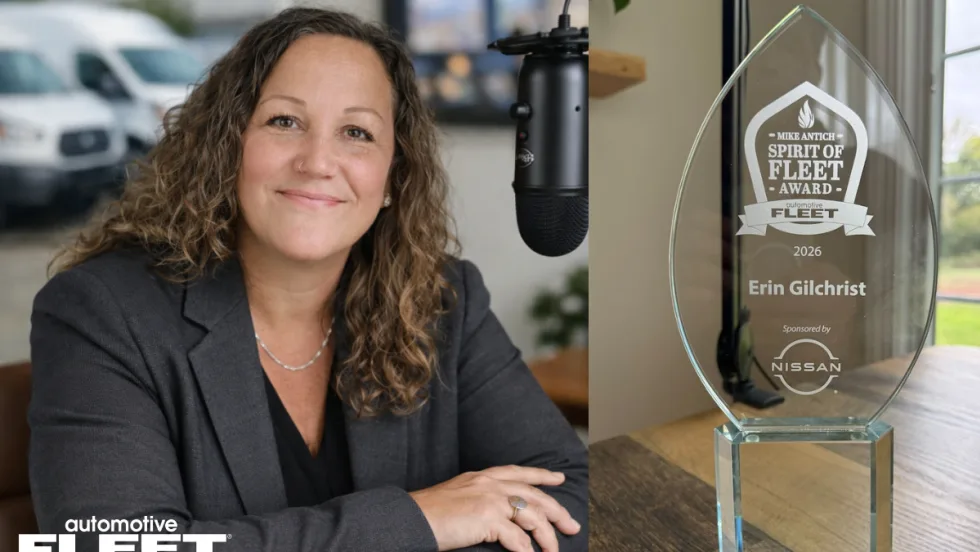
Erin Gilchrist Receives Mike Antich Spirit of Fleet Award
Last week at AFLA in Vegas, Erin Gilchrist received the inaugural, brand-new Spirit of Fleet Award.
Read More →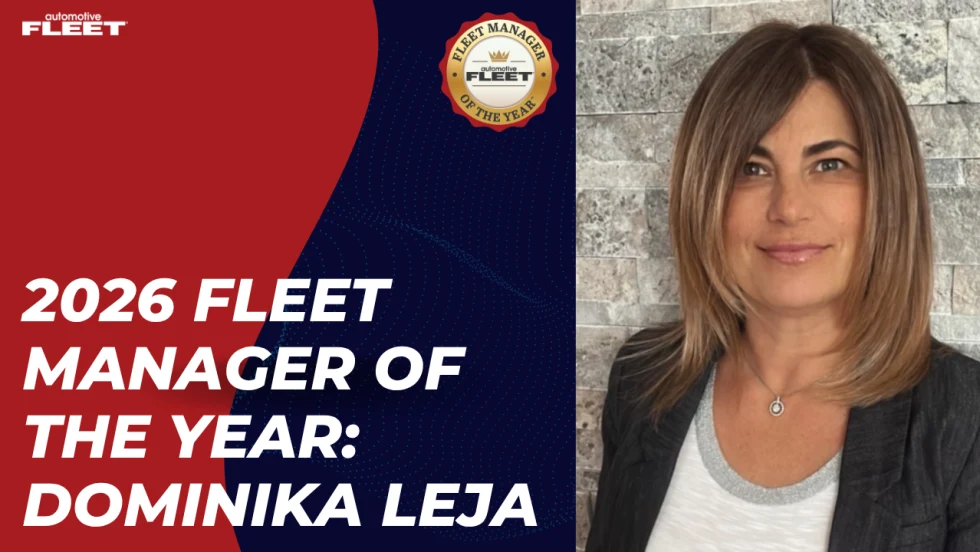
Dominika Leja Named the 2026 Fleet Manager of the Year
The AstraZeneca associate director of fleet was recognized for her leadership in fleet electrification, cost savings, and operational transformation.
Read More →
Jamie McKay Named the 2026 Fleet Visionary Award Winner
The Aptive Pest Control fleet manager was recognized for her approach to operations, data, lifecycle management, and driver needs.
Read More →
Fleet Forward Conference Introduces One-Day Passes for 2026
New one-day registration gives fleet professionals the flexibility to attend Tuesday, Wednesday, or Thursday, with passes available for $199 through Sept. 18.
Read More →
Vibe Coding: When Fleet Managers Become Software Builders
Five fleet professionals — none with programming skills — discuss how they’re using AI to build fleet solutions in-house and in a fraction of the time.
Read More →
Fleet Forward Conference Tackles Fleet Industry’s Growing Leadership Gap
This session will examine succession planning, knowledge transfer, and the skills the next generation of fleet leaders will need as veteran professionals leave the industry.
Read More →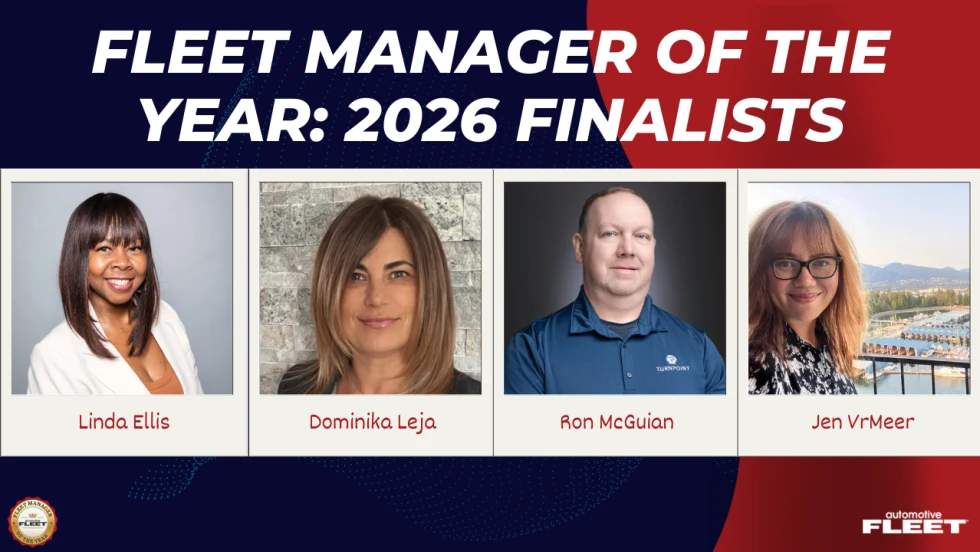
2026 Fleet Manager of the Year Finalists Announced
Who are the 2026 Fleet Manager of the Year finalists?
Read More →
John Rossant to Deliver Opening Keynote at 2026 Fleet Forward Conference
The CoMotion founder will draw on developments across Europe, China, the Middle East, and other international markets to identify trends that could influence how U.S. fleets plan for the coming decade.
Read More →
How to Build Custom Fleet Tools With AI and Vibe Coding [Webinar]
A new Automotive Fleet webinar explores how fleet managers are using AI and vibe coding to automate routine work and create simple operational tools without traditional programming skills.
Read More →