




Outlining the Future of Aftermarket to Factory-Installed Telematics
With multiple manufacturers running varying embedded technologies, industry experts see the need for newer, third-party solutions to tie in the data and drive value to fleets.
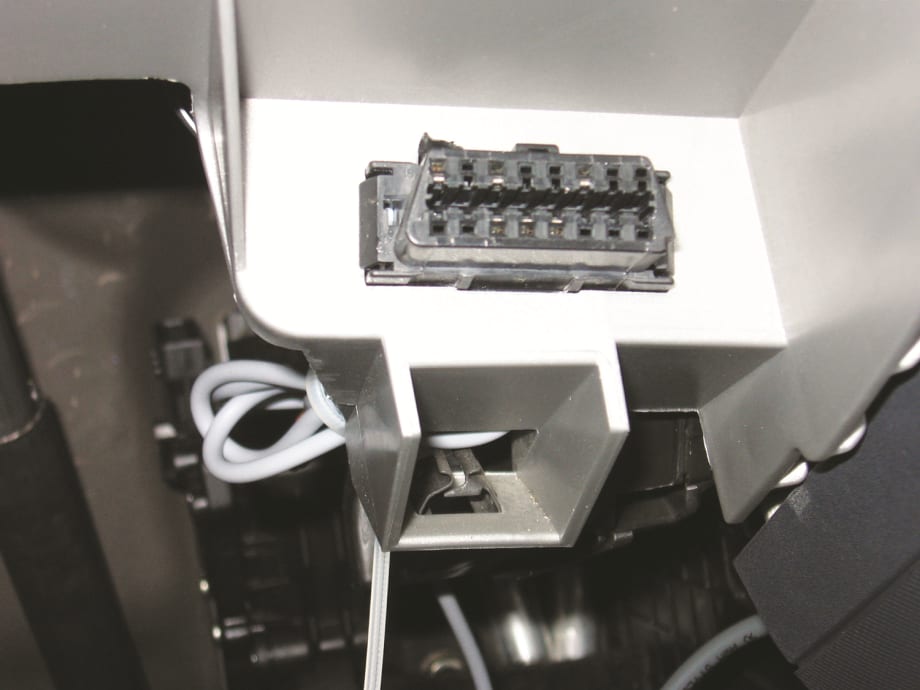
The on-board diagnostics (OBD-II) port is usually located under the dashboard beneath the steering wheel column. The OBD-II port wasn’t originally designed to operate with firewalls, data encryption features, or anti-virus software. As a result, the auto manufacturers are investing heavily in cyber-security and data management to address these concerns.
Photo via M.M. Minderhoud/Wikipedia
For years, when fleet operators wanted to implement a telematics system, telematics service providers (TSPs) generally professionally installed the proprietary hardware as an aftermarket option through the vehicle’s onboard diagnostics (OBD-II) port.
Fast forward to the 21st Century’s second decade and a new path is gaining momentum. More vehicle manufacturers have entered into agreements with various TSPs to offer telematics through factory-installed options — some through the TSPs’ provided hardware, and some through the manufacturers’ own embedded hardware.
Five years ago, General Motors partnered with Telogis, now Verizon Connect. This partnership offers a web-based fleet management solution connected to GM vehicles through factory-installed OnStar 4G LTE technology.
Today, Verizon Connect has partnerships with 15 automakers for factory-installed telematics in both consumer and fleet applications.
In 2017, Spireon Inc. partnered with GM using the same OnStar 4G LTE system to power a customized version of Spireon’s FleetLocate fleet management system. In 2018, Spireon signed an agreement with Ford Commercial Solutions for FleetLocate to access data through Ford’s open-platform Transportation Mobility Cloud.
Both GM (Commercial Link) and Ford (Ford Telematics) also offer their own proprietary telematics software that leverages each automakers’ factory-installed hardware.
In 2018, Toyota announced a partnership with Fleet Complete, where the latter’s Connvex platform would leverage data from Toyota Connected Data Services.
A Pandora’s Box
“The on-board diagnostics port was originally intended as a diagnostics port to better troubleshoot the powertrain and emissions control systems. It was never really intended as a gateway for complex telematics devices,” says Arun Rajagopalan, co-founder and CEO of Motorq.
Rajagopalan’s company offers a connected data and analytics platform that enables businesses to get insights on their connected cars based on data from the OEMs’ embedded hardware.
“Kudos to the early (TSPs) who took advantage of that opportunity and developed these systems,” he says.
Fast-forward a couple decades since the OBD-II protocol was adopted: The complexity of data inside the vehicle has increased tremendously, driven by more sensors, more processors, and emerging high-speed data communication frameworks. As a result, Rajagopalan says, vehicle manufacturers are thinking hard about this Pandora’s Box — the role the OBD-II port should play going forward.
How should they balance their need to retain the ability of dealers and the service network to run necessary diagnostics, with their need to control and secure access to the large and complex datasets within the vehicle?
Manufacturers are also worried about cyber-security and the ability of hackers to use the OBD-II port to breach a vehicle’s network to access proprietary data and commands, he adds. The original OBD-II port was designed to pull data from simple computers; it wasn’t designed to operate with firewalls, data encryption features, or anti-virus software.
As a result, the auto manufacturers are investing heavily in cyber-security and data management to address these concerns.
Industry experts acknowledge that installing a telematics system at the factory that integrates well with the vehicle’s electronics could improve security. However, factory-installed devices don’t necessarily solve common concerns of telematics systems today:
Can they be made compatible with solutions offered by multiple TSPs? What happens when the vehicle is eventually sold? Will the system still work for the vehicle’s next owners? When should these systems be replaced or reprogrammed?
Since few fleets choose to operate only one brand of vehicles, and since most fleets have a mix of newer and older vehicles, most OEMs aren’t in a position to provide all the tools the fleets need independently, Rajagopalan says.
For these reasons the OEMs have chosen for now to partner with various third-party TSPs and technology companies, he says.
A Small Percentage, but Growing
While factory-installed options have been available in varying levels of sophistication for the past five years, given challenges with technology and business models, Rajagopalan estimates that only a small percentage of commercial vehicles and passenger cars served by third-party TSPs actually utilize the factory-installed option.
This is because OEMs are at varying mileposts when it comes to data sophistication, Rajagopalan says. While OEMs invest in the right technology, it will take some years for fleet turnover to scale out the factory option.
As a result, the aftermarket installation remains a far more common path. But this is changing.
“The value of OEM telematics will soon seep down to the customer,” Rajagopalan says. “Undoubtedly, the potential advantage of OEM data sets is tremendous. (They’re) safe. (They’re) secure and you get much higher reliability data (than you can get through an aftermarket device).”
But the data sets must be delivered through the right end-user product that is better, faster, and cheaper for the customer, Rajagopalan adds.
The Keys for FMCs
Erik Renth is director of digital and commercial strategy with Sasser Family Companies, which owns Union Leasing, a fleet lessor, and Express 4x4 Truck Rental.
Renth agrees that even though a large majority of vehicles being manufactured and sold today have some form of factory-installed onboard telematics, the advantages of OEM data come with a number of potential technical hurdles.
Specifically, Renth mentions the need to provide a “seamless, integrated experience” to fleet customers, which can mean integrating data sets from multiple OEMs and legacy TSP devices with significantly variable capabilities.
“Customers expect a low-friction process, and providing that type of consistency and ease-of-use means thinking strategically about how data will be brought together in a unified experience — especially when fleets have a wide variety of vehicles and capabilities.”
Renth believes third-party data services could emerge as a key component to unify and standardize disparate data sources, including OEMs and TSPs. These aggregator solutions can ingest and normalize data from many different sources to provide a consistent stream of key data points and actionable insights.
“In my mind, this sort of ‘smart plumbing’ removes some of the technical burden because it serves as a clearinghouse,” he says. “It’s a value-add data mediator, of sorts.”
Renth cautions that OEM data may not be the only contender in the long term, though. “We generally believe there will be an ongoing need for third-party telematics solutions, especially in cases where functionality needed by fleets surpasses what a traditional OEM will be willing to build into its vehicles,” he says.
“In a landscape where TSPs need to innovate to stand out, we’re seeing some newer entrants that are bringing compelling technology and a ‘data-first’ mindset that may be long-term counterparts in a world where OEM data becomes the norm.”
These entrants to the market are introducing capabilities such as computer vision, artificial intelligence (AI), and Internet of Things (IoT) capabilities that could potentially extend the telematics ecosystem beyond the vehicle itself.
Renth adds that the key for FMCs will continue to be providing a consistent experience for customers no matter if their needs are met by OEM data or more complex systems.
Until vehicle manufacturers and telematics service providers can agree on a common industry standard for data structures, quality, and transmission rates, Renth says providers of third-party services could make it possible for fleets with multiple brands of vehicles and TSPs to deploy telematics solutions more seamlessly across a variety of fleets.
“The point at which we have solid and standardized data is really the inflection point,” he says. “From the time we have (the data), the key differentiator for FMCs will be what they do with the data — how it’s interpreted, presented, and ultimately acted upon to drive value.”
Originally posted on Work Truck Online
More Global Fleet
GeoFencing Adds to Your Truck Security Arsenal
Geofencing is a familiar fleet tool today, but its early adoption marked a major shift in vehicle tracking, route monitoring, and the debate over employee privacy.
Read More →
Holman Takes Full Ownership of ARIZA in Mexico
Holman is bringing its Mexican fleet management operation fully under its own brand after more than 30 years as a joint venture. The change gives multinational fleet customers a single Holman operation across the U.S., Canada, and Mexico.
Read More →
5 Tire Maintenance Tips to Help Prevent Work Truck Downtime
Regular tire checks can do more than extend tread life. These five maintenance practices can help work truck fleets catch problems early, reduce costs, and prevent downtime.
Read More →

Proven Ways to Reduce Work Truck Downtime
The age-old problem of downtime will always be a reality, but with new strategies at hand, fleets have more ways to keep trucks on the road longer.
Read More →


Cameras, Safety and Insurance: From Reactive Claims to Real-Time Prevention (Part 2 of 2)
Part Two: Commercial auto remains one of the most challenging and costly lines of coverage for fleet operators and insurers alike. Continue learning more about how to effectively address these issues from Onur Aksan, Enterprise Business Development Executive, Geotab
Read More →
Cameras, Safety and Insurance: From Reactive Claims to Real-time Prevention
Commercial auto remains one of the most challenging and costly lines of coverage for fleet operators and insurers alike. Learn more about how to effectively address these issues from Onur Aksan, Enterprise Business Development Executive, Geotab.
Read More →
Fleet Costs Are Rising: Here’s How Leaders Are Responding
Fleet leaders are under pressure to reduce costs, adapt to economic uncertainty, and make smarter decisions. See how peers across North America are responding with real data, proven strategies, and forward-looking insights. Download the 2026 Market Pulse Report to benchmark your strategy and uncover where you can gain an edge.
Read More →
Enterprise Fleet Management Surpasses 900,000 Vehicles in U.S. & Canada
Enterprise Mobility connects with mobility solutions around the globe
Read More →