




Omar Landis: A Classic in His Own Time
A love of cars gave the inspiration to the man who is credited as the creator of specialty auctions for classic, collectible, and unusual cars. After three decades, Landis' honeymoon with classic cars is far from over.
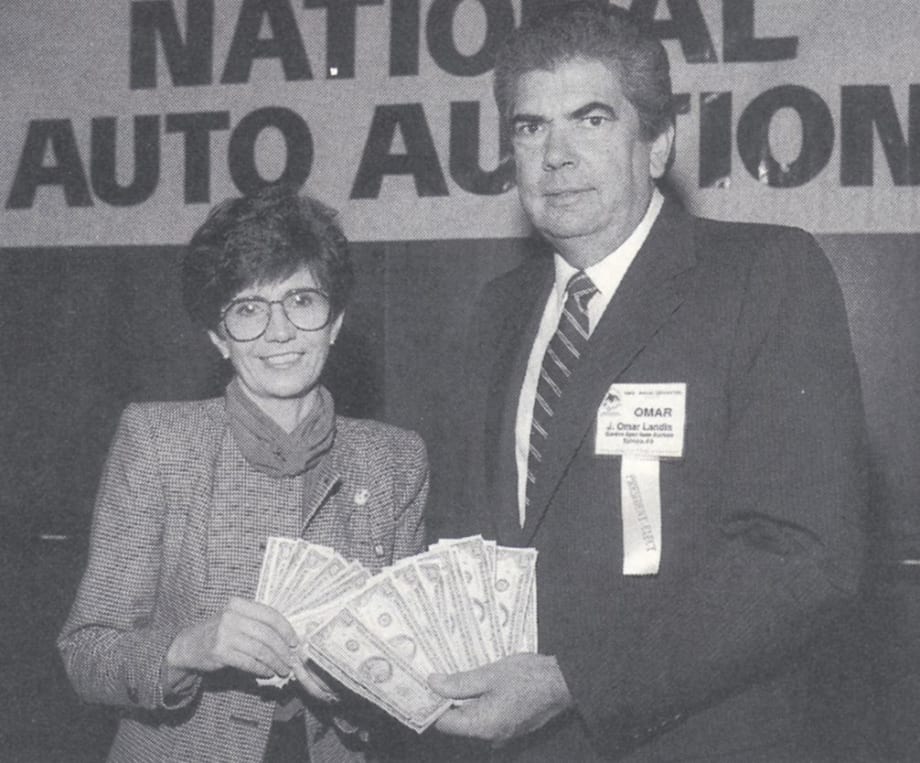
Landis presents Red Cross regional director Dottie Roterman part of the $52,000 raised at a charity auction for earthquake relief.
Landis presents Red Cross regional director Dottie Roterman part of the $52,000 raised at a charity auction for earthquake relief.
Following Omar Landis' installation as president of the National Auto Auction Association last year, his employees presented him with a 100,000-mile, 1982 brown Dodge Omni four-door sedan, covered with fluorescent green polka dot stickers and wrapped in a giant pink ribbon.
His reaction ? A classic, he chuckled.
Landis owns and drives a host of other real classics: one of the few existing 1947 Crosley pickup trucks; a cherry 1971 Chevelle convertible; a 1940 Ford street rod; a 1978 Silver Anniversary Corvette; an original 1951 stakebody Ford truck; and a 1962 Ford Galaxie 500 hardtop, unrestored and in mint condition.
Dealer, manufacturer, lease company executive, or classic car nut, wherever you fit into this car business, you've probably met Omar Landis somewhere along your way.
Thirty-five years of auctioneering has polished Landis into a classic himself - and also turned his classic "hobby" into a business.
Since 1969, the demand for classic cars has created a booming new industry with literally hundreds of classic car auctions, collector swap meets and flea markets, restoration businesses, parts fabricators, and suppliers.
Just two months ago, The Wall Street Journal featured "The Muscle Cars of the 60s" that were bringing prices above $50,000 each.
Many collectors credit Landis with founding the industry. In today's megadeal classic sales, he remains a true original. Landis is also the owner of the Dutchland Collector Car Auction, a $2 million, once-a-year sale.
Automotive Fleet interviewed Landis in the town square of Gettysburg, PA, one evening late last month. He chose the location as one of convenience, as he was being driven between meetings. His arrival in a 35-foot white limousine drew confused stares from passers-by as we sat down on a park bench to talk.
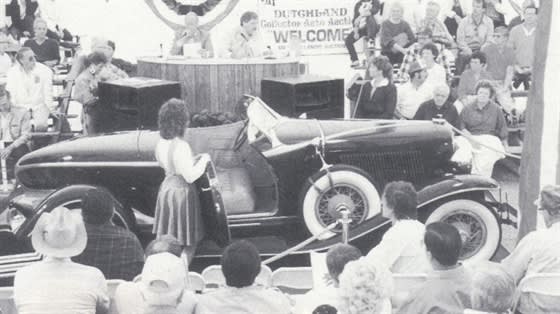
A classic Auburn Boattail up for bidding at Dutchland Classic Car Auction.
AF: What got you involved with classic cars?
Landis: I love cars. I grew up with them, and like any small-town kid, I used to sneak down and peek through the dealership windows as the new models came in each fall. The reason I got into the auction business was to be close to cars. We also make money with our classic, collector, and special car sales. And, I buy and sell, too.
AF: Tell us about the classic car business. Who and what makes up this industry?
Landis: Classic cars are good art - a true classic is apparent to everyone. And classic car auctions are made by hungry buyers. Good cars, like good art, are scarce. Older cars, unique models, and small production runs have a big influence on prices. But good design and good quality make the car a classic.
Classic cars are built on nostalgia, ego, and for some, an investment as a hedge against inflation. Classic cars remind the buyer or collector of special times in his or her life. Investors, however, treat classic cars like stocks or interest-bearing CDs, and they move their money through cars with care. Just like stocks and bonds, this market is affected by interest rates and has cycles just like any other commodity business.
AF: What changes have you seen in the classic car business?
Landis: We've seen it grow from a "car buff hobby into a serious business with serious money. Last year, for example, two collectors bought a classic Ferrari at another collector car auction. They paid $1.2 million! They put $200,000 down and financed the rest - imagine financing $1 million on one car that's never even driven! But, there's still room for careful buyers who just love cars. Buyers and sellers can be truck drivers or college professors, car industry executives, or just buffs.
Aside from the serious money, people usually dabble in the business as a hobby. There are few dealers and even fewer wholesalers. The number of active classic, collector car, and special sales continues to grow.
The biggest classic sale, in Auburn, Indiana, offered $100 million worth of cars this year to hundreds of buyers, and was viewed by thousands via Financial News Network.
AF: Are there financial measurements on the size of the industry?
Landis: The accepted figure is that classics are a half-a-billion dollar annual business. Collector and special cars are untotalled. The truth is, it's hard to measure. True collectors do many private deals and, until recently, the non-buff press paid scant attention to the industry.
It's certainly profitable. Our auctioneering service will conduct dozens of special car sales this year, both in this region and across the country. Some might be considered "classics." We'll have about 450 cars at our collector car sale next month.
AF: Tell us how you got started.
Landis: We held our first classic car auction on a college campus in Philadelphia back in 1969. I think it was the first ever. We had to dig up cars, and I even seeded the auction with my own cars.
No one had ever attempted to sell 250 classic cars in one sales location before, and we had no idea what prices the cars might bring.
It was a great success and we were shocked by the sale prices. The Auburn, Indiana people were at that first sale and they began their own operation the following year. We moved our sale to Lancaster County the following year and it's been a success here every fall since then.
AF: What's the strangest car you've ever sold?
Landis: That's easy. The first "Chitty-Chitty Bang-Bang" car. We sold it in 1971. It came from the Movie World Museum. A dealer bought it from the movie company and we had no idea what to ask for it. We set a $ 10,000 reserve, described its original quality and made our first request $50,000, the highest price I ever asked for a car. Our first bid came in at $11,000 and the car eventually sold for $25,000 to a man who bought it for his granddaughter. The story doesn't end there. The following year, a second "Chitty-Chitty Bang-Bang" car showed up and we panicked. Turned out that the movie company had three of the cars built in case of problems. The same guy showed up the second year and bought that car for $32,000. The third car was cannibalized for parts. We sure had some nervous moments when that second car showed up.
AF: What's your most expensive car sold? Your most unusual?
Landis: In October 1989, in Lancaster, we sold a Tucker for the Domino's Pizza Museum collection. It was one of the original 51 Tuckers that were built (only 48 remain). The timing was perfect. You'll recall that the movie about Mr. Tucker was popular around then. The car sold for $275,000 to one collector.
Our most unusual sale was at an estate sale. We sold some cars directly from a farm storage barn. We offered a Stanley Steamer that hadn't been fired up in 15 years. It sold to a telephone bidder for $40,000, sight unseen.
AF: What's the biggest negative about today's classic or collector cars?
Landis: The cost. Some prices have skyrocketed. We've sold '50s and '60s muscle cars that originally retailed for $5-6,000, for $70-100,000. I'm also appalled at the high costs of restoration work today. Materials and labor have gotten too expensive and costs are pushing many cars well beyond regular folk's pocket-books.
Parts are a problem, too. For example, just this year in California, a collector's flea market sold an original 1956 Pennsylvania inspection sticker to the owner of a restored Chevrolet convertible for $500. Apparently, the guy wanted authenticity and he paid for it.
AF: What new areas do you see forming in the business?
Landis: I'd say it's in the aftermarkets developed around these big classic sales. For example, collector flea markets have grown into a very large and very expensive business.
But, the newest wrinkle is a toy line auction. They take place after the classic cars are auctioned. Last year, for example, a buyer paid $2,600 at one of our sales for a plastic Corvette model that originally sold for $3. We've added c1assic toys, car models, and antique toys to our Dutchland Collector Sale and they attract almost as much attention as the cars.
AF: Okay, let's make a prediction. What's ahead for classic cars?
Landis: The current Mideast situation and general economic downturn impacts classic, collector, and special car businesses just like any other part of the car business.
Overall, classic and collector sales should see a steady growth and, if interviews like this continue, I should see more buyers at future sales. I'm bullish on the business
More Operations

Here's When You Should Make an Exception to Fleet Policy
Fleet policies are designed to create consistency, but not every driver or situation fits neatly within standard rules.
Read More →
AI-Native or AI-Acquired: What Should Fleet Managers Look for in an AI Platform?
Six questions can help fleet managers look beyond AI marketing claims to evaluate integration, data access, and real-world operational performance.
Read More →
A buyer's guide to fleet management software in 2027
Buying fleet management software in 2027 means looking beyond features and price. As fleet operations, technology and expectations evolve, this guide explores what today’s fleet professionals should consider when choosing a system that can deliver value now and adapt to what comes next.
Read More →

What Will Shape the Next Era of Fleet Management?
EVs, AI, and autonomous vehicles are reshaping fleet management. Discover what’s ahead—and how fleet leaders can prepare for the next era.
Read More →
How Fleets Can Recruit and Train Veterans for Technician Roles
Here's how the technician shortage has affected uptime for fleets, and what to do about it.
Read More →
Avis Budget Group Deploys Neology Toll Management Technology Across Major Brands
Neology’s neoFleet platform will manage toll transactions and toll-authority operations for vehicles across Avis, Budget, Payless, Budget Truck and Zipcar.
Read More →
Fleet Personal-Use Charges Edge Higher in 2026
Nearly eight in 10 surveyed fleets allow personal use of company vehicles, while just over half of respondents report charging employees for the privilege.
Read More →
The Future of Fleet + What’s Changing Right Now | AF News Recap
Could developments overseas offer a preview of what’s coming for U.S. fleets? This week, we’re looking at the future of AI, autonomy, and electrification, plus Ford Pro’s new certified pre-owned program, smarter vehicle offboarding, and a new way for fleets to manage toll expenses.
Read More →
How to Handle Vehicle Offboarding
What do fleet managers need to do when a driver leaves?
Read More →
Fleet Manager’s Ultimate Playbook: Navigating the New Standard in OEM Connectivity
Rising operating costs, driver safety concerns, and unplanned downtime are putting unprecedented pressure on modern fleets. Discover how fleet managers use embedded OEM connectivity and real-time vehicle data to cut TCO, prevent downtime, and protect drivers without aftermarket telematics hardware.
Read More →